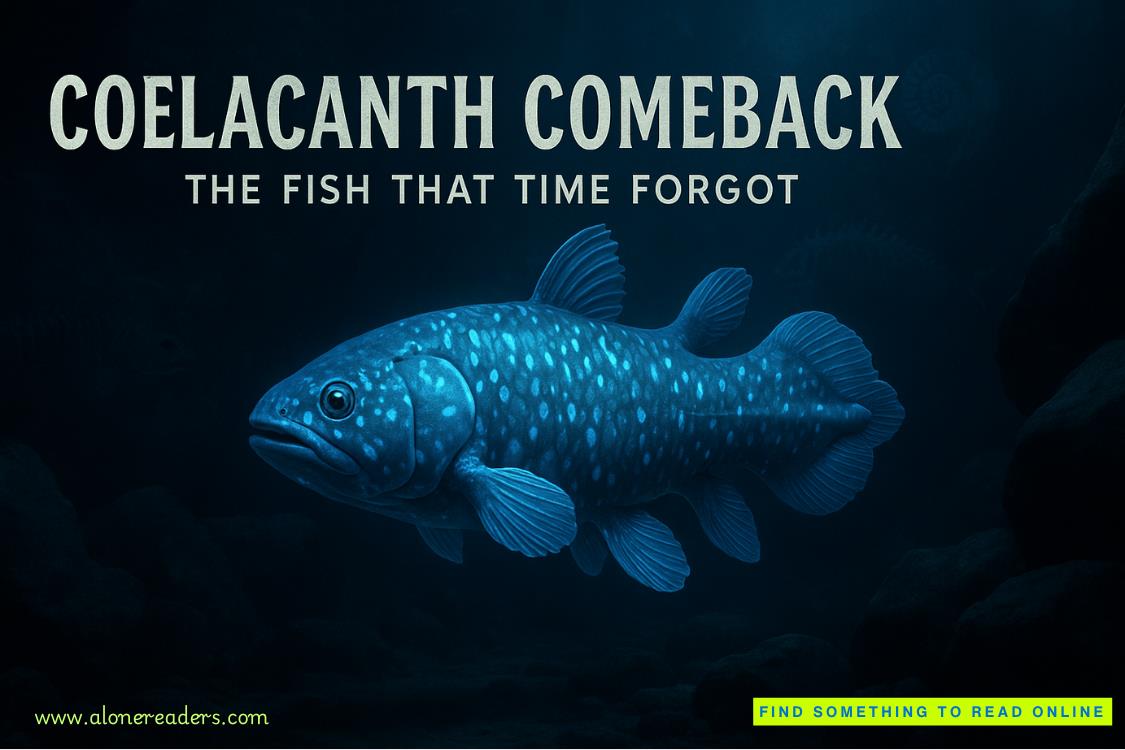
For decades, the coelacanth existed only in fossil records and textbooks. It was thought to be long extinct since the Late Cretaceous period, more than 65 million years ago. Yet in 1938, off the coast of South Africa, reality struck science like a tidal wave—a living coelacanth was pulled out of the deep. This wasn’t merely a discovery; it was a time machine disguised as a fish. The coelacanth was not extinct at all—it was hiding, perfectly preserved by time and protected by the abyss. Its existence fundamentally challenged our understanding of evolution, survival, and the limits of nature’s resilience.
What makes the coelacanth so extraordinary isn’t just its ancient lineage but how little it has changed in nearly 400 million years. Most species evolve rapidly due to environmental pressures, but the coelacanth remained almost frozen in time. Scientists call it a “living fossil”, yet this term hardly captures its biological sophistication. It represents a transitional group—the early evolutionary bridge between marine life and land-based vertebrates, holding clues to how ancient fish may have taken their first steps onto land.
Unlike most modern fish, coelacanths possess lobed, limb-like fins that move in a unique alternating pattern resembling the gait of four-legged animals. This anatomical feature is not coincidence—it links them evolutionarily to the earliest tetrapods, the ancestors of amphibians, reptiles, birds, and mammals. Their fins may not allow them to walk, but they represent a frozen blueprint of an evolutionary experiment from deep time.
Despite its prominent place in evolutionary history, the coelacanth survives in near-total darkness in the deep-sea caves of the Indian Ocean and occasionally in Indonesian waters. These depths—from 500 to 700 meters down—offer cold, low-oxygen stability, a world unchanged enough to support an unchanged species. Their bodies are equipped with a shimmering blue skin, reflective scales, and a rostral organ, a specialized sensory system to detect prey in darkness. They don’t swim fast but hover gracefully like silent ghosts of the abyss, conserving energy to suit their slow metabolic rate.
The coelacanth’s biology defies modern expectations. It grows exceptionally slowly, reaches up to two meters in length, and can live over a century. Even more remarkable is its gestation period—around three years, one of the longest of any known animal. Females give birth to fully-formed live young, not eggs, indicating an advanced reproductive system. This slow development and low offspring count, however, make them vulnerable to overfishing and environmental disturbances. Nature designed them for survival—not speed.
The rediscovery of the coelacanth sparked global scientific interest, cascading into modern studies using genetic sequencing. Researchers were stunned to find that its genome has remained extraordinarily stable over millions of years. Unlike adaptable animals such as birds or mammals, coelacanths have experienced what scientists call evolutionary stasis. It raises a profound question: do species always need to change to survive, or can perfect designs simply stand still?
Yet, the story of the coelacanth is not just scientific—it also reflects human curiosity and our evolving relationship with the natural world. Historically, some local fishermen believed it to be an ordinary fish, unaware that their catch was the biological equivalent of a dinosaur emerging from hiding. Now, the coelacanth has become an icon of marine conservation and a symbol of how close we can come to losing ancient wonders before we even know they exist.
Conservation efforts have improved over the past few decades, yet the coelacanth remains under threat. Deep-sea trawling, habitat disturbance, and accidental bycatch are persistent dangers. The species isn’t aggressive or adaptable—it depends on stability, isolation, and darkness. Its survival depends on a world that respects its fragile ecosystem. The challenge is clear: how do we protect a creature built for the past while living in the fast-changing present?
Scientists have turned to non-invasive research technologies to study the coelacanth without capturing it. Submersibles, high-precision sonar, and remotely operated vehicles have helped reveal its behaviors: slow cruising near cave entrances at night, hovering motionless for hours, and returning to the same shelters across generations. These behaviors indicate memory, strong spatial awareness, and territorial habits—all traits uncommon in traditional fish anatomy.
One of the greatest mysteries surrounds its evolutionary role. Did coelacanths once explore shallow waters? Were they truly precursors to land animals? Or are they simply remnants of a failed evolutionary path that was preserved by chance? Their genome suggests that they share an ancient lineage with land vertebrates, but they do not represent a direct ancestor. They exist like evolutionary cousins—a parallel branch that never proceeded onto land but retained ancestral features.
Perhaps their greatest survival strategy is one that seems invisible: by living so deep, in areas where humans rarely looked, they avoided detection for centuries. They require minimal oxygen and metabolize at extremely low rates. In darkness where most life cannot thrive, the coelacanth found safety. Isolation became its armor.
Today, the coelacanth serves as a reminder that natural history is not a closed book. It is still being written, in the deepest oceans and most remote ecosystems. The deep sea remains Earth’s most unexplored frontier, harboring life forms as alien as any we could imagine. If a creature once believed extinct can emerge from the depths, then what else waits in the darkness—undiscovered and untouched?
The coelacanth comeback is not just a biological miracle—it is a challenge to human arrogance. It tells us that extinction is not always the end, and that life finds ways to adapt—or to endure—in ways that defy scientific prediction. It stands as a living witness to 400 million years of Earth’s history, surviving five mass extinctions, continental shifts, and countless ocean transformations. Its heartbeat echoes an ancient world whose traces still live within it.
In every sense, the coelacanth is more than a fish. It is a survivor of deep time, a silent reminder that the past is never truly gone—it sometimes swims quietly beneath us, waiting to be seen again. Protecting it means protecting the forgotten pages of Earth’s evolutionary story. As long as the coelacanth endures, part of our planet’s ancient memory remains alive, pulsing quietly in the depths where time moves slowly—and history never fully dies.



 Château de Vincennes: France’s Forgotten Royal Fortress and Medieval Stronghold
 Château de Carcassonne: Europe’s Greatest Medieval Citadel and Fortress
 Château de Chenonceau: The Castle Built by Remarkable Women
 Château de Chambord: France’s Magnificent Renaissance Castle and Architectural Wonder
 Tehri Dam: India's Tallest Dam and the Debate Behind It
 Bhakra Nangal Dam: India's Temple of Modern Development










