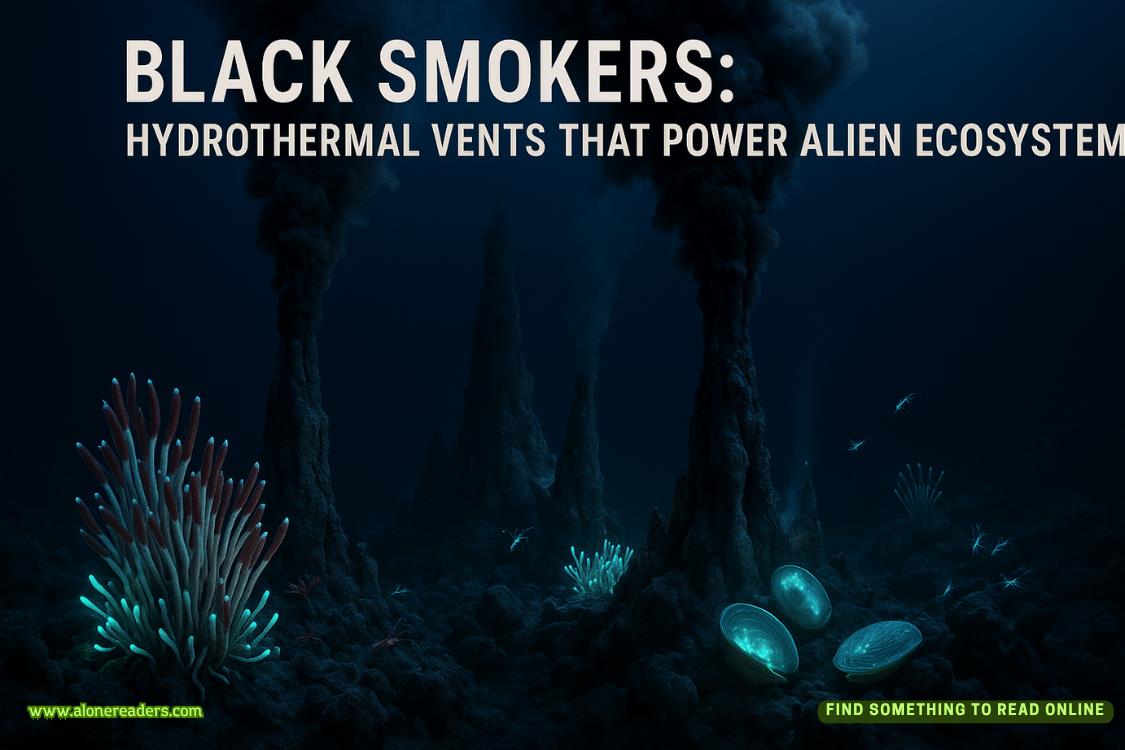
Far beneath the ocean’s surface, where sunlight never penetrates and pressure could crush a submarine, lie some of the most astonishing natural wonders on Earth—black smokers. These hydrothermal vents are not only geological marvels but also biological sanctuaries, hosting entire ecosystems that thrive without sunlight. Instead of relying on photosynthesis, these creatures depend on chemosynthesis, a process that turns chemical energy from the Earth’s crust into the foundation of a thriving food web. To understand black smokers is to glimpse a world that seems more like an alien planet than our own ocean floor.
Black smokers were first discovered in 1979 along the Galápagos Rift, and their discovery completely transformed our understanding of life’s possibilities. Until then, scientists believed that all life ultimately depended on the sun. The sight of vast colonies of organisms flourishing in pitch-black, superheated waters shattered that notion and revealed an ecosystem powered by the Earth’s internal heat.
Beneath mid-ocean ridges—massive underwater mountain chains formed by tectonic activity—seawater seeps through cracks and fissures into the oceanic crust. As this water travels several kilometers below the seafloor, it encounters magma-heated rock and becomes superheated, reaching temperatures above 350°C (662°F). The intense heat causes the water to react with the surrounding basaltic rock, dissolving metals, sulfides, and other minerals. When this scalding, mineral-rich water gushes back into the cold ocean, the sudden drop in temperature causes the dissolved metals to precipitate out as dark, smoky particles—hence the term black smoker.
Each vent forms a towering chimney of metallic sulfides, primarily composed of iron, copper, and zinc, which build up layer by layer as the vent continues to discharge. Over time, these chimneys can grow several meters tall, resembling eerie underwater factories billowing with black smoke. But instead of pollution, these plumes represent the chemical foundation of life in one of the harshest environments on the planet.
What makes black smokers so extraordinary is their role in supporting unique biological communities completely independent of sunlight. Surrounding the vents are ecosystems dominated by extremophiles—organisms that thrive in extreme conditions. At the base of this food chain are chemosynthetic bacteria, microscopic pioneers that convert inorganic compounds like hydrogen sulfide (H₂S) into organic matter. Using chemical reactions rather than sunlight, they perform a process analogous to photosynthesis, producing energy and nutrients that sustain the entire community.
These bacteria live in symbiotic relationships with larger animals such as giant tube worms (Riftia pachyptila), vent clams, and shrimp. The tube worms, for instance, can grow over two meters long and lack mouths or digestive systems entirely. Instead, they house millions of chemosynthetic bacteria within their tissues, which convert the vent’s chemicals into nutrients that feed both host and symbiont. It’s a perfect example of mutualistic adaptation, where survival is a shared enterprise between organism and microbe.
The physical conditions around black smokers are extreme beyond imagination. Temperatures fluctuate from near freezing in the surrounding abyssal water to scalding heat within inches of the vent openings. Pressures exceed 250 times that at sea level, and concentrations of toxic substances like hydrogen sulfide would kill most surface organisms instantly. Yet, in these infernal conditions, life not only endures but thrives with diversity and vigor. This resilience has made black smoker ecosystems a focal point for scientists exploring the limits of biology and the origins of life itself.
In the darkness, vision is useless, so many vent species rely on chemical sensing or thermal gradients to navigate. Some shrimp have developed light-detecting organs that sense faint infrared radiation emitted by the hot vents, allowing them to avoid lethal temperatures. Others, like vent crabs and polychaete worms, feed on bacterial mats or scavenge the remains of other creatures, weaving a complex web of interactions in an environment where every form of life is linked to the chemistry of the vent fluids.
Beyond their biological intrigue, black smokers are also key players in Earth’s geochemical cycles. The fluids they emit continuously alter the chemistry of the ocean by redistributing metals and minerals from the crust to the water column. Over geological timescales, this exchange shapes the composition of the oceans and seafloor sediments, influencing everything from marine chemistry to mineral deposits. Many of the world’s richest sulfide ore deposits, including copper and zinc reserves, are ancient remnants of long-extinct hydrothermal systems.
These vents also play a crucial role in regulating heat and material flow between Earth’s interior and its surface. They serve as pressure valves, releasing the planet’s internal heat in a controlled manner. The study of black smokers therefore extends beyond biology—it touches upon planetary geology, oceanography, and even astrobiology.
One of the most fascinating aspects of black smoker research is its implications for the origin of life. The discovery of self-sustaining ecosystems independent of sunlight has led many scientists to propose that life on Earth may have begun around similar hydrothermal vents billions of years ago. The mineral-rich, energy-laden environment of early vents could have provided the perfect conditions for organic molecules to assemble, forming the first simple cells. Laboratory simulations have even shown that amino acids and lipid membranes can form in vent-like conditions, lending further weight to this theory.
This revelation extends far beyond Earth. Moons like Europa (orbiting Jupiter) and Enceladus (orbiting Saturn) are believed to have subsurface oceans beneath their icy crusts, where hydrothermal activity may occur. If black smokers can sustain entire ecosystems without sunlight here, similar vents could potentially support extraterrestrial life in these distant oceans. Thus, black smokers are not only windows into our planet’s deep past but also blueprints for life beyond Earth.
The microbial communities thriving near these vents are of great interest to biotechnologists as well. The enzymes and metabolic pathways of vent-dwelling microbes, capable of operating at high temperatures and pressures, have potential applications in industrial catalysis, pharmaceuticals, and bioengineering. These extremophiles represent a biological treasure trove, where survival strategies honed over millions of years may inspire innovations in human technology.
Despite their remote locations—often thousands of meters deep—black smokers are dynamic ecosystems subject to change. Vent activity can cease as magma shifts, cutting off heat and energy flow. When this happens, the once vibrant community collapses, leaving behind mineral skeletons of chimneys and shells. Yet, new vents arise elsewhere along the ridge systems, creating a cycle of birth, growth, death, and rebirth that echoes across the seafloor. Life in this alien realm is transient but endlessly renewing, sustained by the restless energy of the Earth itself.
Studying black smokers poses immense challenges. Remotely operated vehicles (ROVs) and submersibles like Alvin or Jason have enabled scientists to explore these remote regions, capturing high-definition footage and collecting samples. These missions reveal not only breathtaking visuals but also intricate details about how chemistry, geology, and biology converge in a symphony of creation beneath the waves.
Ultimately, black smokers remind us that life is far more adaptable and creative than we once imagined. They defy conventional wisdom, existing where conditions should be uninhabitable, thriving without sunlight, and turning toxic gases into nourishment. In their dark, superheated plumes, the boundaries between geology and biology blur, revealing a living planet that breathes, burns, and creates in places we can scarcely imagine.
In the cosmic sense, black smokers represent both a mirror and a promise—a mirror showing the resilience of life on Earth’s frontier, and a promise that even in the most hostile environments of the universe, life may find a way.



 Château de Vincennes: France’s Forgotten Royal Fortress and Medieval Stronghold
 Château de Carcassonne: Europe’s Greatest Medieval Citadel and Fortress
 Château de Chenonceau: The Castle Built by Remarkable Women
 Château de Chambord: France’s Magnificent Renaissance Castle and Architectural Wonder
 Tehri Dam: India's Tallest Dam and the Debate Behind It
 Bhakra Nangal Dam: India's Temple of Modern Development










