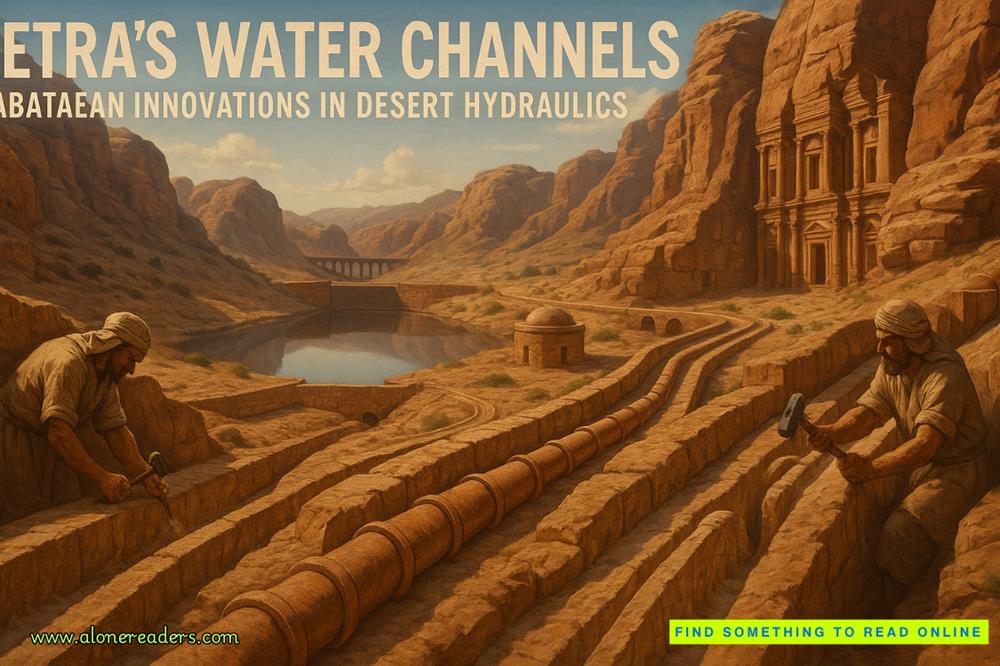
The ancient city of Petra, hidden in the rugged sandstone gorges of southern Jordan, is often celebrated for its magnificent rock-cut façades, but its true genius is revealed in the silent, unassuming traces of channels, conduits, dams, and pipelines that cling to canyon walls or snake beneath desert soil. Without this hydraulic system, Petra could never have existed. The Nabataeans engineered a water network that was nothing short of revolutionary, transforming one of the driest landscapes in the ancient world into a thriving capital city. Their bold mastery of desert hydraulics, their ability to control floods, harvest rainfall, regulate pressure, and store millions of liters of water, stands as one of the most remarkable engineering achievements of antiquity. Their innovations were not only functional but deeply adaptive, blending with the environment in ways that allowed their infrastructure to survive centuries of climate, erosion, and human absence. Petra’s surviving water channels are thus not simply relics; they are proof of an unmatched environmental intelligence that allowed an entire civilization to flourish against nature’s rules.
The Nabataeans were nomadic in origin, but their transition into urbanization did not follow the common pattern of river-valley settlement. They built Petra far from perennial water sources, situated in a basin surrounded by mountains that offered dramatic defense but demanded hydraulic ingenuity. Instead of relying on groundwater or large rivers, they devised systems to capture every drop of rain, channel seasonal runoffs safely, and store water for agriculture, ritual, and daily use. Their success lay in reading the landscape with extraordinary precision. They understood that although the region received little rain annually, flash floods could bring sudden torrents through the Siq canyon and surrounding wadis. These dangerous floods could destroy a city, yet they also represented potential wealth if tamed. The Nabataeans responded by constructing flood-control dams that not only diverted catastrophic flows but redirected them into Petra’s channel systems. The smooth grooves carved high along the Siq’s canyon walls are not decorative remnants; they are the arteries of a hydraulic body whose purpose was to feed and protect a desert metropolis.
One of the most striking features of Petra’s system was its gravity-based water transport. The Nabataeans exploited natural gradients with astonishing accuracy, carving conduits along cliff faces with slopes gentle enough to prevent erosion but steep enough to maintain steady flow. These channels, some only a few centimeters wide yet kilometers long, reveal an intimate knowledge of hydrodynamics. A miscalculation of even a few degrees could lead to overflowing, stagnation, or collapse. To ensure durability, they lined many channels with terracotta pipes, which offered protection from contamination and evaporation. The pipes were fitted using bell-and-spigot joints and sealed with waterproof mortar, demonstrating a technical sophistication that rivals Roman engineering. In fact, the Nabataeans matched—and sometimes exceeded—the hydraulic precision of civilizations far larger and more resource-rich.
The Siq, Petra’s main entrance, remains the most iconic example of this engineering brilliance. Visitors walking through this narrow canyon often marvel at its towering walls, but few realize that the channels running along both sides once carried water into the heart of the city. These conduits formed a dual-channel system: one carved directly into the rock, the other formed by a series of terracotta pipes. This redundancy ensured reliability and allowed maintenance without interrupting flow. The Nabataeans even integrated settling basins at strategic points to allow sediment to sink before the water continued forward. The channels also incorporated occasional drop shafts, which reduced pressure by allowing water to fall vertically, dissipating energy and preventing structural damage. Such pressure-control strategies were essential in a landscape where seasonal surges could easily rupture conduits.
Another remarkable innovation was the extensive use of covered channels to limit evaporation in the scorching desert environment. Petra’s climate required a hydraulic design that prioritized retention. By burying pipes or enclosing rock-cut channels, the Nabataeans protected their water from the relentless sun and from contamination by debris. When conduits passed through areas prone to shifting sands or falling rock, they added stone slabs as protective lids, creating a system that was both resilient and self-preserving. The strategic alternation between open and covered sections reveals an understanding of climatic variables and maintenance needs far beyond what most ancient societies achieved.
Storage formed another critical pillar of Nabataean hydraulic strategy. Petra depended on hundreds of cisterns, both natural and artificially expanded, many of which could hold vast quantities of water collected during the brief rainy seasons. These cisterns were often carved deep into sandstone, coated with thick waterproof plaster made from gypsum or lime, and connected to feeder channels that captured runoff from surrounding hillsides. The distribution network was designed with staggering foresight: even minor rain showers were harvested, and every catchment area was linked to the system by a web of channels that reached far beyond the city center. Some cisterns were located high above the city, allowing water to be gravity-fed downward when needed, while others formed emergency reserves for extended droughts. Archaeological studies suggest that Petra could store millions of liters of water, enough to support a population far larger than the visible ruins suggest.
Flood management was just as impressive as water collection. The Nabataeans faced a paradox: deadly floods were the primary natural threat, yet also the most dependable water source. To navigate this dilemma, they constructed a series of diversion dams that controlled the violent flash floods of the Siq. One major dam redirected the floodwaters to a tunnel known as al-Mudhlim, bypassing the entrance entirely. This engineering miracle protected Petra’s core from destruction while rerouting water into areas where it could be harvested or stored. The Nabataeans turned chaos into order, taming the desert’s most unpredictable force and transforming it into a resource for urban life.
Beyond the Siq, Petra’s engineers shaped the entire landscape. They sculpted hillside terraces to reduce erosion and slow runoff, turning steep slopes into controlled waterways that fed agricultural fields. They carved checkpoints in channels to break water speed, avoiding destructive pressure buildup. They built check dams along wadis that acted as both reservoirs and silt traps, retaining fertile soil for cultivation. The result was a hybrid system—part hydrological, part agricultural—that allowed the Nabataeans not only to survive but to thrive economically. The abundance of water supported gardens, date palms, vineyards, and olive groves, making Petra a lush, fragrant city admired by traders who passed through on long incense routes. The hydraulic system thus served not only practical needs but formed the economic foundation of a city whose wealth once rivaled kingdoms.
Perhaps the most astonishing aspect of Petra’s hydraulic infrastructure is its adaptability. Unlike rigid Roman aqueducts designed for consistent river sources, Petra’s system responded to radically fluctuating conditions. Some years brought generous rains; others were harshly dry. The Nabataeans countered this variability by designing flexible water pathways with multiple options for distribution. Channels could feed cisterns, domestic areas, gardens, or temples based on demand. Water gates and locks served as regulators, allowing adjustability based on season or availability. This decentralized approach made the system robust and resistant to collapse. Even if one channel was blocked by debris, redundancy ensured water continued to flow through alternate routes.
The urban layout of Petra reflected the importance of hydraulic planning. Major structures such as the Great Temple, the Qasr al-Bint, and elite residences were carefully positioned relative to water distribution lines. The presence of fountains, pools, and ritual ablution basins speaks to an intentional integration of water into civic and religious life. Water was not only a lifeline; it was a symbol of power, prosperity, and divine favor. Public spaces were designed to display controlled water flow, showcasing the Nabataeans’ mastery over an element that defined their identity as desert innovators.
One of Petra’s most advanced technologies was the pressure-pipe system that allowed water to be lifted or delivered under forced pressure—a feature rare in the ancient world. Terracotta pressure pipes with narrow diameters were strategically used to push water uphill or across uneven terrain, relying on gravitational compression from elevated storage tanks. This technology enabled water to reach higher city districts where ordinary gravity-fed channels would have been insufficient. Such pressure systems demonstrate an understanding of hydraulic physics far beyond what is usually attributed to pre-Roman engineers.
The robustness of these systems becomes evident when considering that Petra flourished for centuries despite political, economic, and climatic challenges. The hydraulic network allowed it to withstand prolonged droughts and supported a cosmopolitan population engaged in trade, crafts, and agriculture. Even after the city’s decline under Roman and Byzantine administration, many of the channels and cisterns remained functional, a testament to the engineering foresight embedded in their design. The endurance of these structures into the modern era reflects their creators’ mastery not only of technology but of environmental harmony. The Nabataeans did not fight the desert so much as synchronize with it, reading its rhythms and turning its unpredictability into opportunity.
Today, when visiting Petra, it is easy to be swept away by the grandeur of the Treasury or the Monastery, yet the subtle presence of water channels tells the deeper story of how the city truly lived. The Nabataeans engineered a hydraulic world that ran silently behind the façades, enabling every aspect of Petra’s culture—from agriculture to ritual, from hospitality to commerce. Modern urban planners and hydrologists still look to Petra for lessons on sustainable water use in arid environments. In an age where water scarcity challenges millions, the Nabataeans stand as examples of how innovation, adaptability, and ecological intelligence can transform even the harshest landscapes into thriving human centers.
Ultimately, Petra’s water channels are not merely remnants of ancient engineering; they are monuments to ingenuity, carved into stone with such subtlety that they blend seamlessly with nature. Their craftsmanship reveals a society that understood the desert better than any before or since. The Nabataean innovations in desert hydraulics allowed Petra to defy environmental limitations and become a crossroads of civilizations. Their legacy endures in every channel that still clings to the canyon walls, every cistern carved deep into sandstone, and every dam that continues to redirect the occasional desert flood. These systems stand as silent witnesses to a profound truth: that the survival and brilliance of Petra were built not only on trade and architecture but on an astonishing mastery of water, the rarest and most precious resource of the desert world.




 The Hundred Days Offensive: How the Allies Defeated Germany in World War I
 The Second Battle of the Marne: The Turning Point of World War I in 1918
 The Spring Offensive of 1918: Germany's Final Gamble to Win World War I
 The Treaty of Brest-Litovsk: How Russia Left World War I
 The Russian Revolution and World War I: How War Brought Down the Tsar
 The Zimmermann Telegram Explained: Germany's Secret Offer to Mexico in World War I