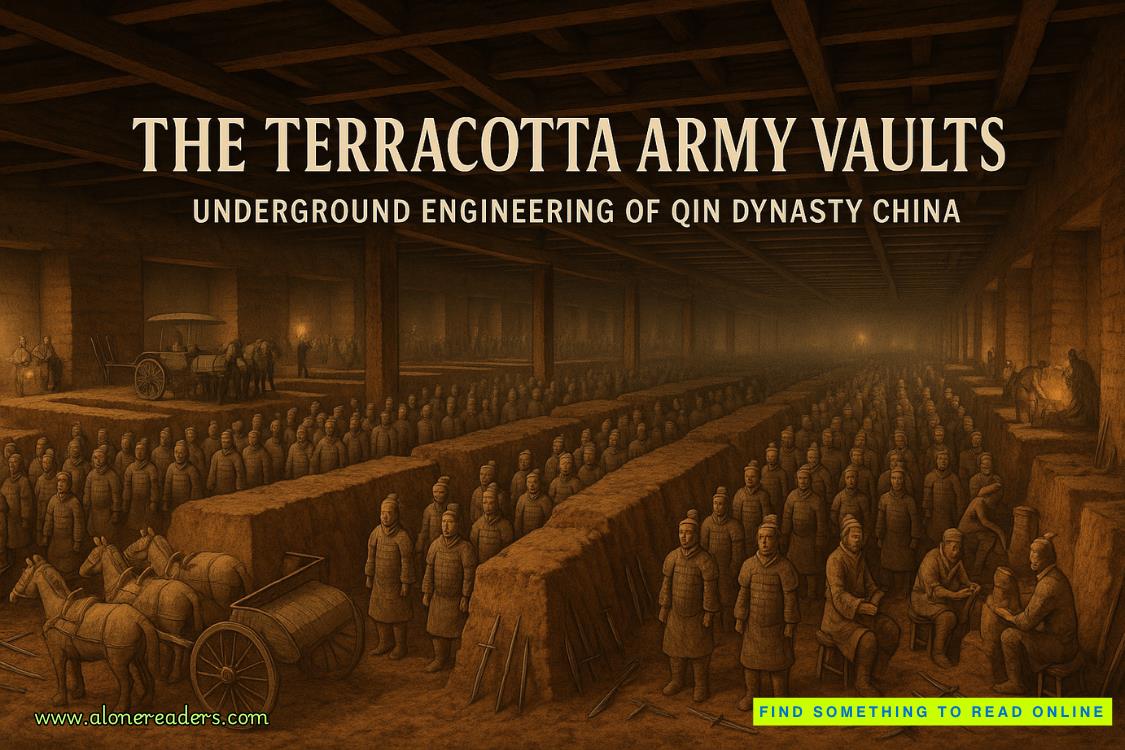
The discovery of the Terracotta Army in 1974 revealed far more than an extraordinary collection of funerary sculptures. It unveiled one of the most astonishing feats of bold, large-scale underground engineering in ancient China, a project of staggering ambition supervised during the rule of Qin Shi Huang, the first emperor who unified China. The vaults that held the Terracotta Army were not merely storage pits for clay figures; they were an integrated, sophisticated system of chambers, subterranean corridors and structural reinforcements constructed to preserve an entire mechanized military ecosystem beneath the earth. Understanding these vaults requires studying not just the artistry of the terracotta soldiers, but the engineering logic that made such a massive underground complex possible, centuries before the emergence of modern tools, concrete science or mechanized lifting equipment.
The Qin Dynasty was already renowned for its use of rammed-earth fortifications, an engineering method that compacted layers of soil into extremely solid and durable blocks. This same principle was applied to the construction of the Terracotta Army vaults. Workers excavated deep trenches, often exceeding the size of modern aircraft hangars, then shaped the walls with angled sides to withstand pressure from millions of kilograms of earth above. The surfaces were strengthened using a specialized mixture of clay, silt and gravel compacted through systematic pounding, creating walls so dense and resilient that many still stand after more than two millennia. The Qin engineers likely understood the structural loads associated with subterranean chambers in a way that was equal parts empirical knowledge and inherited tradition from earlier warring states.
The layout of the vaults reflects a surprising adaptation of military formation architecture, mirroring the arrangement of real Qin armies. Vault 1, the largest chamber, contains broad corridors separated by thick earthen partitions that acted as both load-bearing walls and tactical divisions. The soldiers were placed in precise battle configurations, meaning the vaults had to be engineered with a grid-like design: long east-to-west corridors intersected by narrow north-south walkways. This structure was not arbitrary; it distributed weight evenly across the ceiling and minimized the risk of collapse. To reinforce these spaces further, the builders installed heavy wooden beams, laid out horizontally to support a roofing system of logs, mats and earth layers. The result was a subterranean hall strong enough to protect more than 6,000 clay warriors for thousands of years.
Another engineering marvel lies in the method used to create the roofing structure. These ceilings were composed of large timber frameworks placed over the corridors, then layered with bundles of reed mats. Afterward, workers piled thick layers of soil, sometimes exceeding several meters, which acted as a protective arch. The wooden beams bore the primary load, while the earthen layers sealed the vaults from moisture and climate fluctuations. This combination mimicked the structural principles seen in early Chinese tomb architecture, where timber and earth worked together to distribute compressive forces. Even though much of the timber has decayed, the imprint of this technique remains visible in the collapsed sections, revealing a highly deliberate and calculated approach to subterranean construction.
The creation of the Terracotta Army itself demanded industrial-scale production capacity, implying an equally robust underground transport and staging design. Archaeological evidence suggests that teams of sculptors, metalworkers and laborers used the edges of the vaults as operational zones during construction. They crafted the statues in modular segments—legs, torsos, arms and heads—which were then assembled and painted near the installation sites. This means the vaults were not simply passive burial chambers but active underground workshops, requiring ventilation corridors, temporary access shafts and internal movement paths for carts and workers. The engineers must have planned these logistics early, integrating engineering demands with artistic workflow. Even today, traces of ramps and work trenches show that the underground complex was built with intentional functionality, not just ceremonial design.
One of the most fascinating aspects of the vaults is the preservation of bronze weapons, many of which remain astonishingly sharp after 2,200 years. This has raised questions about the engineering conditions within the tomb complex. The microenvironment of the vaults—regulated by compacted earth, limited oxygen infiltration and stable underground humidity—created a sealed chamber that naturally slowed oxidation. The vault design, therefore, functioned not only as a structural system but as an early climate-control engineering achievement. The long-term corrosion resistance seen on weapons such as spears, swords and arrowheads was supported by the vaults’ exceptional environmental stability, demonstrating precise understanding of materials and their interaction with buried spaces.
The sheer scale of the Terracotta Army vaults also speaks to the Qin Dynasty’s mastery of human resource engineering. More than 700,000 laborers reportedly participated in constructing the emperor’s mausoleum complex, including the underground chambers that held the Terracotta Army. Organizing manpower on such a scale required a hierarchical system of supervisors, artisans and labor units, each specializing in specific tasks. The vaults exhibit clear signs of segmented labor: some corridors reveal uniform carving marks, others contain evidence of different firing techniques and clay compositions. This level of variation indicates that the vault construction was divided into zones, each handled by separate teams following centrally issued engineering plans. Such coordination is consistent with the Qin state’s reputation for bureaucratic precision and uncompromising discipline.
Another layer of engineering sophistication appears in the alignment of the vaults. The layout of the pits follows a cardinal orientation, with corridors and soldier formations pointing primarily eastward—the direction from which Qin armies expected threats during the Warring States period. Whether this orientation was symbolic, tactical or dictated by geomantic principles, it reflects a deep integration of engineering with ideology. The precise alignment required careful surveying, likely performed using early sighting tools such as gnomons and calibrated cords. Achieving this accuracy on a project spanning more than 20,000 square meters underscores the high mathematical intelligence applied to the mausoleum’s underground design.
Excavations show that the underground chambers originally included protective coverings, possibly coated with lacquer or sealed with fired-earth tiles, now mostly lost due to natural degradation. These materials would have added another layer of insulation, creating a multi-tiered barrier between the clay warriors and external elements. The presence of lacquer traces on the soldiers themselves indicates the vault microenvironment was carefully calibrated to preserve painted surfaces. Although most color has faded due to rapid oxygen exposure after excavation, the original preservation within the sealed vaults hints at an engineering focus on maintaining internal stability for as long as possible.
Perhaps the most mysterious engineering challenge relates to the unexcavated central tomb of Qin Shi Huang, located a short distance from the Terracotta Army vaults. Early historians described an underground palace with rivers of mercury and a cosmic ceiling painted with stars. If even part of this description is accurate, the engineering required to create such an environment would surpass that of the terracotta pits. The vaults of the Terracotta Army may thus represent only the outer defensive systems of a far more complex subterranean engineering masterpiece, one that remains hidden due to concerns over preservation and safety. The ability to construct multi-level underground chambers with symbolic geography and protected internal climate would represent an engineering tradition unmatched until many centuries later.
The collapse of certain vault sections provides insight into ancient construction risks. In areas where wooden beams weakened or were undersized, ceilings eventually caved in, crushing soldiers beneath layers of soil. These failures help modern engineers understand load distribution errors made during the original construction. Yet even these partial collapses illustrate the remarkable longevity of the surviving sections, where the engineering succeeded so well that soldiers have remained nearly intact for 2,200 years. It is a testament to the dual nature of ancient engineering—practical calculation combined with empirical evolution, refined through generations of structural experimentation.
The underground vaults also reveal the Qin Dynasty’s approach to security and concealment engineering. After the soldiers were installed and the roofing system completed, workers filled the remaining access shafts and compacted the soil thoroughly. This erased visible traces of underground construction, transforming the surface into farmland over time. Airflow was intentionally limited to prevent decay, and the concealment was so successful that the Terracotta Army remained undiscovered until accidental excavation in the 20th century. This demonstrates a sophisticated understanding of how to create structures meant to remain hidden, stable and protected from nature and human interference for millennia.
The Terracotta Army vault complex embodies the sophisticated synergy between art, engineering and imperial ideology during the Qin Dynasty. The underground chambers were not just architectural achievements but symbolic creations, asserting the emperor’s eternal power. The scale and precision of the vaults reflect an empire determined to engineer not only its military supremacy but its afterlife continuity. Every corridor, every earth wall and every timber beam served a dual purpose: preserving ceramic soldiers and safeguarding the emperor’s cosmic authority beyond death.
The engineering brilliance of these vaults continues to inspire awe because they represent a world where technology, symbolism and statecraft blended seamlessly. The Terracotta Army may be celebrated for its artistry, but beneath that artistry lies an even more astounding legacy: the ability of ancient engineers to shape vast subterranean landscapes with mathematical precision, logistical mastery and structural foresight. These vaults were not temporary structures; they were engineered as eternal chambers, places where time would slow, materials would endure and imperial ambition would become physically immortalized beneath the ground.
Today, as archaeologists uncover more hidden sections of the mausoleum complex, the vaults stand as monumental evidence that the Qin Dynasty’s engineering capabilities were far ahead of their time. They challenge assumptions about ancient construction and reveal a civilization capable of extraordinary architectural innovation. In many ways, the underground vaults of the Terracotta Army represent the pinnacle of early Chinese engineering, an achievement unparalleled anywhere in the ancient world. The silent soldiers stand as witnesses to a mastery of underground construction that remains as impressive now as it was more than two thousand years ago—a triumph of technical ingenuity, strategic planning and the relentless ambition of an emperor determined to reshape both the living world and the realm of death through the power of engineering.




 The Hundred Days Offensive: How the Allies Defeated Germany in World War I
 The Second Battle of the Marne: The Turning Point of World War I in 1918
 The Spring Offensive of 1918: Germany's Final Gamble to Win World War I
 The Treaty of Brest-Litovsk: How Russia Left World War I
 The Russian Revolution and World War I: How War Brought Down the Tsar
 The Zimmermann Telegram Explained: Germany's Secret Offer to Mexico in World War I










