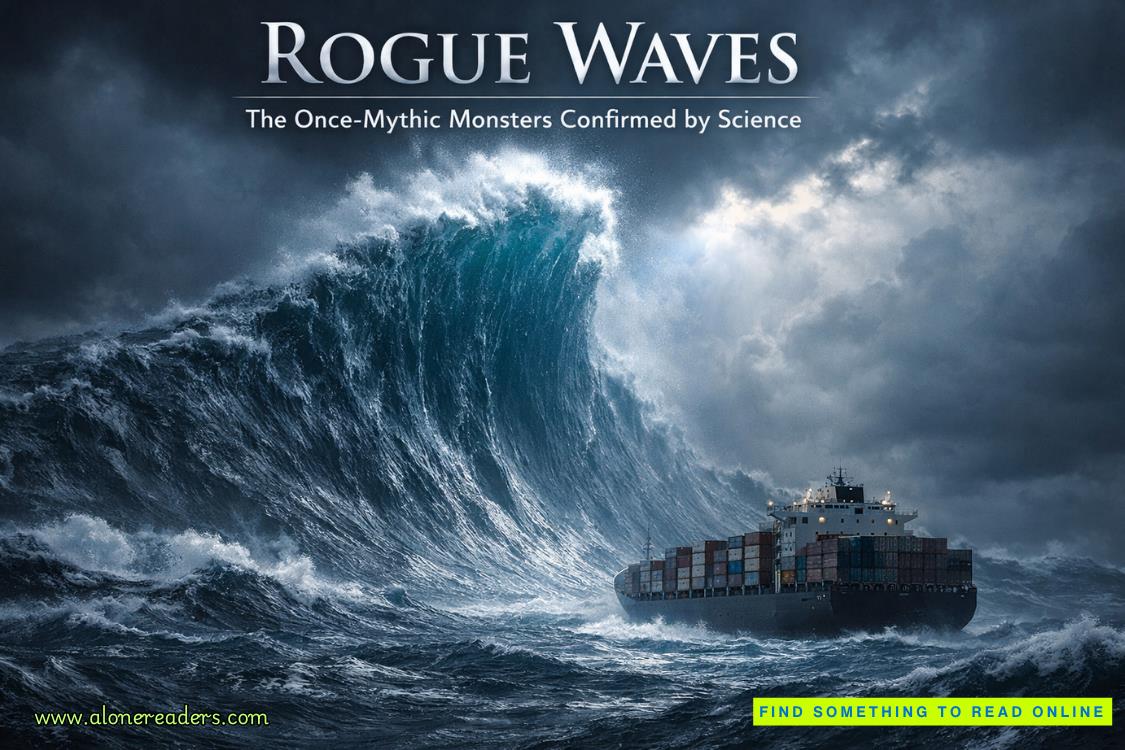
For centuries, sailors told stories of enormous walls of water that appeared without warning, towering above surrounding seas and crushing even the strongest vessels in a single, merciless blow. These accounts were often dismissed by scientists and naval authorities as exaggerations born from fear, fatigue, or the unreliable memory of survivors. The open ocean, after all, was believed to obey predictable statistical rules, where wave heights followed neat patterns and extremes were rare to the point of near impossibility. Yet the ocean has never been particularly interested in human assumptions, and over time, mounting evidence forced science to confront an unsettling truth: rogue waves are real, they are measurable, and they are far more dangerous than anyone once believed.
The skepticism surrounding rogue waves was rooted in classical wave theory, which treated ocean waves as largely random but statistically constrained. According to these models, the probability of a wave reaching more than twice the significant wave height of its surrounding sea state was vanishingly small. In practical terms, waves exceeding 20 or 25 meters in height were considered almost impossible outside of extreme storms or hurricanes. When sailors claimed encounters with single, isolated waves rising to twice that height in otherwise moderate conditions, their stories clashed violently with accepted mathematics. For decades, scientific consensus quietly assumed that such waves were artifacts of perception rather than physical reality.
This view began to unravel as unexplained maritime disasters accumulated. Large, modern ships with advanced navigation systems and experienced crews were being lost or severely damaged in conditions that should not have been catastrophic. Containers were torn from decks, bridges were smashed far above the waterline, and reinforced steel hulls bore scars that conventional waves could not explain. Insurance records, naval incident reports, and structural damage assessments slowly painted a picture that no longer fit traditional models. Something in the ocean was producing short-lived but extraordinarily powerful waves, and these waves were striking with enough force to overwhelm vessels designed to survive the worst storms on record.
The decisive turning point came with direct measurement. In 1995, an offshore platform in the North Sea recorded a wave over 25 meters high, nearly twice the surrounding wave height, during a storm that was intense but not unprecedented. Unlike anecdotal accounts, this measurement came from calibrated instruments, not human observation. The data were indisputable. A single, steep-faced wave had emerged from a chaotic sea state, delivering energy far beyond what linear wave theory predicted. This moment forced oceanographers to revisit long-held assumptions and admit that the statistical framework governing wave behavior was incomplete.
Once rogue waves were acknowledged as real, the critical question shifted from whether they existed to how they formed. Modern research has revealed that rogue waves are not random freaks of nature but the result of complex physical mechanisms that allow energy to concentrate rapidly in one place. One of the most important of these mechanisms is nonlinear wave interaction. In simple terms, ocean waves do not always pass through one another harmlessly. Under certain conditions, they exchange energy, amplifying some waves at the expense of others. This nonlinear process can cause a single wave to grow dramatically in height over a very short distance and time.
Another key factor is wave focusing, which occurs when waves traveling at different speeds and directions converge. Ocean currents play a crucial role here. When a strong current flows against the direction of incoming waves, it compresses their wavelengths, forcing energy upward instead of forward. This effect is particularly pronounced in regions like the Agulhas Current off South Africa or the Gulf Stream in the North Atlantic, where fast currents meet long-distance swells. In these areas, waves can steepen rapidly, transforming from ordinary swells into towering walls of water capable of breaking ships apart.
Wind conditions also contribute in subtle but powerful ways. Rapid changes in wind speed or direction can inject energy unevenly into the sea surface, destabilizing wave groups and promoting sudden amplification. Unlike steady winds that produce relatively uniform waves, gusty or shifting winds can create chaotic interactions that favor the formation of extreme events. When combined with nonlinear effects and current-induced focusing, these wind patterns help explain why rogue waves often appear without warning, even in seas that seem manageable moments earlier.
What makes rogue waves especially dangerous is not just their height but their shape and energy density. Unlike typical storm waves, which have relatively gentle slopes, rogue waves tend to be exceptionally steep, with near-vertical faces. This steepness concentrates immense force into a small area upon impact. For ships, this means loads far exceeding design assumptions, particularly when waves strike the bow or side at close to perpendicular angles. The result can be catastrophic structural failure, flooding, or loss of stability within seconds.
Modern ship design has been profoundly influenced by the growing understanding of rogue waves. Naval architects now recognize that relying solely on average sea conditions is insufficient for safety. Hulls, superstructures, and bridge placements are being reassessed to account for the possibility of extreme, localized impacts. Computer simulations incorporating nonlinear wave dynamics are increasingly used to test how vessels respond to rogue-wave scenarios, revealing vulnerabilities that would have remained hidden under older models. These insights are gradually leading to stronger designs, improved materials, and revised safety standards across the maritime industry.
Despite these advances, predicting rogue waves in real time remains one of the greatest challenges in ocean science. Unlike hurricanes or large storm systems, rogue waves do not leave clear signatures days in advance. They arise from the spontaneous alignment of multiple factors, often within minutes. While satellites and wave buoys can identify regions where conditions are favorable for rogue-wave formation, pinpointing the exact time and location of a specific event is still beyond current capabilities. This unpredictability is what makes rogue waves so terrifying: they strike without warning, leaving crews with no time to react.
Nevertheless, progress is being made. High-resolution satellite imagery, machine-learning models, and advanced ocean simulations are beginning to identify patterns associated with increased rogue-wave risk. Researchers are learning to recognize combinations of wave spectra, current strength, and wind variability that statistically elevate the likelihood of extreme waves. Although this does not amount to precise prediction, it allows for improved risk assessment and route planning. Ships can be advised to avoid certain regions during specific conditions, reducing exposure to the most dangerous environments.
Beyond their threat to shipping, rogue waves have reshaped our understanding of the ocean itself. They serve as a powerful reminder that natural systems are often governed by nonlinear dynamics, where small changes can lead to disproportionately large effects. The discovery of rogue waves has influenced research far beyond oceanography, offering insights into similar phenomena in optics, plasma physics, and even financial markets, where sudden, extreme events can emerge from complex interactions rather than simple randomness.
There is also a psychological dimension to the story of rogue waves. For generations, sailors were marginalized for speaking of encounters that contradicted scientific orthodoxy. Their lived experience was discounted because it did not fit existing theory. The eventual confirmation of rogue waves stands as a rare case where traditional knowledge and modern science converged, vindicating those who trusted observation over assumption. It underscores the importance of humility in scientific inquiry and the need to remain open to phenomena that challenge established models.
Today, rogue waves occupy a unique place in the public imagination, straddling the line between myth and measurable reality. They are no longer sea monsters born of superstition, yet they retain an almost mythic power due to their suddenness and destructive force. As science continues to unravel their behavior, one truth remains clear: the ocean is far more dynamic and capable of extremes than once believed. Rogue waves are not anomalies to be ignored but integral expressions of a complex, energetic system that still holds many secrets.
In acknowledging rogue waves, humanity has taken a small but significant step toward understanding the true nature of the seas. Each discovery strips away a layer of false certainty, replacing it with deeper respect for the forces that shape our planet. The monsters of old legends were not imaginary after all; they were simply waiting for science to catch up.



 Château de Vincennes: France’s Forgotten Royal Fortress and Medieval Stronghold
 Château de Carcassonne: Europe’s Greatest Medieval Citadel and Fortress
 Château de Chenonceau: The Castle Built by Remarkable Women
 Château de Chambord: France’s Magnificent Renaissance Castle and Architectural Wonder
 Tehri Dam: India's Tallest Dam and the Debate Behind It
 Bhakra Nangal Dam: India's Temple of Modern Development