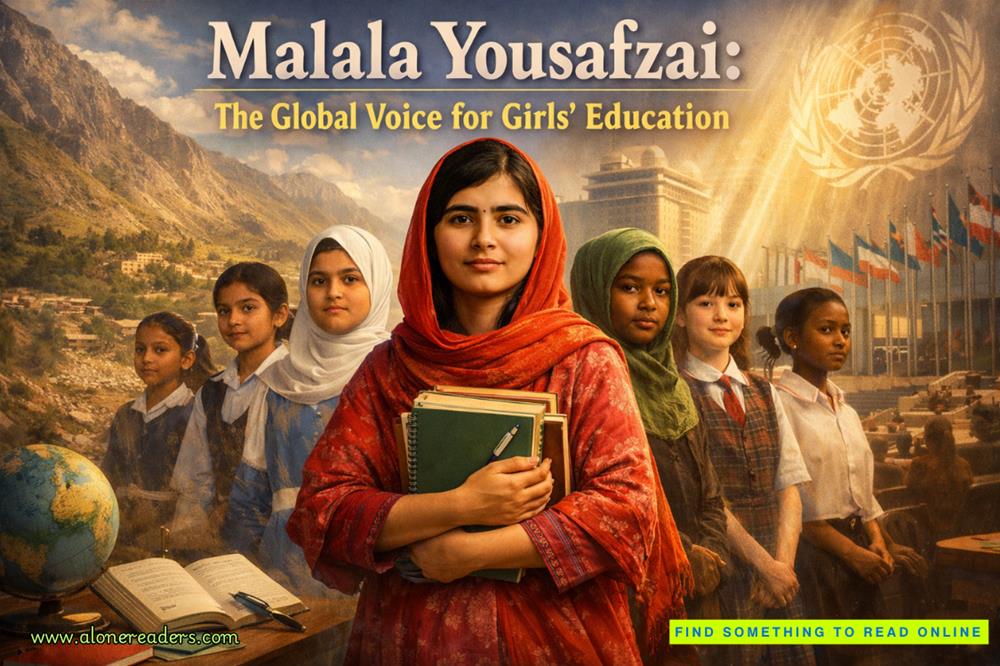
Malala Yousafzai stands as one of the most extraordinary figures of the twenty-first century, not because she sought power or authority, but because she transformed personal suffering into a global moral force. Her story is not simply one of survival; it is a sustained challenge to entrenched systems of oppression that deny girls their most basic human right—education. What distinguishes her historical significance is the continuity of purpose that defines her life: from a child speaking anonymously through a blog to a stateswoman-level advocate shaping international education policy.
Born in 1997 in Pakistan’s Swat Valley, Malala grew up in an environment where education was both cherished and contested. Her father, an educator and school founder, instilled in her an early belief that learning was not a privilege but a necessity. This intellectual foundation would later prove critical, because her activism was never rooted in impulse; it was grounded in moral reasoning, cultural awareness, and an unwavering belief in universal rights. Even as a child, she demonstrated an unusual capacity to articulate injustice in ways that resonated beyond her immediate community.
When the Taliban tightened control over Swat and imposed bans on girls’ education, Malala’s world narrowed violently. Schools were shut, threats became routine, and silence was enforced through fear. Yet, in this climate, she began documenting her experiences, offering a rare inside view of life under extremist rule. These writings did more than describe hardship; they exposed the systematic erasure of female autonomy and the strategic use of ignorance as a weapon of control. Her voice, though young, carried clarity that international audiences could not ignore.
The assassination attempt against her in 2012 marked a turning point not only in her life but in global discourse on girls’ education. Shot for the act of learning and speaking, Malala survived an attack designed to erase her existence. Instead, it amplified her message exponentially. What followed was not a retreat into victimhood, but a deliberate, disciplined transformation into a global advocate. Her recovery period became a redefinition of resistance, demonstrating that courage is not the absence of fear but the refusal to be governed by it.
After relocating to the United Kingdom, Malala’s activism entered a new phase—strategic, institutional, and international. She addressed world leaders with composure far beyond her years, framing education not as charity but as a foundational investment in global stability. Her speeches avoided emotional excess, relying instead on moral logic: educated girls lead to healthier families, stronger economies, and more resilient societies. This framing helped shift education advocacy from a humanitarian issue to a policy imperative.
The establishment of the Malala Fund reflected her understanding that change requires structure. Rather than centering herself as a symbol, she prioritized grassroots leadership, supporting local educators and activists in regions where girls face systemic exclusion. This approach distinguished her from many global figures; she consistently emphasized that she was not the exception, but the product of opportunity. Her goal was replication—millions of girls empowered to claim education as their right, not their reward.
In 2014, Malala became the youngest recipient of the Nobel Peace Prize, a milestone that solidified her place in history. Yet, the significance of this recognition lies less in the accolade itself and more in what it symbolized: a global acknowledgment that girls’ education is inseparable from peace. By honoring a teenage girl, the international community implicitly rejected the notion that authority must come from age, gender, or political office. It validated moral leadership rooted in lived experience.
What makes Malala historically distinct among influential women is her dual identity as both survivor and strategist. She never allowed her narrative to be confined to trauma. Instead, she consistently redirected attention toward systemic solutions—education funding, policy reform, and cultural change. Her advocacy addresses not only access to schools, but the quality of education, teacher safety, and the socioeconomic barriers that disproportionately affect girls in conflict zones.
Equally important is her intellectual evolution. Malala’s later work reflects a nuanced understanding of feminism that respects cultural contexts while rejecting relativism that excuses oppression. She speaks of education as empowerment, but also as agency—the ability for women to shape their own futures. This perspective resonates across cultures because it avoids imposing identity while insisting on dignity. It is a form of global feminism grounded in respect rather than prescription.
Her influence extends beyond education into youth leadership itself. Malala redefined what young people can represent in global politics—not as symbolic participants, but as serious contributors. Her presence at international forums challenges entrenched hierarchies and forces policymakers to confront the lived realities behind abstract statistics. In doing so, she helped normalize youth voices in spaces historically reserved for elites.
Critically, Malala’s legacy is not static. Unlike historical figures whose impact is measured retrospectively, her influence continues to evolve. Each year, new initiatives, partnerships, and policy shifts bear her imprint. This ongoing relevance positions her not only as a historical icon but as an active architect of the future. Few figures manage to occupy both roles simultaneously.
From a historical perspective, Malala represents a convergence of individual agency and global conscience. Her life demonstrates how one voice, when sharpened by principle and sustained by action, can disrupt even the most rigid systems of power. She belongs in the lineage of influential women not because she endured violence, but because she transformed that experience into a framework for global change.
Ultimately, Malala Yousafzai’s significance lies in her refusal to allow the world to lower its expectations. She demands that girls be educated not someday, but now; not selectively, but universally. Her message is uncompromising yet hopeful: that knowledge is not merely a tool for personal advancement, but the most enduring force for justice humanity possesses. In that conviction, her place in history is not only secure—it is still being written.





 The Hundred Days Offensive: How the Allies Defeated Germany in World War I
 The Second Battle of the Marne: The Turning Point of World War I in 1918
 The Spring Offensive of 1918: Germany's Final Gamble to Win World War I
 The Treaty of Brest-Litovsk: How Russia Left World War I
 The Russian Revolution and World War I: How War Brought Down the Tsar
 The Zimmermann Telegram Explained: Germany's Secret Offer to Mexico in World War I