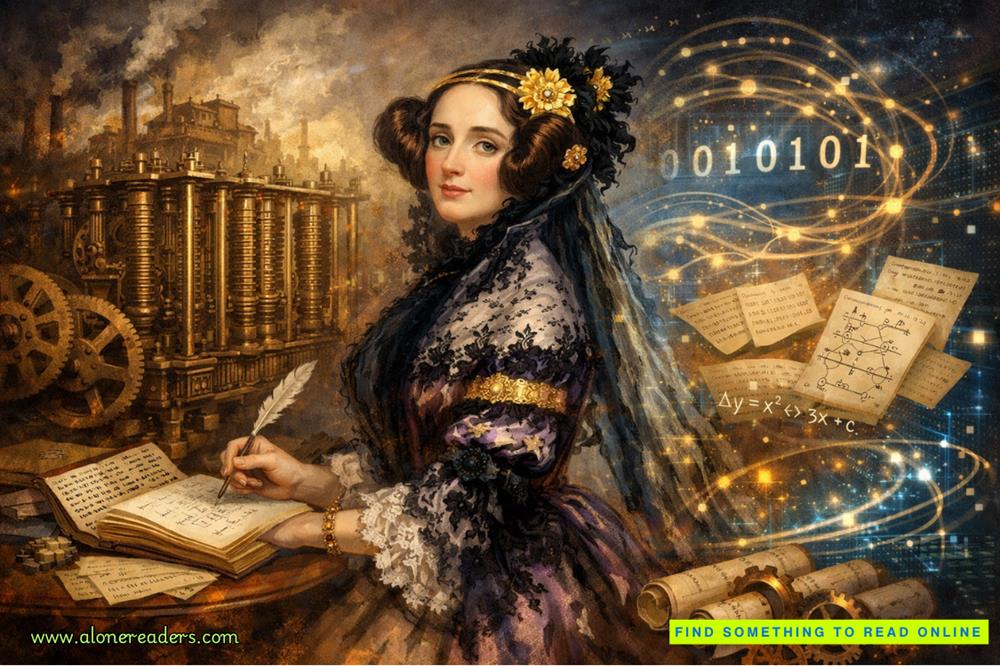
Ada Lovelace occupies a singular and often misunderstood position in the history of science and technology. She is not remembered merely as a gifted aristocrat with an interest in mathematics, nor simply as an assistant to more famous male inventors of her era. She is recognized today as the first computer programmer in history, a title earned not through symbolic association but through concrete intellectual achievement. Her work represents the earliest known example of a published algorithm designed explicitly for execution by a machine, written nearly a century before electronic computers became reality. To understand why this distinction matters, and why it continues to shape modern conversations about technology and gender, one must examine her life, her intellectual formation, and the depth of her theoretical insight with precision rather than myth.
Born Augusta Ada Byron in 1815, she entered the world already burdened with contradiction. Her father was the poet Lord Byron, whose romantic genius and personal volatility made him a cultural icon of his age. Her mother, Anne Isabella Milbanke, was a woman of rigorous logic, deeply interested in mathematics and determined to shield her daughter from what she considered the dangerous excesses of poetic temperament. This parental divide shaped Ada’s intellectual upbringing. Rather than discouraging imagination, her mother sought to discipline it through mathematics, believing structured reasoning could act as a counterweight to emotional instability. This decision, unusual for women of the early nineteenth century, would prove historically consequential.
From an early age, Ada demonstrated an extraordinary capacity for abstract reasoning. She was not simply trained in arithmetic but encouraged to think conceptually about systems, relationships, and formal logic. Her tutors included some of the most prominent scientific thinkers of the era, and she absorbed advanced mathematics at a level rarely accessible to women at the time. Importantly, her education did not suppress creativity. Instead, it fused imagination with analytical rigor, allowing her to envision not only what machines could do, but what they could become. This fusion would later underpin her most important intellectual breakthrough.
Her encounter with Charles Babbage marked a turning point. Babbage was developing designs for mechanical calculating machines, most notably the Difference Engine and later the more ambitious Analytical Engine. These devices were conceived to automate mathematical computation, eliminating human error from complex calculations. While many contemporaries saw Babbage’s machines as advanced calculators, Ada perceived something far more profound. She recognized that the Analytical Engine, if constructed, would not merely manipulate numbers but could operate on symbols according to formal rules. This insight placed her intellectually ahead of nearly everyone in her time.
The significance of her contribution emerged most clearly in her translation and expansion of an Italian engineer’s paper on the Analytical Engine. Ada did not simply translate the text; she appended extensive notes that ultimately exceeded the length of the original work. Within these notes, she articulated a sequence of operations for the machine to compute Bernoulli numbers. This sequence was not a vague suggestion but a step-by-step procedural method, explicitly designed for mechanical execution. In modern terms, this was an algorithm. Crucially, it was not meant for human calculation but for a machine following formal instructions, which is the defining criterion of computer programming.
What distinguishes Ada’s algorithm from earlier mathematical methods is intent. Mathematical procedures had existed for centuries, but they were conceived for human execution. Ada’s work explicitly framed the machine as the active agent of computation. She understood that the engine could store intermediate results, loop through operations, and follow conditional logic. These concepts form the conceptual foundation of modern programming. Her notes reveal a mind thinking not in isolated calculations but in structured processes, anticipating ideas that would only be formalized much later in computer science.
Equally important was her recognition of the machine’s limitations. Ada famously argued that the Analytical Engine could not originate ideas on its own; it could only do what it was instructed to do. This observation, often called Lovelace’s objection, remains relevant in contemporary debates about artificial intelligence. Far from diminishing her vision, this statement demonstrates her philosophical clarity. She understood the difference between mechanical symbol manipulation and human creativity, while still appreciating the immense power of automated computation.
Her vision extended beyond mathematics. Ada speculated that such machines might one day compose music, create art, or manipulate symbols in domains other than numbers. While she acknowledged that these outputs would still depend on human instruction, her speculation represents the first recorded anticipation of general-purpose computing. She grasped that numbers could represent more than quantities; they could encode relationships, patterns, and abstract concepts. This realization lies at the heart of all modern digital systems.
Despite these intellectual achievements, Ada’s life was marked by physical illness, social constraint, and personal struggle. She lived in a society that offered women little recognition for scientific work, and her contributions were often framed as secondary to those of male colleagues. Her health deteriorated in her thirties, and she died in 1852 at the age of thirty-six. For decades, her work remained largely obscure, overshadowed by broader narratives of industrial progress and later technological revolutions.
The rediscovery of her significance in the twentieth century was not a matter of symbolic revisionism but of scholarly reevaluation. As computer science emerged as a formal discipline, historians began to recognize that Ada’s notes contained conceptual elements strikingly similar to modern programming structures. Her work was not an anachronistic curiosity but a genuine intellectual precursor. The fact that it predated electronic hardware did not diminish its relevance; on the contrary, it demonstrated the power of theoretical insight independent of technological implementation.
In modern discourse, Ada Lovelace has become a symbol of women’s contributions to science and technology, but this symbolic role should not obscure the technical substance of her work. She was not significant because she was a woman in a male-dominated field; she was significant because her ideas were correct, original, and transformative. Recognizing her as the first computer programmer is not an act of historical generosity but an acknowledgment grounded in evidence.
Her legacy continues to influence how we understand the relationship between humans and machines. She exemplified an approach to technology that balanced ambition with restraint, imagination with discipline. In an era increasingly defined by algorithms and automation, her insights remain strikingly contemporary. She reminds us that technological progress is not merely about faster machines or more powerful hardware, but about the clarity of thought that guides their use.
Ada Lovelace’s place in history is therefore secure not as a footnote, muse, or anomaly, but as a foundational thinker whose work anticipated an entire field. Her algorithm was not a curiosity of the Victorian age; it was the first articulation of a new way of thinking about computation. In recognizing her as the first computer programmer, we are not projecting modern values onto the past. We are finally seeing the past clearly, acknowledging a mind that understood the future long before it arrived.




 The Hundred Days Offensive: How the Allies Defeated Germany in World War I
 The Second Battle of the Marne: The Turning Point of World War I in 1918
 The Spring Offensive of 1918: Germany's Final Gamble to Win World War I
 The Treaty of Brest-Litovsk: How Russia Left World War I
 The Russian Revolution and World War I: How War Brought Down the Tsar
 The Zimmermann Telegram Explained: Germany's Secret Offer to Mexico in World War I










