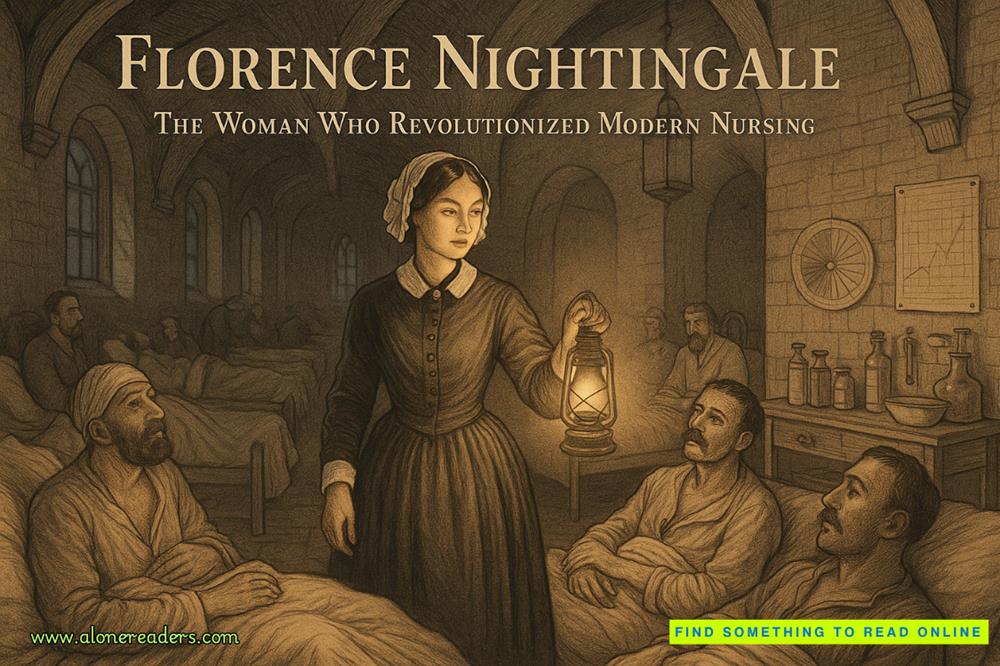
Florence Nightingale remains one of history’s most transformative figures, not merely because she cared for the wounded but because she fundamentally changed what it meant to practice nursing. Her legacy is not built on sentimental stories of kindness but on bold, systemic innovations, analytical brilliance, and a lifetime committed to reforming public health. What makes her extraordinary is not only the compassion she carried into the Crimean War but her ability to pair that compassion with methodical discipline, rigorous data analysis, and visionary thinking that forever altered medical practice. She did not simply enter history as “The Lady with the Lamp”; she entered as the architect of modern nursing, a reformer who introduced sanitation standards, statistical analysis, structured hospital design, and professional training systems at a time when such concepts barely existed.
Born into a wealthy British family, Nightingale grew up surrounded by intellectual stimulation, philosophy, mathematics, and debates on social progress. Yet she sensed from early childhood that her purpose lay outside the expectations placed upon upper-class Victorian women. While her peers prepared for marriage and domestic life, she felt a compelling inner force—what she described as a “calling from God”—to serve the sick and suffering. Her insistence on becoming a nurse shocked her family, as nursing at the time was considered a low, unskilled, and often morally questionable occupation. Hospitals were dangerous, filthy, and disorganized; trained nurses barely existed; and patient care fell largely to untrained attendants or relatives. For an educated aristocratic woman to pursue nursing was seen as almost scandalous. Nightingale’s determination to follow this calling, despite enormous social resistance, reveals the unyielding resolve that shaped her entire life.
In 1853, she took charge of a small London hospital for “Sick Gentlewomen,” and in doing so, demonstrated her exceptional administrative talent. She reorganized patient care, introduced hygiene standards, and implemented data-driven management strategies. Her leadership was calm, rational, and unshakeable—characteristics that would soon define her wartime legacy. When the Crimean War erupted in 1854, reports of catastrophic conditions inside British military hospitals horrified the public: unsanitary wards, insufficient supplies, rampant infections, and staggering death rates among soldiers who survived battle only to perish from disease. Nightingale, along with a team of nurses, was sent to the British camp hospital in Scutari to address these dire conditions. What she encountered there exceeded even the worst expectations—overcrowded wards, contaminated water, vermin infestation, no proper ventilation, and a death rate so high that the hospital itself had become a place of inevitable deterioration.
Nightingale’s response was immediate and systematic. She reorganized the kitchens, established laundries, instituted strict cleaning routines, separated patients based on condition, created systems for food distribution, and forced military officials to adopt proper waste disposal practices. Although she faced intense opposition from military surgeons who resented civilian interference, she persisted with unyielding discipline and organizational clarity, transforming a chaotic hospital into a functioning medical institution. Her nightly rounds carrying a lamp became an enduring symbol of care, yet behind this gentle image existed a deeply analytical strategist whose reforms were grounded in mathematics, epidemiology, and operational management.
One of Nightingale’s most remarkable contributions was her use of statistical analysis to reveal the true causes of soldier mortality. She meticulously recorded hospital data, tracking daily death counts, illness patterns, supply shortages, sanitation failures, and environmental conditions. She then used this information to demonstrate that far more soldiers were dying from preventable diseases than from combat wounds, and that unsanitary conditions within military hospitals were primarily responsible. Her innovative “coxcomb” or polar area charts became one of the earliest powerful examples of data visualization used to influence public policy. These diagrams communicated complex information in a visually compelling, accessible way that even government officials could not ignore. With these data-driven arguments, she forced systemic changes in military healthcare and established herself as one of the world’s pioneers in medical statistics.
Nightingale’s influence extended far beyond wartime. After returning to Britain, weakened by illness but driven by relentless purpose, she dedicated the rest of her life to reforming public health. She advised governments on sanitary improvements, helped design hospitals to maximize ventilation and efficiency, and authored groundbreaking works that laid the foundation for modern nursing ethics and education. Her book on nursing, written in her distinctive plain, direct style, emphasized that patient environments—clean air, clean water, proper drainage, light, warmth, and quiet—were central to recovery. This was revolutionary in a time when medical treatment focused almost exclusively on direct interventions. Nightingale recognized that the environment itself was a therapeutic agent, and her approach would become a cornerstone of modern healthcare design.
One of her clearest legacies is the establishment of the Nightingale Training School for Nurses at St. Thomas’ Hospital in London. Here, she implemented a rigorous curriculum that blended theoretical knowledge with practical experience, emphasizing discipline, hygiene, empathy, and scientific reasoning. Her model professionalized nursing worldwide, turning it from a menial occupation into a respected, structured profession with standards, ethics, and long-term career paths. The graduates from her program became leaders who spread her principles throughout Britain, North America, India, and beyond. This training system is recognized as the foundation of nursing as we know it today.
Although widely celebrated as a heroic figure, Nightingale’s personality was far more complex than the sentimental image often portrayed. She was a fierce reformer, not afraid to confront powerful institutions or challenge long-held medical assumptions. Her letters reveal a woman of sharp intellect, high expectations, and a deep sense of responsibility toward the vulnerable. She possessed a relentless commitment to evidence-based practice, long before such a concept existed. She believed that every decision in patient care should be backed by measurable outcomes and that healthcare administrators had a moral duty to track and optimize those outcomes. In many ways, she prefigured the principles of modern quality improvement, clinical governance, and hospital management.
Nightingale’s work in India exemplifies her broader vision of global public health. Although she never traveled there, she spent decades advocating for sanitation, clean water systems, and improved living conditions across the subcontinent. She worked tirelessly with government commissions, analyzing data from Indian villages and proposing detailed reforms. Her understanding of population health—based on environmental conditions, economic constraints, and cultural factors—makes her an early champion of what we now call global health and epidemiology. This global perspective underscores the breadth of her intellect and her belief that healthcare must serve not only the sick but entire nations.
Her later years were marked by chronic illness, likely a lingering effect of the infections she contracted during the Crimean War. Despite being bedridden for long periods, she remained a powerhouse of influence, writing letters, reports, and policy papers with astonishing productivity. Visitors and statesmen often found her room filled with charts, data tables, and drafts of new reforms. Even in physical weakness, her intellectual strength remained undimmed. She continued to advocate for nurses’ rights, hospital reform, and patient welfare until her final days, shaping generations of healthcare leaders.
Perhaps the most enduring contribution of Florence Nightingale is her insistence that healthcare is fundamentally an act of humanity guided by science. She rejected the idea that kindness alone was sufficient and equally rejected the notion that medicine should be cold and mechanical. Instead, she forged a middle path grounded in compassion, structure, discipline, and empirical understanding, establishing a professional ethos that still guides nursing today. Her belief that every patient deserved dignity, cleanliness, and competent care transformed the moral framework of medical practice. She elevated nursing into a profession defined by integrity, expertise, and rigorous standards.
Her legacy also challenges the modern assumption that change requires advanced technology or massive institutions. Nightingale transformed healthcare with keen observation, disciplined methodology, and fearless advocacy, proving that systemic reform begins with clear thinking and moral courage. In an era when women were scarcely acknowledged in the scientific world, she became one of the most respected authorities on healthcare policy. Her work forced governments to confront their failures, revolutionized hospital practices, and established the statistical foundations of evidence-based medicine.
The reverence for Nightingale today often centers on her humanitarian image, but understanding her full impact requires recognizing her as a strategist, innovator, statistician, reformer, and visionary. She was not merely a caring nurse; she was a brilliant thinker who reshaped the philosophical and operational foundations of healthcare. Her legacy is visible in modern infection control standards, nursing education programs, public health policies, and hospital architecture. Every sanitized ward, every structured training curriculum, every data-driven medical reform echoes her pioneering spirit.
Ultimately, Florence Nightingale transformed nursing from an improvised duty into an organized, scientific profession that sits at the heart of modern healthcare. Her contributions were not confined to the bedside—they extended to national policy, global health, statistical science, and administrative reform. She remains a testament to the power of disciplined intellect combined with profound empathy. Her life demonstrates how one person, armed with conviction and knowledge, can reshape entire systems to serve humanity more effectively.
Today, her legacy endures not only in the textbooks and historical accounts but in every nurse who approaches their work with professionalism, compassion, and critical thinking. The very idea that healthcare must be structured, clean, humane, and evidence-based is a direct inheritance from her work. Florence Nightingale did not simply revolutionize nursing; she revolutionized the way the world understands health, illness, and the responsibility society holds toward its vulnerable. Her impact is woven into the fabric of modern medicine, making her one of history’s most influential women and a permanent icon of transformative leadership.



 The Hundred Days Offensive: How the Allies Defeated Germany in World War I
 The Second Battle of the Marne: The Turning Point of World War I in 1918
 The Spring Offensive of 1918: Germany's Final Gamble to Win World War I
 The Treaty of Brest-Litovsk: How Russia Left World War I
 The Russian Revolution and World War I: How War Brought Down the Tsar
 The Zimmermann Telegram Explained: Germany's Secret Offer to Mexico in World War I










