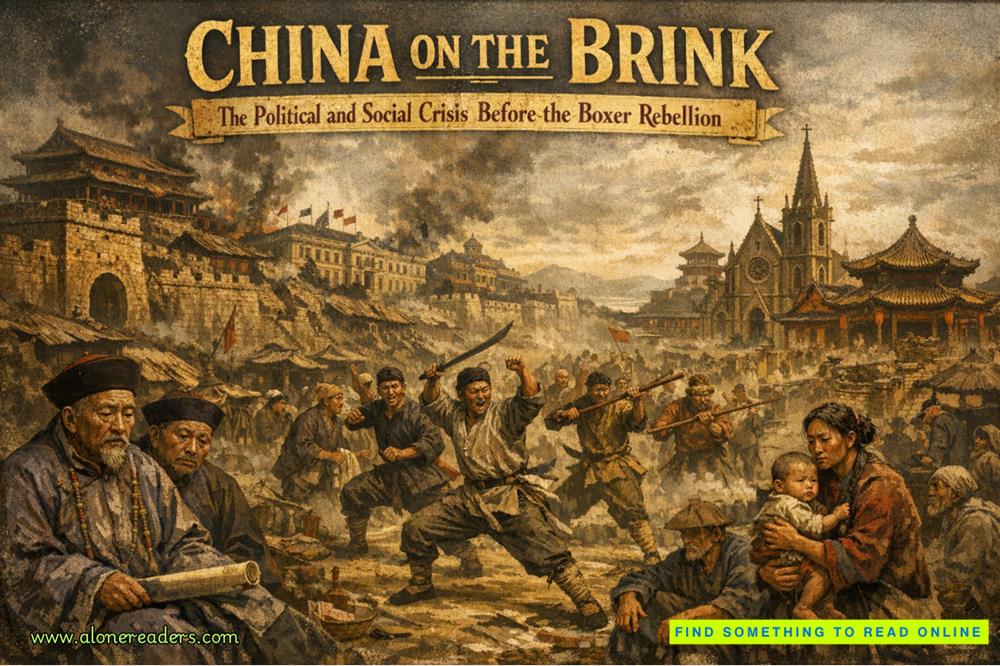
China at the close of the nineteenth century stood at a historic breaking point, trapped between the collapsing structures of an ancient imperial system and the relentless pressure of a rapidly modernizing world. The Boxer Rebellion did not erupt suddenly or irrationally, as it was often portrayed by contemporary Western observers, but rather emerged from a long-accumulating crisis rooted in political paralysis, social disintegration, economic exploitation, and cultural humiliation. By the late 1890s, the Qing state had lost not only its authority but its moral legitimacy in the eyes of millions of its own subjects, creating a volatile environment in which popular violence became, for many, the only remaining language of resistance.
The political foundations of the Qing dynasty had been eroding for decades before the Boxer uprising. The imperial bureaucracy, once admired for its administrative sophistication, had become deeply compromised by corruption, factionalism, and inertia. Official posts were increasingly obtained through bribery or patronage rather than merit, hollowing out the state’s ability to govern effectively. Provincial officials often prioritized personal enrichment or local power consolidation over imperial directives, while the central government in Beijing struggled to impose coherent policies across its vast territory. This fragmentation of authority meant that imperial edicts frequently existed only on paper, with little enforcement at the village level where unrest was most intense.
The dynasty’s repeated military failures further accelerated political decay. Defeats in conflicts against foreign powers exposed the Qing state as militarily obsolete and diplomatically weak. The crushing loss in the Sino-Japanese War of 1894–1895 was particularly devastating, shattering the long-held belief that China remained the dominant civilization of East Asia. The war demonstrated that even a formerly subordinate neighbor could defeat China using Western-style institutions, technology, and organization. The resulting indemnities drained the imperial treasury, forcing the state to raise taxes and extract resources from already struggling rural populations, thereby intensifying popular resentment.
Foreign encroachment transformed political weakness into national humiliation. Unequal treaties stripped China of tariff autonomy, granted extraterritorial rights to foreigners, and opened ports and cities to foreign control. Railways, mines, and commercial concessions were imposed with little regard for local interests, often displacing communities and disrupting traditional economies. To many Chinese, the Qing government appeared incapable of defending the realm, complicit in selling national sovereignty piece by piece. This perception of betrayal proved especially corrosive, as loyalty to the dynasty had historically been intertwined with the belief that the emperor served as the guardian of cosmic and social order.
Social conditions across northern China further primed the population for upheaval. The countryside was plagued by chronic poverty, land scarcity, and demographic pressure. Smallholder farmers faced mounting debts, volatile grain prices, and predatory taxation. Natural disasters such as floods and droughts were interpreted not merely as environmental misfortunes but as signs that the ruling dynasty had lost the Mandate of Heaven. In traditional political culture, such calamities legitimized rebellion by signaling divine withdrawal of support from the emperor. When relief efforts proved insufficient or corrupt, despair hardened into anger.
The disruption of local social structures deepened this sense of crisis. Village elites, once intermediaries between state and society, were increasingly unable or unwilling to protect communal interests. Secret societies and martial groups filled the vacuum, offering both material support and a sense of belonging to those excluded from official power. These organizations blended physical training, ritual practice, and moral discipline, framing themselves as defenders of Chinese tradition against foreign intrusion. Their appeal lay not only in promises of resistance but in the restoration of dignity to populations who felt economically crushed and culturally despised.
Religion became one of the most explosive fault lines of this era. The expansion of Christian missionary activity, protected by foreign powers, disrupted established hierarchies and customs at the local level. Converts were often exempted from traditional obligations, including certain taxes and community rituals, creating resentment among non-Christian neighbors. Missionaries, though motivated by spiritual goals, were widely perceived as agents of foreign domination. Rumors circulated that churches desecrated sacred spaces, kidnapped children, or undermined ancestral worship, intensifying fears that Chinese moral order was under assault.
The Qing court’s response to these tensions was hesitant, contradictory, and ultimately disastrous. Reform-minded officials advocated modernization of military, education, and administration, arguing that survival required institutional transformation. Conservative factions, however, feared that reforms would erode Confucian values and imperial authority. This paralysis culminated in half-measures that satisfied no one: insufficient to strengthen the state, yet disruptive enough to inflame opposition. The failure of the Hundred Days’ Reform exemplified this deadlock, reinforcing the perception that meaningful change was impossible within the existing system.
As central authority weakened, popular movements increasingly took matters into their own hands. Anti-foreign sentiment fused with millenarian beliefs, producing a worldview in which spiritual purity and physical resistance were inseparable. The Boxers drew on martial traditions, folk religion, and moral absolutism to frame their struggle as a righteous crusade against invaders and collaborators. Their rituals promised invulnerability, not merely in a literal sense, but as a symbolic rejection of the powerlessness imposed by imperial decline and foreign domination.
Importantly, the Boxers’ violence cannot be understood solely as xenophobia or irrational fanaticism. It reflected a collective psychological rupture, born of sustained humiliation and systemic failure. The Qing state’s inability to mediate between global forces and local realities left ordinary people exposed to rapid change without protection or representation. In this vacuum, extreme solutions gained plausibility. Violence became a means of reclaiming agency, even when the odds of success were minimal.
By the eve of the Boxer Rebellion, China was no longer merely a weakened empire but a society in existential crisis. Political legitimacy had collapsed, social cohesion was fraying, and cultural identity felt under siege. The uprising that followed was both a symptom and an indictment of these conditions. It represented a desperate attempt to halt historical momentum, to restore a moral universe that seemed to be dissolving under the weight of modern imperialism and internal decay.
The tragedy of the Boxer era lies not only in its violence but in its inevitability. When a state loses the capacity to govern justly, defend sovereignty, and articulate a credible future, resistance will emerge in forms shaped by fear, tradition, and desperation. The Boxers were not an anomaly but the final expression of a system that had failed its people. Their rebellion marked the moment when China’s internal crisis became impossible to ignore, setting the stage for foreign intervention, punitive treaties, and the final unraveling of imperial rule.
In this sense, the political and social crisis before the Boxer Rebellion was not merely a prelude to catastrophe but a turning point in Chinese history. It exposed the limits of imperial governance in an age of global power politics and forced a reckoning with the costs of delayed reform. The flames that erupted in 1900 illuminated decades of neglect, contradiction, and suffering, revealing a civilization struggling to survive on the edge of transformation.



 The Hundred Days Offensive: How the Allies Defeated Germany in World War I
 The Second Battle of the Marne: The Turning Point of World War I in 1918
 The Spring Offensive of 1918: Germany's Final Gamble to Win World War I
 The Treaty of Brest-Litovsk: How Russia Left World War I
 The Russian Revolution and World War I: How War Brought Down the Tsar
 The Zimmermann Telegram Explained: Germany's Secret Offer to Mexico in World War I










