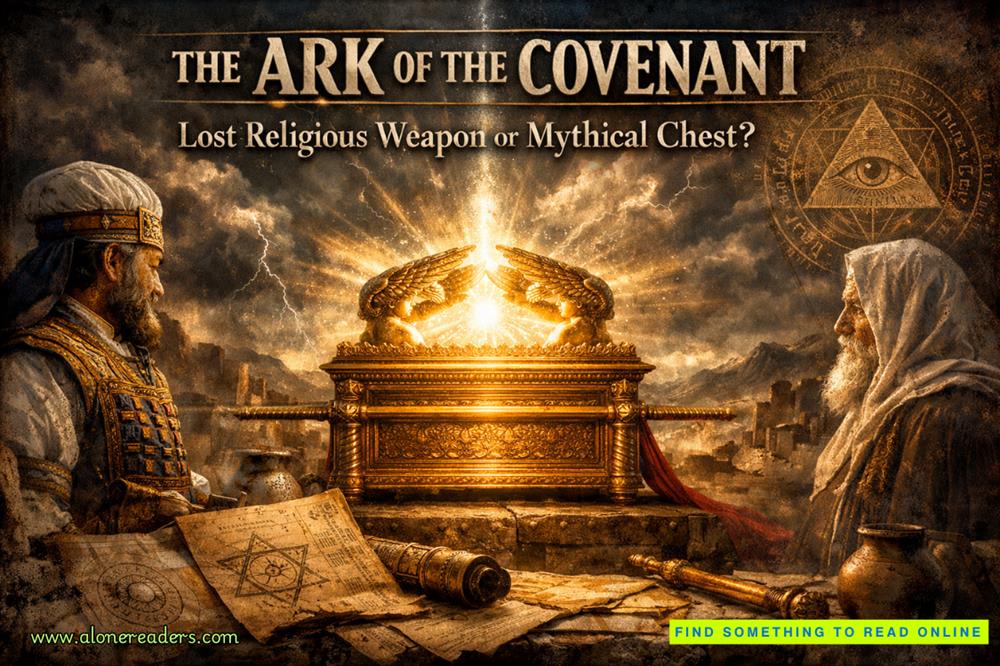
The Ark of the Covenant stands among the most enigmatic objects in human history, occupying a unique intersection of religion, power, warfare, and myth. Described in ancient Hebrew tradition as a sacred chest constructed at divine instruction, the Ark was not merely a religious symbol but a physical manifestation of covenant, authority, and judgment. For centuries, it has provoked a single enduring question: was the Ark a lost religious weapon of extraordinary power, or a mythical object shaped by theological imagination and political necessity?
According to ancient tradition, the Ark was built during the formative period of Israelite identity, following the exodus from Egypt. It was constructed from acacia wood, overlaid with pure gold inside and out, and crowned by a solid gold mercy seat flanked by two cherubim. These details are not incidental. The precision of its design suggests ritual technology rather than simple symbolism, implying that every measurement, material, and placement carried functional as well as theological meaning. Within the Ark were placed the stone tablets of divine law, and in some traditions, Aaron’s rod and a vessel of manna—objects themselves associated with miraculous power.
What elevates the Ark beyond ordinary sacred relics is the consistent portrayal of active force. Ancient narratives describe it emitting destructive energy, bringing victory in battle, causing plagues, and even killing those who approached it improperly. Entire cities were said to fall before it, rivers parted at its presence, and enemies struck down without physical contact. This recurring theme of lethal holiness has fueled speculation that the Ark functioned as a weapon, whether supernatural, technological, or psychological.
In early Israelite warfare, the Ark was carried ahead of armies as both standard and instrument. Its presence was believed to guarantee victory, not through military strategy but through divine intervention. When enemies captured the Ark, calamities reportedly followed—tumors, disease, and societal collapse—until it was returned. These accounts blur the line between mythic exaggeration and historical memory, but their consistency across traditions is striking. A sacred object that brings catastrophe to adversaries and danger to handlers resembles less a passive shrine and more a controlled force.
Skeptical interpretations argue that such descriptions reflect theological storytelling rather than empirical events. Yet conspiracy theorists and alternative historians suggest otherwise. They propose that the Ark may have been an advanced ancient device, possibly electrical, radioactive, or chemical in nature. The use of gold as a conductor, the strict insulation requirements, and prohibitions against direct contact have been interpreted as safety protocols rather than ritual taboos. In this view, the Ark’s “holiness” masked knowledge of dangerous technology lost to time.
Others contend that the Ark functioned as a psychological weapon. In a pre-scientific world, belief itself was power. An object believed to house divine presence could terrify enemies and embolden allies, altering outcomes without physical force. Fear, expectation, and mass belief can destabilize societies, and the Ark’s reputation alone may have been sufficient to cause panic, illness, and disorder among those who believed themselves cursed by its capture.
The Ark’s disappearance deepens the mystery. After playing a central role in early Israelite history, it vanishes from the record. It is last definitively mentioned during the era of the First Temple, after which it is never clearly described again. Unlike other sacred objects, it was not paraded, restored, or rediscovered. Its absence has generated centuries of speculation, from secret priestly concealment to divine removal.
One dominant theory claims the Ark was hidden to prevent desecration during foreign invasions. Others argue it was destroyed, either deliberately or accidentally, due to its perceived danger. More radical theories place it far from its origins, suggesting it was transported to distant lands by priestly orders, secret societies, or royal expeditions. Ethiopia, Egypt, the Arabian Peninsula, and even Europe have all been named as possible resting places.
Ethiopian tradition, in particular, asserts that the Ark resides within a guarded sanctuary, inaccessible to all but a single appointed guardian. According to this belief, the Ark was transferred generations earlier and remains active and dangerous. Whether this represents historical continuity or symbolic tradition remains unresolved, but the persistence of such claims suggests the Ark’s power extends beyond physical evidence into cultural identity itself.
Archaeologists, constrained by the absence of verifiable artifacts, approach the Ark with caution. No confirmed remains exist, and the materials described—wood and gold—would not easily survive millennia. Critics argue that the Ark is best understood as a mythical construct, a narrative device designed to centralize religious authority and legitimize early leadership. In this view, the Ark unified tribes, enforced obedience, and provided a tangible focus for abstract law.
Yet dismissing the Ark as pure myth fails to explain its detailed construction, consistent behavioral rules, and the intensity of fear surrounding it. Myths often exaggerate, but they rarely invent technical specificity without purpose. The Ark’s narrative includes operational constraints, handling instructions, and consequences for misuse, elements more typical of dangerous tools than allegorical symbols.
Another perspective interprets the Ark as a ritual interface—a means by which leaders communicated with the divine or simulated such communication. The Ark was consulted before major decisions, battles, and political shifts. Whether through acoustics, chemistry, or theatrical ritual, it may have served as a controlled environment for producing sensory experiences interpreted as divine response. Smoke, sound, light, and secrecy can manufacture awe, especially when framed within religious authority.
The idea of the Ark as a weapon also raises ethical implications. If it truly possessed destructive capability, its disappearance may represent a deliberate act of restraint. Ancient societies were acutely aware of the dangers of uncontrolled power, often embedding such warnings in religious language. The Ark’s removal could symbolize the rejection of divine violence, a transition from miraculous dominance to moral law.
Modern fascination with the Ark reflects deeper anxieties about lost knowledge and forbidden power. It embodies the fear that ancient civilizations understood forces we no longer grasp, and the hope that history contains answers to contemporary limits. Whether imagined as a divine throne, an ancient weapon, or a sacred myth, the Ark challenges modern assumptions about progress and ignorance.
Ultimately, the Ark of the Covenant resists singular interpretation. It is simultaneously religious symbol, political instrument, cultural myth, and speculative technology. Its power lies not only in what it may have been, but in what it continues to represent—the enduring human struggle to define authority, fear the unknown, and reconcile belief with evidence. Whether lost weapon or mythical chest, the Ark remains one of history’s most potent and unresolved enigmas, standing at the boundary between faith and conspiracy, memory and imagination.




 The Hundred Days Offensive: How the Allies Defeated Germany in World War I
 The Second Battle of the Marne: The Turning Point of World War I in 1918
 The Spring Offensive of 1918: Germany's Final Gamble to Win World War I
 The Treaty of Brest-Litovsk: How Russia Left World War I
 The Russian Revolution and World War I: How War Brought Down the Tsar
 The Zimmermann Telegram Explained: Germany's Secret Offer to Mexico in World War I