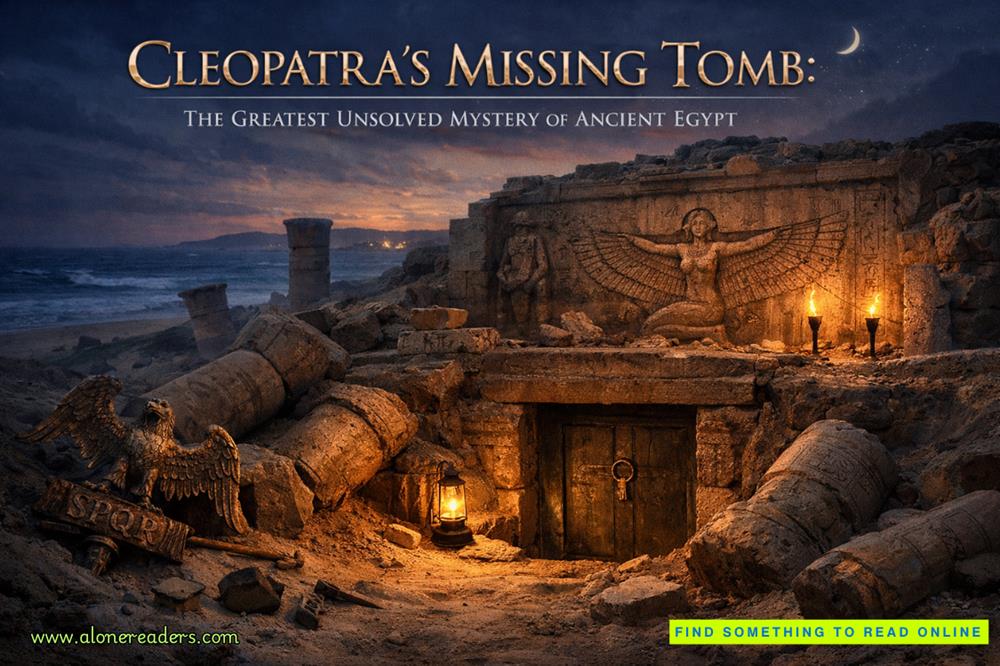
Cleopatra VII Philopator remains one of the most intensely studied figures of antiquity, yet the final chapter of her life is wrapped in a silence that has endured for more than two millennia. Despite her status as the last active ruler of Ptolemaic Egypt, despite the extraordinary political drama surrounding her death, and despite the obsessive interest of Roman historians, the location of Cleopatra’s tomb has never been definitively identified. This absence is not merely an archaeological gap; it is a historical anomaly that has fueled speculation, conspiracy theories, and academic debate for generations.
According to ancient accounts, Cleopatra did not die anonymously. She died as a queen who understood symbolism, legacy, and power. Her suicide in 30 BCE followed the defeat of her forces and the death of Mark Antony, and it was orchestrated with theatrical precision. Classical writers describe a carefully prepared end, rich in ritual and deliberate messaging. Such a woman would not have accepted an unmarked or insignificant burial, which makes the complete disappearance of her tomb profoundly puzzling. In a civilization that preserved even minor officials in stone and inscription, the vanishing of Egypt’s most famous ruler demands explanation.
One of the central problems lies in Alexandria itself. Cleopatra ruled from a city that was both cosmopolitan and fragile, a marvel of Hellenistic engineering built along a shifting coastline. Large sections of ancient Alexandria are now submerged beneath the Mediterranean Sea, victims of earthquakes, subsidence, and rising water levels. Entire royal quarters, including palaces, temples, and harbors, lie underwater. If Cleopatra was buried within the traditional royal necropolis of Alexandria, her tomb may quite literally be lost beneath the sea, inaccessible to conventional excavation and obscured by centuries of geological change.
Yet this explanation alone is insufficient. Submerged ruins have been located and studied in other parts of Alexandria, and while difficult, underwater archaeology has yielded remarkable discoveries. The absence of any inscription, funerary object, or architectural trace directly associated with Cleopatra suggests something more deliberate than environmental destruction. This has led many scholars to consider whether her burial site was intentionally concealed, relocated, or erased.
Roman political motives provide a compelling avenue of analysis. After Cleopatra’s death, Egypt ceased to exist as an independent kingdom and became a Roman province under Augustus. Cleopatra was not merely a defeated monarch; she was a potent symbol of resistance, legitimacy, and dynastic continuity. Allowing her tomb to become a pilgrimage site could have inspired dissent or nostalgia for the old order. It is entirely plausible that Roman authorities suppressed knowledge of her burial or ensured that it was obscured from public memory.
Augustus was a master of narrative control. He reshaped Roman history to legitimize his rule and carefully curated the image of his enemies. Cleopatra, portrayed in Roman propaganda as an exotic temptress and political threat, was useful as a cautionary tale but dangerous as a martyr. A grand tomb would have contradicted the Roman portrayal of her as a defeated antagonist, so minimizing or concealing her burial may have served imperial interests.
Another persistent theory suggests that Cleopatra was not buried in Alexandria at all. Ancient texts imply that she and Mark Antony were buried together, in a location associated with religious significance. This has led some researchers to focus on temple complexes outside the city, particularly those dedicated to Isis, the goddess with whom Cleopatra closely identified. Cleopatra deliberately cultivated her image as the living embodiment of Isis, and her public appearances reinforced this divine association. A burial within or beneath an Isiac temple would have aligned perfectly with her self-crafted identity.
The idea that Cleopatra’s tomb lies at a sacred site rather than a royal necropolis challenges traditional assumptions about Ptolemaic burial practices. However, Cleopatra was not a conventional ruler. She was bilingual in a dynasty that largely ignored the Egyptian language, deeply engaged with local religious traditions, and acutely aware of symbolism. Her final resting place may have been designed to transcend dynastic norms, blending Greek royal customs with Egyptian theology in a way unprecedented for her lineage.
Archaeological efforts over the past century have repeatedly attempted to locate such a site, often focusing on regions west of Alexandria. Excavations have uncovered temples, catacombs, and ceremonial structures, but no definitive royal tomb has emerged. Each promising lead has ended in ambiguity, reinforcing the perception that Cleopatra’s burial was either extraordinarily well hidden or systematically dismantled.
Adding to the mystery is the issue of documentation. Egyptian burial culture was meticulous, and Roman historians were prolific record keepers. Yet references to Cleopatra’s tomb are vague, indirect, and frustratingly incomplete. This silence may reflect deliberate omission rather than accidental loss. Records could have been destroyed, altered, or selectively preserved to suit political narratives. Over time, what was once common knowledge may have faded into obscurity through intentional neglect.
There is also the uncomfortable possibility that Cleopatra’s tomb was discovered in antiquity and looted long before modern archaeology began. Tomb robbing was widespread in Egypt, even during the pharaonic era. If Cleopatra’s burial was stripped of its treasures early on, its remaining structure may have been repurposed, collapsed, or misidentified as an ordinary ruin. Without inscriptions or grave goods, distinguishing her tomb from countless others would be nearly impossible.
Some conspiracy theories take this idea further, proposing that Cleopatra’s tomb was not only looted but actively erased. According to this line of thought, Roman authorities or later regimes may have dismantled the structure to prevent the survival of any physical reminder of her reign. Stone could have been reused in construction, inscriptions defaced, and the site absorbed into the urban landscape. In such a scenario, the tomb did not vanish naturally; it was deliberately unmade.
Modern technology has reignited interest in the search, with ground-penetrating radar, satellite imagery, and underwater scanning offering new tools. These methods have identified anomalies and structures consistent with ancient foundations, but technology alone cannot solve a mystery shaped by politics, ideology, and time. Without clear textual confirmation or unmistakable iconography, even the most advanced tools can only suggest possibilities, not provide certainty.
The enduring fascination with Cleopatra’s missing tomb reflects more than historical curiosity. It speaks to the tension between power and memory, between those who shape history and those who attempt to erase it. Cleopatra understood the importance of legacy, and it is deeply ironic that her final monument, intended to secure her place in eternity, may have been denied that very purpose.
What makes the mystery particularly compelling is that it resists simple resolution. Natural disasters, political suppression, religious symbolism, and human greed all offer plausible explanations, yet none fully account for the total absence of evidence. Cleopatra’s tomb exists at the intersection of archaeology and conspiracy, where gaps in the historical record invite speculation but resist closure.
In the end, the missing tomb may be the most fitting monument Cleopatra could have left behind. A ruler who defied Rome, mastered propaganda, and blurred the line between queen and goddess has left a legacy that remains tantalizingly incomplete. Her absence continues to provoke inquiry, debate, and imagination, ensuring that even without a tomb, Cleopatra remains immortal in the human mind.



 The Hundred Days Offensive: How the Allies Defeated Germany in World War I
 The Second Battle of the Marne: The Turning Point of World War I in 1918
 The Spring Offensive of 1918: Germany's Final Gamble to Win World War I
 The Treaty of Brest-Litovsk: How Russia Left World War I
 The Russian Revolution and World War I: How War Brought Down the Tsar
 The Zimmermann Telegram Explained: Germany's Secret Offer to Mexico in World War I