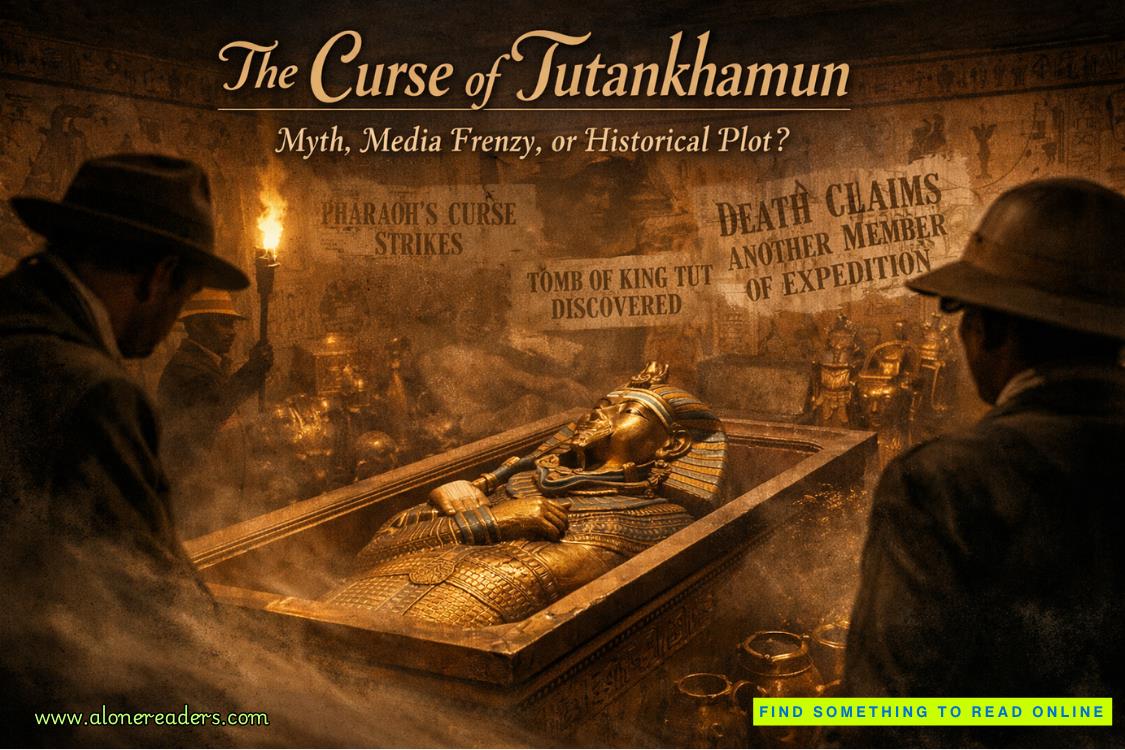
The story of Tutankhamun’s curse occupies a unique space between archaeology, popular imagination, and modern conspiracy thinking. Few historical discoveries have generated such an enduring aura of dread and fascination. When the nearly intact tomb of the young Egyptian pharaoh was opened in the early twentieth century, the world did not simply witness a breakthrough in ancient history; it became consumed by a narrative in which death, destiny, and defiance of the past seemed to collide. What began as a scientific excavation soon transformed into a global spectacle, raising the enduring question of whether the so-called curse was a genuine warning from antiquity, a creation of sensationalist media, or something more calculated and deliberate.
Tutankhamun himself was an unlikely candidate for eternal notoriety. A minor king who ruled briefly during Egypt’s Eighteenth Dynasty, he died young and left behind no great monuments or conquests. Yet paradoxically, his modest historical footprint made his tomb all the more powerful. Unlike the graves of more prominent pharaohs, which had been plundered over centuries, his burial lay hidden and largely undisturbed. This pristine state created an unprecedented moment: modern humanity peering directly into a sealed royal past. The psychological impact of this moment cannot be overstated. To step into a chamber untouched for millennia is to challenge deeply rooted human anxieties about disturbing the dead and violating sacred boundaries.
Ancient Egyptian culture itself encouraged such anxieties. The Egyptians believed intensely in the afterlife and in the continued agency of the dead. Tombs were not merely resting places but carefully engineered gateways between worlds. Spells, inscriptions, and symbolic guardians were intended to protect the deceased and ensure cosmic balance. While popular imagination often exaggerates these beliefs into crude “death curses,” the underlying worldview did emphasize consequences for those who disrupted sacred order. This cultural context became fertile ground for later interpretations, allowing modern observers to project supernatural intent onto a discovery that already felt transgressive.
The notion of a curse did not emerge immediately from the tomb walls. Rather, it developed gradually, shaped by coincidence, fear, and narrative opportunity. Several deaths and illnesses occurred among individuals connected, directly or indirectly, to the excavation. In isolation, these events were unremarkable for the era. Early twentieth-century medicine was limited, tropical diseases were common, and life expectancy was far lower than today. Yet when clustered around a dramatic discovery, these deaths took on symbolic weight. Human psychology is adept at finding patterns, especially when uncertainty and awe are involved. Random misfortune began to look like retribution.
The media played a decisive role in transforming scattered events into a cohesive myth. Newspapers of the period thrived on melodrama and exoticism, particularly when reporting on non-Western cultures. Egypt, long romanticized as a land of mysteries and magic, provided the perfect backdrop. Headlines spoke of ancient warnings and divine vengeance, often embellishing or inventing details that were never supported by evidence. In an age before rigorous fact-checking and instant verification, such stories spread rapidly and took on a life of their own. The curse narrative was not merely reported; it was performed for public consumption.
This media frenzy cannot be separated from its colonial context. European powers dominated much of the Middle East and North Africa at the time, and archaeological expeditions were often extensions of imperial authority. The idea of a curse subtly reinforced colonial anxieties about guilt and overreach. On one level, it dramatized the fear that Western intrusion into ancient civilizations carried moral consequences. On another, it exoticized Egyptian culture, portraying it as mystical and dangerous rather than sophisticated and rational. In this sense, the curse narrative functioned as both entertainment and ideological cover, diverting attention from uncomfortable questions about ownership, exploitation, and cultural sovereignty.
Scientific explanations for the alleged curse have often focused on environmental factors within sealed tombs. Modern researchers have suggested that toxic molds, bacteria, or accumulated gases could plausibly cause illness in those exposed. Such explanations appeal to rational sensibilities, offering a neat resolution that preserves the drama while dismissing the supernatural. However, these theories themselves can be overstated. Many individuals who entered the tomb lived long, healthy lives, while some who never set foot inside were included in curse narratives simply because of loose association. The selective nature of the evidence underscores how easily facts are molded to fit a compelling story.
Another intriguing dimension is the possibility that the curse was, at least in part, a deliberate construction. Some archaeologists and officials may have found the myth useful. By cultivating an atmosphere of danger and mystery, they could discourage looting, control access, and enhance the perceived importance of their work. In this interpretation, the curse becomes a strategic narrative, blending ancient symbolism with modern pragmatism. Whether consciously or unconsciously, those closest to the discovery may have allowed superstition to flourish because it served practical ends.
The idea of a historical plot does not necessarily imply a grand conspiracy but rather a convergence of incentives. Journalists sought sensational stories, archaeologists sought authority and protection, and the public sought meaning in a rapidly changing world. The early twentieth century was marked by war, technological upheaval, and shifting social norms. Against this backdrop, the curse offered a reassuringly old-fashioned explanation for misfortune: angered gods and violated tombs rather than random chaos. It restored a sense of moral order, however illusory.
What makes the curse of Tutankhamun particularly enduring is its adaptability. Each generation reinterprets it according to contemporary concerns. For some, it remains a cautionary tale about scientific hubris. For others, it is evidence of lost ancient knowledge or spiritual power. In popular culture, it has become a flexible symbol, appearing in films, novels, and documentaries that oscillate between skepticism and belief. This persistence suggests that the curse is less about ancient Egypt and more about modern humanity’s relationship with the past.
At its core, the curse narrative reveals how history is shaped not only by evidence but by emotion. Archaeology, despite its scientific aspirations, operates in spaces charged with symbolism. Tombs, relics, and human remains evoke visceral reactions that resist purely rational interpretation. When combined with media amplification, these reactions can crystallize into myths that feel as real as documented facts. The curse thrives in the gap between what we know and what we fear.
It is also important to recognize what the curse obscures. By focusing on supernatural retribution, attention is diverted from the real historical significance of the discovery. Tutankhamun’s tomb offered invaluable insights into art, religion, and daily life in ancient Egypt. The craftsmanship of the burial goods, the religious iconography, and the sheer completeness of the assemblage transformed scholarly understanding of the period. Yet for many, these achievements are overshadowed by tales of death and doom. The myth, in this sense, competes with history rather than illuminating it.
Ultimately, the curse of Tutankhamun is best understood not as a single explanation but as a layered phenomenon. It is simultaneously a product of ancient belief systems, modern media dynamics, colonial power structures, and human psychology. To reduce it to mere superstition is to overlook its cultural complexity. To accept it as literal truth is to ignore overwhelming evidence to the contrary. The most compelling interpretation lies in recognizing how myths are born at the intersection of fact, fear, and fascination.
In asking whether the curse is myth, media frenzy, or historical plot, the most honest answer may be that it is all three. It is a myth sustained by timeless human impulses, a media frenzy shaped by economic and cultural incentives, and a historical construct influenced by the agendas of those who told and retold the story. Its power endures because it speaks less about an ancient king and more about ourselves. The real curse, perhaps, is not death or misfortune, but the enduring human tendency to prefer dramatic narratives over nuanced truth when confronting the mysteries of the past.



 The Hundred Days Offensive: How the Allies Defeated Germany in World War I
 The Second Battle of the Marne: The Turning Point of World War I in 1918
 The Spring Offensive of 1918: Germany's Final Gamble to Win World War I
 The Treaty of Brest-Litovsk: How Russia Left World War I
 The Russian Revolution and World War I: How War Brought Down the Tsar
 The Zimmermann Telegram Explained: Germany's Secret Offer to Mexico in World War I