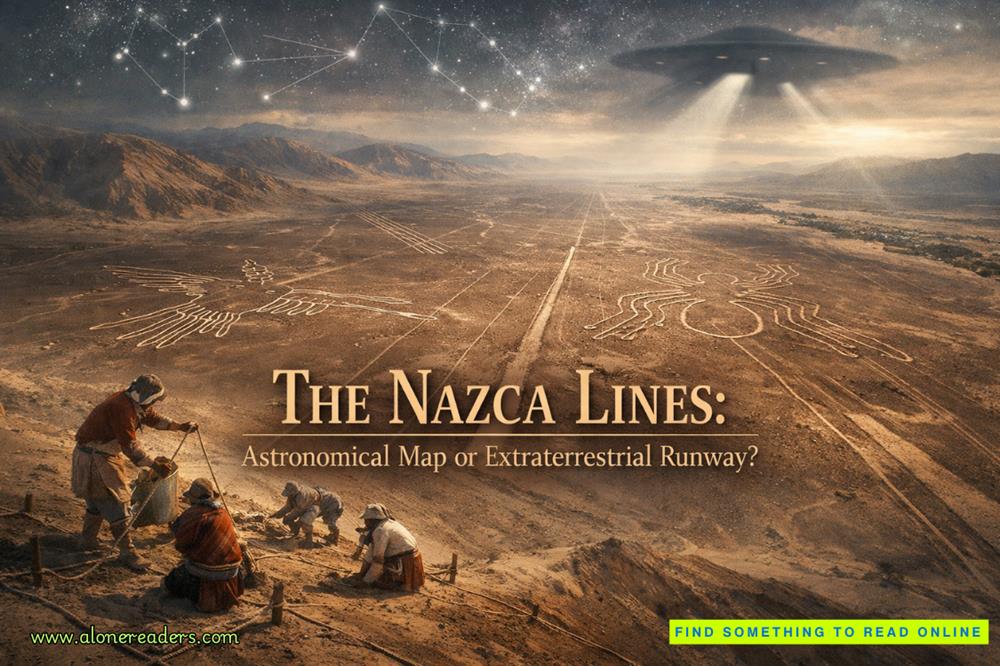
Stretching across the arid plains of southern Peru, the Nazca Lines stand as one of humanity’s most perplexing and evocative archaeological legacies. Carved into the desert surface between roughly 500 BCE and 500 CE, these immense geoglyphs include straight lines extending for kilometers, precise geometric shapes, and stylized figures of animals, plants, and humanoid forms. What makes them extraordinary is not merely their scale, but the fact that their full shapes are best appreciated from the air, a perspective seemingly unavailable to the people who created them. This paradox has fueled decades of debate, speculation, and fascination, giving rise to one of the most enduring questions in historical mystery studies: were the Nazca Lines a sophisticated astronomical map, or could they represent something far more controversial—an extraterrestrial runway?
At first encounter, the Nazca Lines challenge conventional assumptions about ancient societies. The Nazca culture possessed no known written language, no metal tools, and no evidence of flight technology, yet they engineered designs with remarkable precision across a harsh desert landscape. The desert’s unique climate, with minimal rainfall and stable winds, preserved these markings for centuries, allowing modern observers to witness an almost untouched record of ancient intention. This preservation has also meant that the lines appear uncannily deliberate, amplifying the sense that they served a purpose far beyond simple decoration.
One of the earliest serious scholarly interpretations framed the Nazca Lines as a form of astronomical or calendrical system. Proponents of this theory argue that many of the long straight lines align with the rising and setting points of the sun during solstices and equinoxes, as well as with significant stars and constellations visible in the southern hemisphere. In an agrarian society dependent on scarce water and predictable seasonal cycles, tracking celestial movements would have been a matter of survival. From this perspective, the desert became a massive, open-air observatory, where lines functioned as sightlines and markers linking the earth to the sky.
Supporters of the astronomical hypothesis point to the animal figures as symbolic representations of constellations or seasonal forces. The spider, often cited in this context, has been associated with water and fertility in Andean cosmology, while the hummingbird may symbolize rain or solar energy. The monkey, with its spiraling tail, has been interpreted as a reference to cyclical time or the Milky Way. In this reading, the Nazca Lines are not random artworks but a coherent visual language expressing cosmic order, ritual practice, and environmental knowledge encoded into the landscape itself.
Yet, this explanation is not without its critics. Statistical analyses have shown that with such a vast number of lines, some alignments with celestial events may occur by chance. Additionally, not all figures or lines correspond clearly to known astronomical phenomena. This ambiguity has left room for alternative interpretations, particularly those emphasizing ritual movement and social cohesion rather than strict astronomical measurement. According to this view, the lines were ceremonial pathways walked during processions intended to invoke rain, honor deities, or reinforce communal identity. The act of walking the lines, rather than observing them from above, may have been the central ritual function.
Despite these grounded academic explanations, the Nazca Lines entered global popular culture through a far more sensational lens. In the mid-twentieth century, writers and theorists began to suggest that the lines were created not for gods of the sky in a symbolic sense, but for beings who literally came from the heavens. The idea of the Nazca Lines as an extraterrestrial runway gained prominence through claims that the long, flat, straight lines resembled airstrips visible only from the air, supposedly designed to guide alien spacecraft to Earth.
This theory gained traction because it seemed to address the most puzzling aspect of the lines: their aerial visibility. Advocates argued that ancient humans could not have conceived designs meant to be seen from above without assistance from advanced beings. The precision, scale, and apparent lack of practical terrestrial function were presented as evidence of external influence. In this narrative, the Nazca people were either instructed by extraterrestrials or created the lines to communicate with or welcome them.
From a critical standpoint, the extraterrestrial runway theory relies heavily on modern assumptions projected backward in time. It presumes that ancient peoples lacked the intellectual or organizational capacity to design large-scale projects without modern technology. Archaeological experiments, however, have demonstrated that the Nazca Lines could be constructed using simple tools, ropes, and surveying techniques available at the time. By clearing the dark surface stones to reveal the lighter soil beneath, workers could maintain straight lines over long distances with remarkable accuracy.
Moreover, the runway hypothesis struggles with practical inconsistencies. The lines are too narrow and fragile to support the landing of any known aircraft, terrestrial or otherwise. Many lines intersect, change direction abruptly, or end at hillsides, features incompatible with functional runways. Animal and geometric figures further complicate the idea, as they serve no obvious navigational purpose for landing craft. These issues suggest that the extraterrestrial explanation, while compelling as a narrative, lacks empirical grounding.
Still, the persistence of the alien theory reveals something important about modern engagement with ancient mysteries. The Nazca Lines exist at the intersection of archaeology, imagination, and cultural anxiety about humanity’s place in the universe. They invite speculation precisely because they challenge linear narratives of technological progress. When confronted with evidence of sophisticated planning in a society deemed “primitive” by outdated standards, some observers turn to extraordinary explanations rather than revising their assumptions about human ingenuity.
An often overlooked dimension of the Nazca Lines debate is their relationship to water, the most precious resource in the desert. Recent research has highlighted the proximity of many lines and figures to underground aquifers and ancient water systems. In this framework, the geoglyphs may represent ritual maps of water sources, designed to appease deities associated with rainfall and fertility. The desert floor thus became a sacred interface between humans, nature, and the supernatural, not a landing pad for visitors from distant stars.
This water-centric interpretation also helps explain the scale of the project. In a landscape where survival depended on collective effort and ritual assurance, monumental labor served both spiritual and social purposes. Creating the lines would have reinforced shared beliefs, coordinated labor, and symbolically asserted control over an unpredictable environment. The grandeur of the designs was not meant for human eyes alone, but for the gods believed to dwell in the sky and mountains.
What ultimately makes the Nazca Lines so enduringly fascinating is that they resist definitive interpretation. Each theory—astronomical map, ritual pathway, water symbolism, or extraterrestrial runway—reveals as much about the interpreters as about the ancient creators. Scientific explanations emphasize empirical evidence and cultural context, while speculative theories reflect modern preoccupations with space exploration and the search for non-human intelligence.
In evaluating these competing narratives, it becomes clear that the question itself may be slightly misplaced. The Nazca Lines do not need to be either an astronomical map or an alien runway to be extraordinary. Their true significance lies in their demonstration of human creativity, organization, and symbolic thought on a monumental scale. They remind us that ancient societies engaged with the cosmos, the environment, and the sacred in ways that do not always align with modern categories of science or art.
Seen through this lens, the Nazca Lines are less a riddle demanding a single solution and more a testament to humanity’s enduring impulse to inscribe meaning onto the world. Whether traced as celestial alignments, walked as sacred paths, or imagined as messages to the heavens, they continue to provoke wonder and debate. The desert of Nazca remains a vast canvas of questions, inviting each generation to reconsider not only how the lines were made, but why we are so eager to explain them in the first place.





 The Hundred Days Offensive: How the Allies Defeated Germany in World War I
 The Second Battle of the Marne: The Turning Point of World War I in 1918
 The Spring Offensive of 1918: Germany's Final Gamble to Win World War I
 The Treaty of Brest-Litovsk: How Russia Left World War I
 The Russian Revolution and World War I: How War Brought Down the Tsar
 The Zimmermann Telegram Explained: Germany's Secret Offer to Mexico in World War I