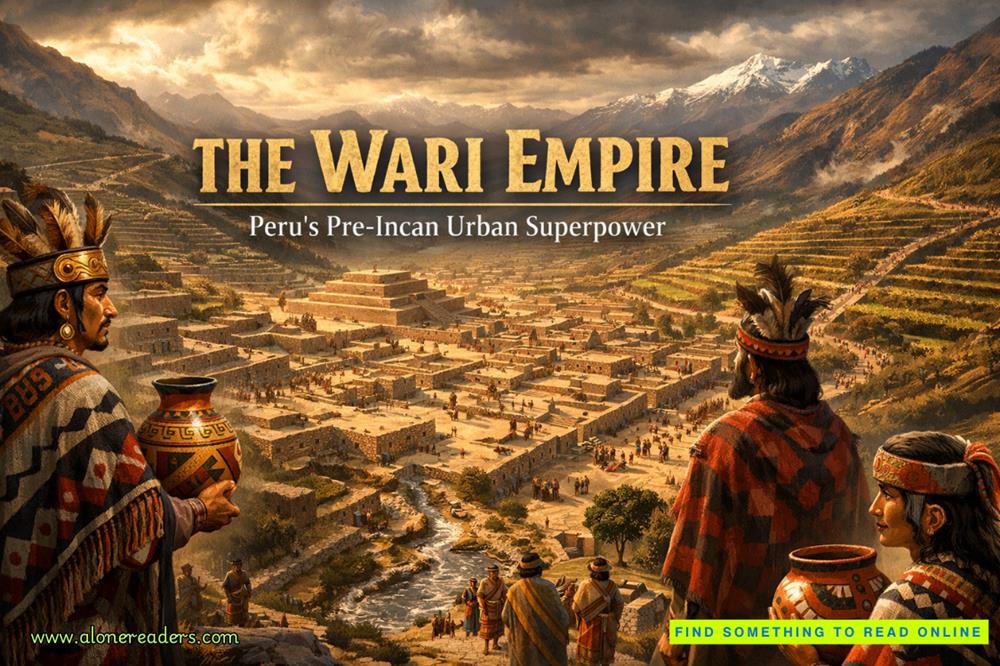
Long before the rise of the Inca, before Machu Picchu became a symbol of Andean brilliance, a powerful civilization had already mastered the art of urban planning, state governance, and imperial expansion across what is now Peru. This civilization, known as the Wari, flourished between roughly the 7th and 11th centuries CE and created what can only be described as South America’s first true urban empire. While later societies would inherit and refine many of its innovations, the Wari stand apart as pioneers who transformed scattered Andean communities into a connected, administratively controlled world.
The heart of the Wari Empire lay in the highlands of modern-day Peru, near present-day Ayacucho. From this strategically positioned core, the Wari expanded across deserts, mountains, and valleys, exerting influence over territories that stretched hundreds of kilometers. Unlike earlier cultures that relied primarily on religious influence or trade prestige, the Wari built planned cities, administrative centers, and road systems that allowed them to govern distant regions with surprising efficiency. This was not a loose cultural horizon, but a deliberate imperial project, executed with precision and long-term vision.
What distinguished the Wari most clearly from their predecessors was their understanding of cities as instruments of power. Wari urban centers were not organic settlements that grew slowly over generations. They were intentionally designed, often constructed in a short time according to standardized layouts. Rectilinear compounds, high defensive walls, restricted access points, and segmented neighborhoods all indicate a society deeply concerned with control, hierarchy, and function. These cities were not built for comfort or aesthetic pleasure alone; they were machines of governance, enforcing order and projecting authority over both local populations and visiting elites.
The Wari capital itself was immense by ancient Andean standards, covering several square kilometers and housing tens of thousands of inhabitants. Massive stone enclosures divided the city into zones that likely served administrative, ceremonial, and residential purposes. Many areas were inaccessible to ordinary people, reinforcing social stratification and elite dominance. This rigid spatial organization reflects a worldview in which power was centralized and carefully managed, rather than dispersed among independent communities.
Beyond the capital, the Wari established a network of provincial centers that mirrored the core city in both design and function. These outposts were often placed in strategically important locations, such as fertile valleys or crossroads between ecological zones. Each center acted as a node of imperial authority, overseeing agricultural production, storage, craft specialization, and local administration. Through this system, the Wari were able to extract resources, redistribute goods, and maintain loyalty across vast distances. The empire functioned not through constant warfare alone, but through bureaucratic presence and logistical mastery.
Agriculture formed the economic backbone of Wari power, yet farming in the Andes was never simple. The Wari responded to environmental challenges with remarkable ingenuity, expanding terraced agriculture and irrigation systems that maximized productivity in harsh landscapes. By controlling access to water, land, and stored food, the state reinforced its authority over both rural farmers and urban populations. Food was not merely sustenance; it was a political tool, used to reward compliance and stabilize the empire during times of stress.
Equally significant was the Wari mastery of craft production, particularly ceramics and textiles. Wari pottery is instantly recognizable for its bold geometric patterns, abstract faces, and standardized forms. These were not individual artistic expressions, but state-sponsored visual language, designed to communicate imperial identity wherever Wari influence reached. When local elites adopted Wari-style ceramics or clothing, they were not simply following fashion; they were signaling allegiance to imperial power.
Textiles, in particular, held immense ideological importance. In the Andes, cloth was more valuable than gold, and the Wari invested heavily in textile production as a marker of status and authority. Elite garments featured complex patterns that likely conveyed rank, role, and religious meaning. By controlling the production and distribution of such items, the Wari reinforced social hierarchy and ensured that power was visible, wearable, and unmistakable.
Religion under the Wari was closely intertwined with state authority. Rather than relying on numerous local cults, the Wari promoted a standardized religious iconography centered on powerful deities associated with order, fertility, and cosmic balance. Religious imagery appeared consistently across ceramics, architecture, and ritual objects, suggesting an intentional effort to unify belief systems under imperial ideology. This was not spiritual diversity, but religious integration, designed to legitimize rule and suppress dissent.
Wari religious practice also reveals a darker side of imperial control. Archaeological evidence indicates ritual feasting, controlled access to sacred spaces, and possibly even human sacrifice in certain contexts. These acts were not random brutality, but carefully staged demonstrations of power, reminding participants of the state’s connection to divine forces. Through ritual, the Wari transformed obedience into sacred duty.
One of the most enduring Wari legacies lies in their transportation infrastructure. Long before the Inca road system astonished Spanish chroniclers, the Wari had already begun connecting the Andes through an extensive network of roads and waystations. These routes facilitated troop movements, trade, communication, and administrative oversight. The later Inca would expand and refine this system, but the conceptual foundation belonged to the Wari. Empire, they understood, could not exist without controlled movement and rapid communication.
Despite their sophistication, the Wari Empire was not eternal. Around the 11th century, the system began to unravel. Climatic instability, prolonged droughts, and internal stresses likely strained agricultural production and weakened state authority. As central control faltered, provincial centers were abandoned or repurposed, and populations dispersed into smaller, more localized communities. Unlike the dramatic collapse narratives often imposed on ancient civilizations, the Wari decline appears to have been gradual and complex, shaped by environmental and social factors rather than sudden catastrophe.
What makes the Wari particularly fascinating is not just their rise and fall, but their quiet influence on everything that followed. Many elements commonly associated with the Inca—administrative centers, road networks, state-controlled storage, and ideological integration—were first tested and proven by the Wari. The Inca did not emerge from a vacuum; they inherited a landscape already shaped by centuries of imperial experimentation. In many ways, the Wari were the architects of Andean empire, even if history later credited others with the final masterpiece.
The relative obscurity of the Wari in popular history is not a reflection of their importance, but of narrative bias. Stone cities like Machu Picchu survived in dramatic mountain settings, while Wari centers were often dismantled, reused, or buried beneath later settlements. Without monumental ruins preserved in postcards and tourist routes, the Wari faded from public memory. Yet archaeology continues to reveal a civilization of astonishing complexity, one that forces us to reconsider how early, how advanced, and how deliberate imperial systems in the Americas truly were.
To understand the Wari is to confront a powerful truth about ancient history: urbanism, bureaucracy, and empire are not exclusive to the Old World. In the highlands of Peru, centuries before European contact, a civilization arose that understood governance not as tribal dominance, but as structured administration across space, people, and resources. The Wari Empire stands as a testament to human ingenuity and ambition, a forgotten superpower whose influence still echoes through the Andes, embedded in roads, fields, and ideas that shaped the civilizations that followed.




 The Hundred Days Offensive: How the Allies Defeated Germany in World War I
 The Second Battle of the Marne: The Turning Point of World War I in 1918
 The Spring Offensive of 1918: Germany's Final Gamble to Win World War I
 The Treaty of Brest-Litovsk: How Russia Left World War I
 The Russian Revolution and World War I: How War Brought Down the Tsar
 The Zimmermann Telegram Explained: Germany's Secret Offer to Mexico in World War I