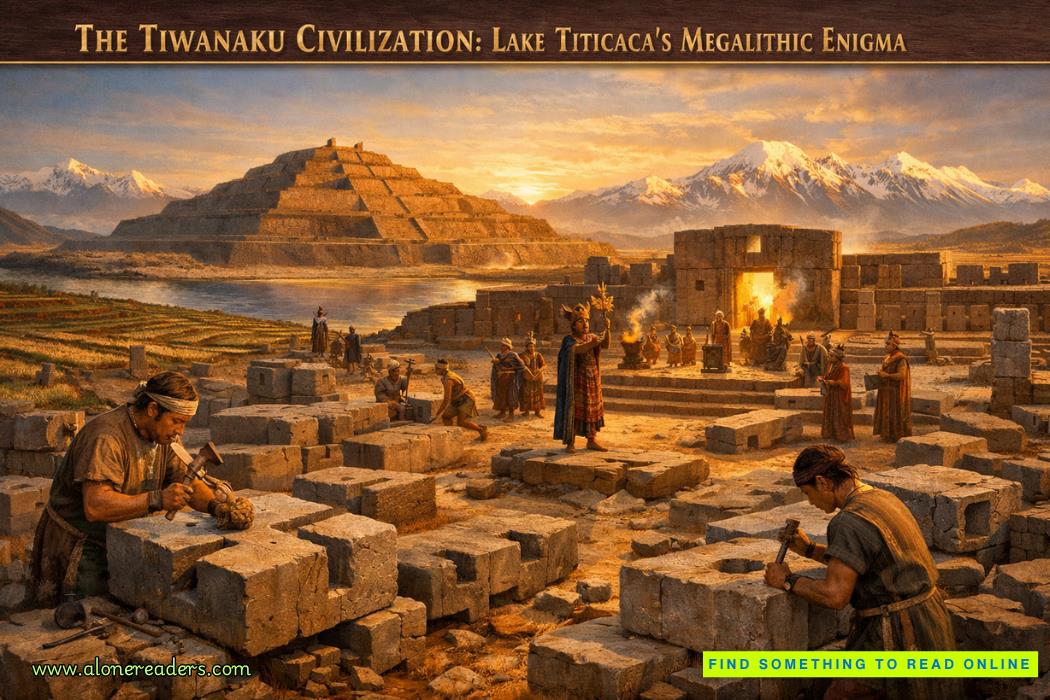
The windswept plateau south of Lake Titicaca, sitting nearly 4,000 meters above sea level, is an environment that appears hostile to urban life even today. Thin air, intense solar radiation, freezing nights, and seasonal droughts define this stark landscape. Yet more than a millennium ago, a powerful civilization flourished here, building monumental stone complexes, organizing vast agricultural systems, and projecting cultural influence across much of the central Andes. This was Tiwanaku, a society whose achievements challenge assumptions about technological development, environmental adaptation, and the diversity of pathways to urban civilization.
Unlike civilizations that rose along fertile river valleys, Tiwanaku emerged in what appears to be an ecological marginal zone. Its success depended not on conquering nature but on engineering an entirely new relationship with it. Archaeological evidence shows that by around 500 CE, Tiwanaku had developed into a planned urban center, with ceremonial architecture carefully aligned to astronomical events and surrounding mountains, which were understood as sacred beings. The city was not chaotic growth but a deliberate construction of cosmology in stone.
At the heart of Tiwanaku lay a sacred precinct dominated by massive platforms, sunken courts, and monolithic gateways. The Akapana Pyramid, a seven-tiered earthen and stone structure, was less a tomb than a ritual mountain, echoing the Andean belief that human-built landscapes should replicate divine geography. Water channels built into its structure directed rainfall through the monument in controlled flows, transforming storms into ceremonial performances. This fusion of hydraulics and symbolism reveals a worldview in which engineering was inseparable from theology.
Perhaps the most iconic artifact of Tiwanaku ideology is the Gateway of the Sun, a single andesite block weighing more than 10 tons, intricately carved with a central staff-bearing deity surrounded by rows of winged attendants. The precision of the carving, combined with the monument’s astronomical alignment, suggests it functioned as both a calendrical device and a theological statement. The imagery expresses a cosmology centered on cyclical time, agricultural renewal, and divine mediation between heaven and earth.
Nearby, the site of Puma Punku has fueled fascination for generations. Its enormous stone blocks—some exceeding 100 tons—are shaped with astonishing geometric precision, including right angles, drilled holes, and interlocking joints. These stones were transported from quarries kilometers away without the use of draft animals or wheeled vehicles. Experimental archaeology indicates that collective labor, rope systems, ramps, and extraordinary logistical organization made this possible. What appears miraculous is instead evidence of social coordination on a massive scale.
Tiwanaku’s power did not depend solely on monumentality. Its true foundation was agricultural innovation tailored to the extreme altiplano climate. Farmers constructed vast networks of raised fields known as suka kollus, elevated planting platforms separated by water-filled canals. These canals acted as thermal regulators, absorbing heat during the day and releasing it at night, protecting crops from frost. This system created a microclimate capable of sustaining reliable harvests of potatoes, quinoa, and other Andean staples.
The scale of this engineered landscape was immense, covering tens of thousands of hectares. Such productivity supported not only urban populations but also regional integration through surplus redistribution. Tiwanaku functioned as a hub in a network of colonies and allied communities stretching into present-day Peru, Bolivia, Chile, and Argentina. Rather than ruling through militaristic conquest, it appears to have expanded via ritual authority, economic exchange, and ideological prestige.
Material culture reinforces this interpretation. Tiwanaku-style ceramics, textiles, and religious imagery appear across distant settlements, often without evidence of warfare. Standardized iconography—particularly depictions of the Staff God—suggests a shared symbolic system binding these regions together. Pilgrimage likely played a central role, drawing participants to the monumental core where ceremonies reaffirmed cosmic order and political alliances simultaneously.
Urban design at Tiwanaku reveals an unusual social logic. Residential areas show relatively little evidence of stark inequality compared to other ancient cities. Elite and commoner spaces were differentiated, yet not to extremes seen in Mesopotamia or Mesoamerica. This has led scholars to propose that Tiwanaku operated as a corporate or collective state, where authority was embedded in institutions and ritual practice rather than concentrated in a single divine king.
Stone itself became a medium of ideology. Monoliths carved in human form, some over seven meters tall, depict elaborately dressed figures holding ceremonial objects. These are not portraits of individuals but embodiments of ancestral authority. Their placement within plazas created a perpetual audience of sacred witnesses, reinforcing continuity between past and present. In Tiwanaku thought, legitimacy derived from ancestry and cosmological balance rather than dynastic personality.
The city’s relationship with Lake Titicaca was equally symbolic and practical. The lake, one of the highest navigable bodies of water on Earth, functioned as both transportation corridor and mythological origin point. Andean traditions later recorded by the Inca describe humanity emerging from these waters. Tiwanaku likely cultivated similar origin narratives, positioning itself as a sacred axis mundi—a center where creation was continually renewed.
Despite its achievements, Tiwanaku did not endure indefinitely. Around 1000 CE, the system began to fragment. Paleoclimatic data indicate a prolonged drought that lowered Lake Titicaca’s level and disrupted the delicate hydrological balance sustaining raised-field agriculture. Without reliable harvests, the redistributive economy faltered. Ritual authority, once anchored in abundance, lost credibility.
Archaeological layers from the city’s final phases show signs not of violent destruction but gradual abandonment. Monuments were left incomplete, construction ceased, and populations dispersed into smaller regional communities. Tiwanaku’s decline illustrates a critical vulnerability of highly engineered environments: when climatic thresholds are crossed, the very systems that enabled success can accelerate collapse.
Yet Tiwanaku did not vanish culturally. Its architectural forms, agricultural knowledge, and religious symbols influenced later Andean civilizations, including the Inca, who regarded the ruins as works of ancient giants. Inca masonry techniques, sacred landscape planning, and state ritualism all echo precedents established centuries earlier at Tiwanaku.
Modern archaeology continues to revise understanding of this civilization. Remote sensing, geoarchaeology, and experimental reconstructions reveal an adaptive society of remarkable resilience and organizational sophistication. The once-popular myths attributing Puma Punku’s construction to lost super-technologies have been replaced by evidence of human ingenuity operating within collective social frameworks.
Tiwanaku stands today not merely as a set of ruins but as testimony to alternative models of civilization. It demonstrates that urbanism can arise without intensive warfare, that political cohesion can be maintained through shared cosmology, and that environmental extremes can be transformed into productive landscapes through deep ecological knowledge.
In the broader narrative of world history, Tiwanaku challenges linear assumptions about progress radiating outward from a few “cradles” of civilization. High in the Andes, far from the classical centers of Eurasia, a society independently developed monumental architecture, complex agriculture, and expansive cultural integration. Its story reminds us that civilization is not a single trajectory but a constellation of human experiments—some enduring, others fading, all contributing to the mosaic of our past.
Today, as climate change forces modern societies to rethink sustainability, Tiwanaku’s legacy feels newly relevant. Its raised fields, water management systems, and integration of environment with belief represent not relics of a vanished age but lessons in resilience, cooperation, and ecological intelligence. The stones of Tiwanaku remain silent, but they continue to ask a question that resonates across centuries: how can human societies thrive in harmony with the most challenging landscapes on Earth?



 The Hundred Days Offensive: How the Allies Defeated Germany in World War I
 The Second Battle of the Marne: The Turning Point of World War I in 1918
 The Spring Offensive of 1918: Germany's Final Gamble to Win World War I
 The Treaty of Brest-Litovsk: How Russia Left World War I
 The Russian Revolution and World War I: How War Brought Down the Tsar
 The Zimmermann Telegram Explained: Germany's Secret Offer to Mexico in World War I