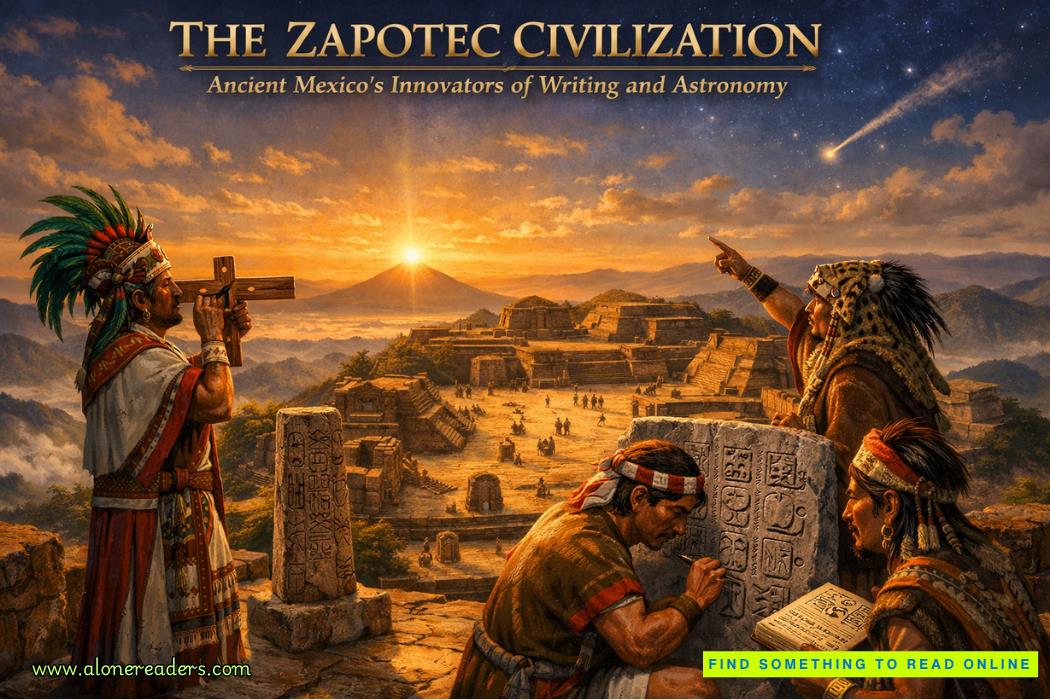
The story of the Zapotec civilization is one of the most remarkable yet often overlooked chapters in the history of ancient Mesoamerica. Long before the rise of the Aztec Empire and even predating many of the Classic Maya achievements, the Zapotec people developed a complex society defined by intellectual ambition, urban engineering, and scientific curiosity. Flourishing in the Valley of Oaxaca in southern Mexico from around 500 BCE, they established one of the earliest true civilizations in the region, complete with monumental architecture, an organized state, and what is widely considered one of the earliest writing systems in the Americas.
At the center of Zapotec achievement stood the extraordinary city of Monte Albán, a mountaintop capital unlike any other in the ancient world. Rather than growing organically from a village, Monte Albán was deliberately constructed as a political and ceremonial center, an act of urban planning that signals the emergence of state-level organization. The city was founded atop a flattened ridge overlooking three converging valleys, a location chosen not for agriculture or water access, but for visibility and control. This decision reveals a civilization already thinking in terms of governance, symbolism, and regional integration.
Monte Albán’s skyline of terraces, pyramidal platforms, and expansive plazas was engineered through immense labor. Entire hilltops were reshaped to create level surfaces, demonstrating a mastery of landscape modification centuries ahead of comparable projects elsewhere in the Americas. The city functioned not only as a political capital but also as a sacred observatory, administrative hub, and symbol of Zapotec unity. From this elevated seat of power, rulers could literally and figuratively look down upon the surrounding communities they governed.
What truly distinguishes the Zapotec civilization, however, is its early development of writing. Carved stone monuments known today as the “Danzantes” depict figures accompanied by glyphic inscriptions that record names, events, and possibly conquests. These inscriptions date to centuries before the flowering of Maya hieroglyphics, making Zapotec writing among the oldest in the Western Hemisphere. Though not yet fully deciphered, the system clearly functioned as a tool of political record-keeping and identity, suggesting an administration concerned with lineage, authority, and historical memory.
Writing allowed the Zapotec elite to formalize governance in ways that transcended oral tradition. By recording events permanently in stone, they created a shared historical consciousness, reinforcing legitimacy across generations. This innovation reflects a society already grappling with bureaucracy, diplomacy, and the challenges of ruling a multi-community state. The Zapotec were not merely builders of monuments; they were architects of institutional continuity.
Their intellectual pursuits extended beyond writing into the realm of astronomy. Like other Mesoamerican cultures, the Zapotec observed celestial movements with great precision, but evidence suggests they were among the earliest to integrate astronomical knowledge directly into urban design. Structures at Monte Albán align with solar and stellar cycles, indicating that the city itself functioned as a cosmological instrument. These alignments were not decorative; they enabled the tracking of agricultural seasons, ritual calendars, and political ceremonies tied to celestial events.
This fusion of architecture and astronomy reveals a worldview in which the heavens and the state were inseparable. Zapotec rulers derived authority not only from military strength but also from their perceived role as intermediaries between cosmic order and human society. Observing the skies allowed priests and astronomers to predict seasonal change, reinforcing the belief that leadership possessed privileged knowledge of the universe’s rhythms.
Zapotec calendrical systems demonstrate a sophisticated understanding of cyclical time, echoing patterns later seen in Maya and other Mesoamerican cultures. Their use of ritual calendars intertwined with solar reckoning suggests they contributed foundational concepts that spread across the region through trade and cultural exchange. In this sense, the Zapotec were not isolated innovators but intellectual catalysts whose ideas influenced neighboring civilizations.
Economically, the Zapotec civilization thrived through strategic control of trade routes linking the highlands of Oaxaca with the Gulf Coast and central Mexico. Goods such as obsidian, jade, shells, and ceramics moved through Zapotec territory, enriching Monte Albán and reinforcing its status as a regional power. The city functioned as both marketplace and administrative center, coordinating economic relationships among diverse communities.
Zapotec artisans produced finely crafted pottery, urns, and funerary objects distinguished by stylized human figures and symbolic motifs. These objects reveal a culture deeply invested in ancestry and ritual continuity. Tombs beneath elite residences contained elaborate offerings, demonstrating beliefs in an afterlife that mirrored social hierarchies. Such practices reinforced status while also anchoring political authority in sacred tradition.
Social organization within Zapotec society appears to have been highly stratified. At the top stood ruling elites and priestly specialists who oversaw rituals, writing, and astronomical observation. Below them were artisans, traders, farmers, and laborers who sustained the urban center. This hierarchy was visually encoded into the city’s layout, with elite residences occupying prominent terraces while common populations lived on surrounding slopes and valleys. The spatial arrangement itself communicated a carefully structured social order.
Unlike some contemporaneous civilizations defined primarily by warfare, the Zapotec appear to have balanced military expansion with diplomatic integration. Inscriptions and archaeological evidence suggest they established influence over surrounding regions through a combination of alliances, colonization, and symbolic authority. Monte Albán became a magnet for cultural convergence, drawing in populations who adopted Zapotec customs while maintaining local identities.
The civilization’s longevity is particularly striking. Monte Albán remained a dominant center for more than a millennium, evolving through multiple phases rather than collapsing abruptly. Over time, political power decentralized, and new regional centers emerged, yet Zapotec culture persisted, adapting rather than disappearing. This resilience underscores a capacity for cultural transformation rather than rigid dependence on a single ruling structure.
Even as Monte Albán declined around the eighth century CE, Zapotec communities continued to thrive in other parts of Oaxaca, maintaining language, traditions, and governance models that survive to this day. Unlike many ancient civilizations known only through ruins, the Zapotec legacy lives on in modern Indigenous populations who trace linguistic and cultural continuity back thousands of years.
One of the most compelling aspects of Zapotec history is how it challenges long-held assumptions about the development of civilization in the Americas. For decades, scholarly focus centered heavily on the Maya and Aztec, often overlooking earlier societies that laid the groundwork for later achievements. The Zapotec demonstrate that urbanism, literacy, and scientific observation emerged in multiple centers simultaneously, reflecting a richly interconnected intellectual landscape.
Their achievements also complicate the narrative that technological innovation must follow Old World trajectories. Without metal tools, draft animals, or wheeled transport, Zapotec engineers reshaped mountains, constructed monumental architecture, and sustained a capital city for centuries. Their accomplishments illustrate that complex civilization can arise through entirely different technological pathways when guided by social organization and environmental adaptation.
Religious life among the Zapotec intertwined with natural forces such as rain, lightning, and fertility, reflecting dependence on seasonal agriculture. Yet these beliefs were expressed through a refined symbolic system, visible in carved monuments, temple layouts, and burial practices. Ritual spaces at Monte Albán were carefully designed to channel movement, sound, and visual focus, creating an immersive sacred environment that reinforced cosmological beliefs.
Archaeological discoveries continue to reshape understanding of Zapotec innovation. Excavations reveal residential compounds with drainage systems, planned streets, and defensive features, indicating a high level of civic engineering. These findings support the interpretation of Monte Albán not merely as a ceremonial center but as a fully functioning metropolis with administrative complexity comparable to ancient cities elsewhere in the world.
The study of Zapotec glyphs remains an active field, offering tantalizing glimpses into political narratives still locked within stone inscriptions. Each undeciphered sign represents a fragment of history waiting to be understood, a reminder that the intellectual world of the Zapotec is only partially recovered. As research progresses, scholars increasingly recognize their writing system as a foundational stage in the evolution of Mesoamerican literacy.
Today, the ruins of Monte Albán stand as silent testimony to this civilization’s ambition. From its terraces, one can still observe the same celestial horizons studied by Zapotec astronomers over two millennia ago. The alignment of structures with solstices and equinoxes continues to function, bridging ancient knowledge and modern observation in a powerful demonstration of enduring scientific insight.
Ultimately, the Zapotec civilization represents far more than an archaeological curiosity. It embodies one of humanity’s earliest experiments in combining political organization, written communication, and astronomical science into a unified cultural system. Their legacy reminds us that innovation is not confined to the most famous empires but often begins in places later overshadowed by history.
By recovering the story of the Zapotec, we gain a clearer understanding of how knowledge systems evolve, how cities become instruments of both governance and cosmology, and how intellectual traditions can endure across thousands of years. In the valleys and mountains of Oaxaca, an ancient people carved their understanding of the universe into stone, aligning earth with sky and memory with monument, leaving behind a civilization that was not forgotten—but simply waiting to be rediscovered.



 The Hundred Days Offensive: How the Allies Defeated Germany in World War I
 The Second Battle of the Marne: The Turning Point of World War I in 1918
 The Spring Offensive of 1918: Germany's Final Gamble to Win World War I
 The Treaty of Brest-Litovsk: How Russia Left World War I
 The Russian Revolution and World War I: How War Brought Down the Tsar
 The Zimmermann Telegram Explained: Germany's Secret Offer to Mexico in World War I










