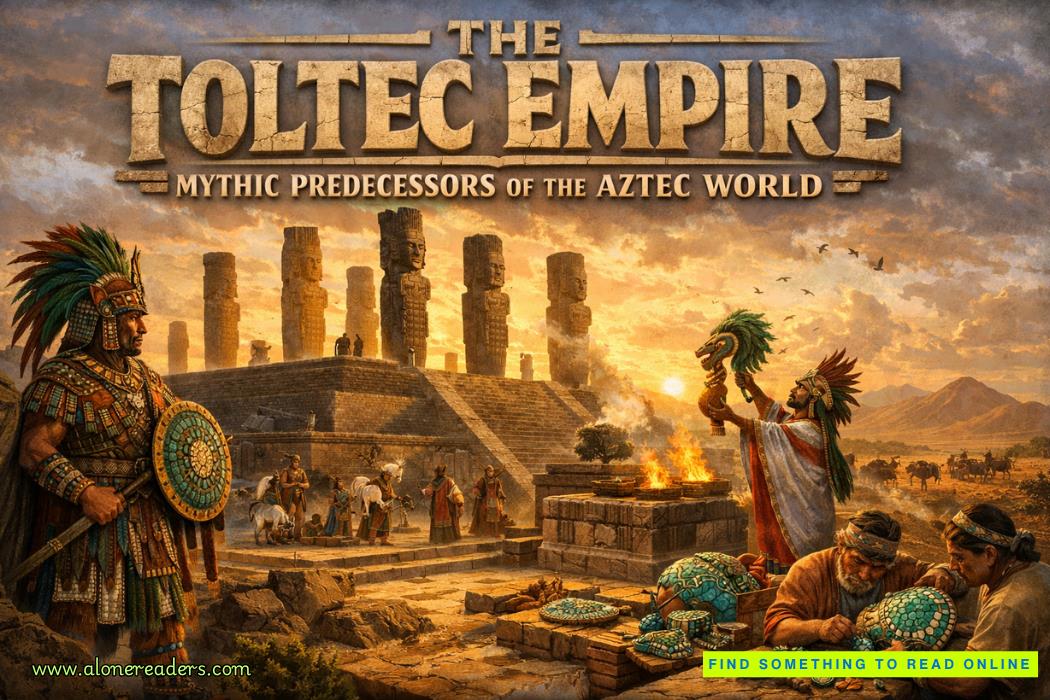
The story of the Toltecs exists at a fascinating intersection of archaeology and legend, where hard evidence and mythological memory intertwine so tightly that separating them becomes nearly impossible. To later civilizations of central Mexico—especially the Aztecs—the Toltecs were not merely predecessors; they were the very definition of civilization itself. In the Nahuatl language, the word “Toltec” eventually came to mean artist, craftsman, or cultured person, suggesting that their identity transcended ethnicity and became synonymous with refinement, knowledge, and authority.
Emerging in the centuries following the collapse of Teotihuacan around the 7th century CE, the Toltecs rose during a period of fragmentation across the central Mexican plateau. Teotihuacan’s fall had left behind abandoned urban systems, disrupted trade networks, and competing regional polities struggling to assert control. Into this vacuum stepped new groups who would reshape the political and cultural landscape. Among them, the people who built their capital at Tollan—modern-day Tula—constructed what would later be remembered as the first great militarized state of Postclassic Mesoamerica.
Unlike Teotihuacan, whose influence was largely commercial and symbolic, the Toltec order appears to have been explicitly martial. Archaeological remains at Tula reveal colonnaded halls decorated with reliefs of marching warriors, jaguars, and eagles consuming human hearts. These were not decorative fantasies but ideological statements. The Toltec state fused political authority with sacred warfare, developing a model that the Aztecs would later emulate with remarkable fidelity.
At the heart of this civilization stood Tula itself, a city strategically positioned along trade corridors linking northern desert cultures with the fertile Basin of Mexico and the Gulf Coast. Its urban layout reflects both continuity and innovation: pyramids and ceremonial plazas echo earlier Mesoamerican traditions, yet the presence of large assembly spaces and warrior imagery suggests a society organized around collective militaristic identity rather than purely theocratic rule. The city was not as massive as Teotihuacan, but its symbolism proved far more enduring.
The most iconic features of Tula are the so-called Atlantean statues—towering basalt columns carved in the form of armed warriors. These monumental figures, standing atop Pyramid B, portray individuals wearing butterfly-shaped breastplates, feathered headdresses, and atlatls, or spear-throwers. They represent not gods, but deified soldiers, signaling a worldview in which martial excellence itself carried divine sanction. In this sense, the Toltecs redefined sacred authority: power was no longer only inherited through priestly lineage but could be achieved through conquest and discipline.
Toltec society appears to have been highly stratified, yet also dynamic. Elite lineages controlled religious rites and long-distance trade, while warrior orders enforced tribute relationships across neighboring regions. Evidence of Toltec-style architecture and iconography has been found far beyond Tula, including at Chichén Itzá in the northern Yucatán. This has led scholars to debate whether the Toltecs established an actual empire or whether their influence spread through prestige emulation, trade alliances, and migrating warrior bands. Regardless of mechanism, their cultural fingerprint became unmistakable across Mesoamerica.
Central to Toltec identity was the cult of Quetzalcoatl, the Feathered Serpent, a deity already ancient by Toltec times but transformed under their theological system. In Toltec narratives, Quetzalcoatl was not merely a god but also a legendary ruler—Topiltzin Quetzalcoatl—who embodied wisdom, restraint, and artistic patronage. His story, preserved in later Aztec chronicles, tells of a golden age disrupted by rival factions advocating more aggressive ritual practices. Whether this figure represents an actual historical king later mythologized remains uncertain, yet his narrative reflects a society grappling with the balance between spirituality and militarism.
The Toltec religious system combined inherited cosmology with innovations emphasizing sacrifice as a sustaining force of the universe. Chacmool sculptures—reclining figures holding offering vessels—appear prominently in Toltec contexts and likely served as receptacles for human hearts or other ritual gifts. These images signal a transformation toward institutionalized sacrificial ideology, one that the Aztecs would adopt on a far larger scale.
Economically, the Toltecs thrived on their ability to control exchange networks connecting turquoise mines of the north, obsidian workshops of central Mexico, and tropical goods such as cacao, feathers, and jade from the south. Artisans at Tula produced fine metalwork, shell ornaments, and intricate mosaics, reinforcing the association between Toltec identity and master craftsmanship. Their cultural prestige was so strong that centuries later, Aztec elites would claim descent from Toltec artisans to legitimize their own authority.
Yet the Toltec world was never as stable as later mythology suggested. Archaeological layers at Tula show signs of burning, restructuring, and eventual abandonment around the 12th century. Climatic fluctuations, internal rebellion, and shifting trade routes may all have contributed to its decline. Unlike Teotihuacan, which vanished into relative obscurity, the memory of Tollan was deliberately preserved and reshaped by successor societies.
For the Aztecs, who arrived in the Basin of Mexico generations later as migrants seeking legitimacy, the Toltecs became a model civilization to emulate. Aztec rulers styled themselves as inheritors of Toltec wisdom, commissioning histories that portrayed Tollan as the cradle of law, art, and sacred kingship. To be called a Toltec was the highest cultural compliment. This deliberate mythologization transformed the Toltecs into something larger than history—a civilizational archetype.
Modern archaeology has complicated this inherited narrative. Excavations reveal that the Toltec state was likely smaller and more regionally constrained than Aztec stories suggested. Rather than ruling a vast empire, Tula may have functioned as a dominant city-state within a network of interacting polities. Still, its ideological innovations—warrior symbolism, sacred rulership, and prestige-based expansion—proved transformative enough to shape centuries of political development.
The ambiguity surrounding the Toltecs highlights a broader methodological challenge in Mesoamerican studies: the blending of oral tradition with material evidence. Unlike cultures with extensive written archives, Toltec history survives largely through later Aztec accounts filtered by conquest-era Spanish chroniclers. These sources must be read critically, recognizing both their historical kernels and their political agendas.
Despite these uncertainties, the Toltecs occupy a crucial transitional role. They linked the Classic-era urban traditions of Teotihuacan with the militarized imperialism of the Aztecs, creating a bridge between two radically different forms of civilization. Their society reoriented central Mexican culture toward expansion, ideological warfare, and the elevation of artistry as a marker of legitimacy.
Environmental adaptation also played a role in shaping Toltec identity. Tula’s semi-arid surroundings demanded careful water management and agricultural planning, reinforcing communal organization and perhaps contributing to its disciplined social order. The ability to sustain an urban center in such a landscape underscored their reputation as skilled planners and builders.
Toltec artistic expression further reveals a worldview centered on duality: refinement paired with violence, spirituality with conquest. Relief carvings juxtapose delicate feather motifs with stark images of skeletal warriors, suggesting an understanding of life as a balance between creation and destruction. This philosophical tension later permeated Aztec cosmology, where the universe itself required continual renewal through sacrifice.
Even in their decline, the Toltecs influenced migration patterns and cultural memory across northern and central Mexico. Groups moving into the region carried fragments of Toltec symbolism, embedding them into new political identities. In this way, Toltec civilization did not disappear so much as dissolve into the cultural bloodstream of Mesoamerica.
Today, the ruins of Tula stand quieter than the grand ceremonial centers of other ancient cultures, yet their importance lies not in scale but in legacy. They represent a moment when political authority, artistic mastery, and mythic storytelling fused into a durable cultural template. The Toltecs were remembered not simply because they existed, but because later civilizations needed them to have existed as a source of origin and validation.
Understanding the Toltecs, therefore, requires accepting their dual nature. They were both a historical society rooted in a specific time and place and a symbolic civilization constructed by those who followed. Their reality can be traced through stone columns, trade goods, and settlement patterns, while their mythic image lives on in stories of wise kings, sacred serpents, and golden ages lost to time.
In this fusion of fact and legend lies their enduring fascination. The Toltecs remind us that civilizations are remembered not only for what they build, but for how their successors reinterpret them. As predecessors of the Aztec world, they became the intellectual and spiritual scaffolding upon which one of the most powerful societies of pre-Columbian America would rise.
Their legacy is thus neither wholly archaeological nor entirely mythical. It is a layered inheritance, shaped by memory, politics, and identity—a testament to how cultures construct the past to define their future.



 The Hundred Days Offensive: How the Allies Defeated Germany in World War I
 The Second Battle of the Marne: The Turning Point of World War I in 1918
 The Spring Offensive of 1918: Germany's Final Gamble to Win World War I
 The Treaty of Brest-Litovsk: How Russia Left World War I
 The Russian Revolution and World War I: How War Brought Down the Tsar
 The Zimmermann Telegram Explained: Germany's Secret Offer to Mexico in World War I










