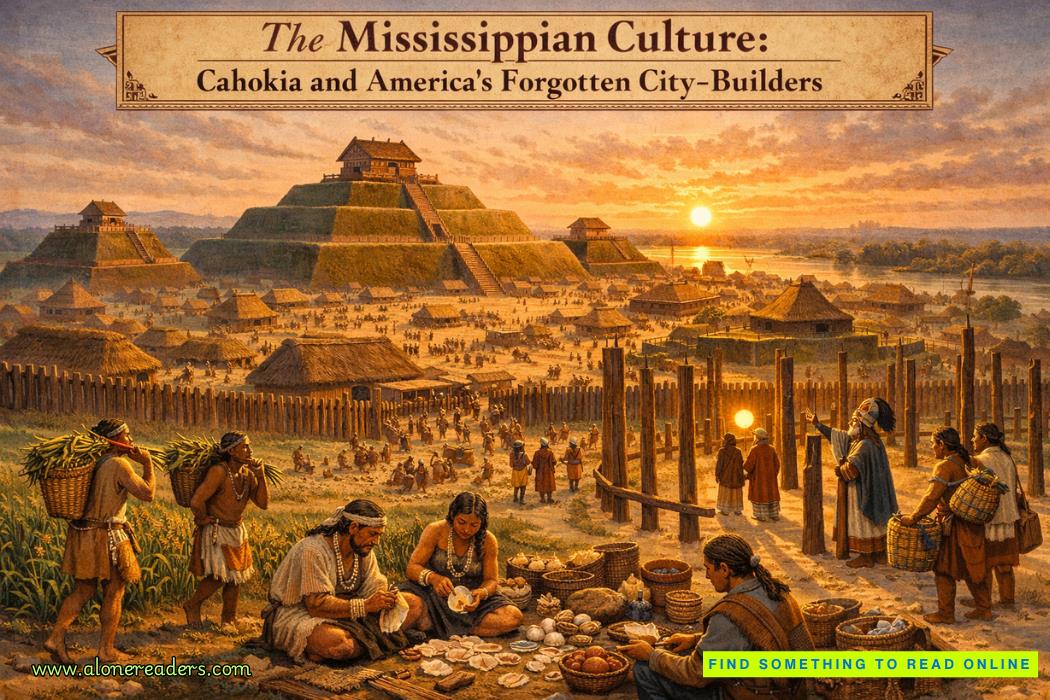
Long before European ships appeared on the Atlantic horizon, long before the rise of colonial towns, North America already possessed cities. Among the most remarkable was Cahokia, the heart of what archaeologists call the Mississippian culture, a civilization that flourished between roughly 800 and 1350 CE across the river valleys of the American Midwest and Southeast. This was not a scattering of primitive villages but a complex, hierarchical society capable of reshaping landscapes, organizing mass labor, and sustaining dense urban populations. Cahokia was, for a time, the largest city north of Mesoamerica, rivaling medieval London in scale and influence, yet its story remains largely absent from popular memory.
The Mississippian world emerged gradually from earlier Woodland traditions, but by the 9th century it had transformed into something far more structured and expansive. Communities began reorganizing around ceremonial centers marked by flat-topped earthen mounds, which served as platforms for temples, council houses, and elite residences. These were not random constructions; they reflected carefully planned civic landscapes, laid out with plazas, avenues, and symbolic alignments to celestial events. At Cahokia, located near present-day St. Louis, this transformation reached its most dramatic expression. The city’s planners engineered an environment that fused political authority, religious cosmology, and economic production into a unified urban system.
At its height around 1050–1200 CE, Cahokia covered nearly six square miles and supported a population estimated between 10,000 and 20,000 inhabitants, with many more living in surrounding satellite communities. This population density required not only agricultural surplus but administrative coordination. The people cultivated maize intensively, along with beans, squash, and native seed crops, using fertile floodplains to generate reliable yields. Maize agriculture was the engine of Mississippian expansion, allowing leaders to accumulate surplus, sponsor construction projects, and maintain social hierarchies. Food production was not merely subsistence; it was the foundation of political power.
Dominating the city skyline was Monk’s Mound, an immense earthen structure rising over 30 meters high and covering more than 14 acres at its base. Built in stages with millions of basket-loads of soil, it remains the largest prehistoric earthwork in the Americas. The mound’s summit supported a massive building, likely the residence of Cahokia’s paramount leader. From this elevated vantage point, authority was both literal and symbolic: power was meant to be seen. The physical act of building such monuments reinforced communal identity while simultaneously expressing elite control over labor and ritual.
The layout of Cahokia reveals a striking degree of urban planning. A grand central plaza, larger than many modern civic squares, served as the focal point for gatherings, ceremonies, and markets. Surrounding this space were more than one hundred mounds, each associated with specific functions—burial, administration, or ritual performance. Residential districts extended outward in organized neighborhoods, connected by causeways and open spaces that regulated movement and visibility. This was not accidental growth but intentional city-building guided by cosmological principles.
Religion infused every aspect of Mississippian life. Their worldview conceived of the universe as layered—an Upper World of celestial beings, a Middle World of human existence, and an Underworld associated with water and fertility. Cahokia’s architecture mirrored this cosmology. Mounds symbolized sacred mountains linking earth and sky, while plazas represented the ordered human realm. Even the orientation of structures aligned with solar cycles, equinoxes, and solstices. A remarkable feature known as “Woodhenge,” a circle of large wooden posts west of Monk’s Mound, functioned as a solar calendar. Observers could track seasonal changes by watching the sun rise over specific posts. Time itself was ritualized, embedding agricultural rhythms within sacred observance.
Trade networks extended Cahokia’s influence across vast distances. Archaeological evidence reveals marine shells from the Gulf Coast, copper from the Great Lakes, mica from the Appalachians, and exotic stones from distant quarries. These materials were transformed into ceremonial objects—engraved shell gorgets, copper plates, stone effigies—that circulated through elite exchange systems. Such artifacts demonstrate that Cahokia was not isolated but a hub in a continental interaction sphere. Ideas, symbols, and technologies flowed along the same routes as goods, creating what scholars term the “Southeastern Ceremonial Complex,” a shared ideological tradition spanning multiple regions.
Social organization within Mississippian communities was stratified. Elites lived atop or near mounds, while commoners resided in residential compounds of wall-trench houses arranged around courtyards. Burials reveal stark contrasts: some individuals were interred with elaborate grave goods, while others were placed in mass graves, possibly reflecting sacrificial rites or social subordination. One famous burial at Cahokia contained a high-status male laid upon a bed of shell beads arranged in the shape of a falcon, a powerful sky symbol. Such findings suggest a society deeply invested in hierarchy, symbolism, and ceremonial display.
Yet Cahokia’s rise was as dramatic as its eventual decline. By the 13th century, signs of stress began to appear. Defensive palisades were constructed around portions of the city, hinting at conflict or insecurity. Environmental pressures likely intensified as forests were cleared for fuel and construction, contributing to erosion and flooding. Climatic fluctuations associated with the Medieval Warm Period’s end may have disrupted agricultural productivity. At the same time, internal political tensions could have undermined centralized authority. Whatever the precise combination of causes, Cahokia was largely abandoned by 1350 CE, centuries before Europeans arrived to document its existence.
The disappearance of such a major urban center raises profound questions. Unlike civilizations that left written records, the Mississippians relied on oral traditions and symbolic imagery rather than alphabetic text. Their history had to be reconstructed through archaeology—soil layers, postholes, pottery fragments, and landscape modifications. This absence of written testimony contributed to their marginalization in conventional narratives of world history. For generations, scholars underestimated the scale of Indigenous North American societies, assuming they were inherently small or nomadic. Cahokia shattered those assumptions, demonstrating that urbanism was not exclusive to Eurasia or Mesoamerica.
The influence of Mississippian culture did not vanish entirely with Cahokia’s decline. Many descendant communities carried forward elements of its social organization, cosmology, and artistic expression. Later historic tribes of the Southeast, including groups encountered by early European explorers, retained practices rooted in Mississippian traditions—platform mounds, chiefly authority, and ceremonial cycles tied to agriculture. Thus, Cahokia should not be viewed as a lost anomaly but as a foundational chapter in the broader continuum of Native American history.
Modern archaeology continues to uncover new dimensions of this civilization. Remote sensing technologies, soil chemistry analysis, and geophysical surveys have revealed previously unknown neighborhoods and activity zones without disturbing the ground. These tools show that Cahokia was even more extensive and carefully managed than earlier excavations suggested. Evidence of craft specialization—potters, stoneworkers, and ritual artisans—indicates an economy capable of supporting full-time skilled labor. Such findings reinforce the understanding that this was a true city, not merely a ceremonial gathering place.
Equally significant is the recognition of Cahokia’s ecological engineering. The inhabitants reshaped wetlands, redirected water flows, and constructed terraces to stabilize soil. Their interventions reveal an advanced knowledge of landscape management, balancing agricultural needs with environmental constraints. However, these same modifications may have contributed to long-term instability, illustrating the delicate relationship between urban growth and ecological sustainability. In this sense, Cahokia’s story resonates with modern concerns about environmental impact and resilience.
Why, then, has Cahokia remained relatively obscure compared to ancient Egypt, Mesopotamia, or the Maya? Part of the answer lies in historical bias. Early European settlers encountered the remnants—towering mounds rising from the plains—but often attributed them to vanished “mound builders,” refusing to credit Indigenous peoples with such achievements. This misconception delayed serious scholarly investigation for decades. Only in the late 19th and 20th centuries did systematic archaeology begin to correct the narrative, restoring Cahokia to its rightful place as one of the great urban experiments of human history.
Today, the site stands as a UNESCO World Heritage landscape, its grassy mounds quietly preserving the memory of a once-vibrant metropolis. Visitors walking its expanse may find it difficult to imagine the bustling plazas, the smoke of cooking fires, the sound of drums echoing across the river valley. Yet beneath those fields lies the imprint of a civilization that organized labor on a monumental scale, cultivated extensive trade connections, and expressed its worldview through earth and sky alike. Cahokia reminds us that complexity is not the monopoly of any one culture or continent.
Reintegrating the Mississippian story into global history challenges long-held assumptions about the development of cities and states. It compels historians to recognize multiple pathways to urbanism, shaped by local environments, belief systems, and social innovations. Cahokia was not a derivative civilization copying others; it was an independent achievement, forged from Indigenous knowledge and collective endeavor. Its people engineered landscapes, coordinated economies, and articulated cosmologies that rivaled contemporaneous societies across the world.
The legacy of the Mississippian culture is therefore not simply archaeological—it is interpretive. It forces us to reconsider what constitutes civilization and how narratives of progress are constructed. When viewed alongside the great cities of antiquity, Cahokia stands as a testament to the diversity of human ingenuity, a reminder that history’s most remarkable achievements are sometimes hidden in plain sight, waiting to be rediscovered.
In recovering the story of Cahokia and its Mississippian builders, we do more than illuminate a forgotten past. We restore balance to the human narrative, acknowledging that North America, too, fostered monumental cities, complex societies, and enduring cultural traditions long before colonial encounters reshaped the continent. The earthen mounds rising above the Mississippi floodplain are not silent relics; they are enduring statements of identity, creativity, and resilience. They declare, across centuries, that a great city once stood there—and that its builders deserve remembrance among the architects of the ancient world.



 The Hundred Days Offensive: How the Allies Defeated Germany in World War I
 The Second Battle of the Marne: The Turning Point of World War I in 1918
 The Spring Offensive of 1918: Germany's Final Gamble to Win World War I
 The Treaty of Brest-Litovsk: How Russia Left World War I
 The Russian Revolution and World War I: How War Brought Down the Tsar
 The Zimmermann Telegram Explained: Germany's Secret Offer to Mexico in World War I