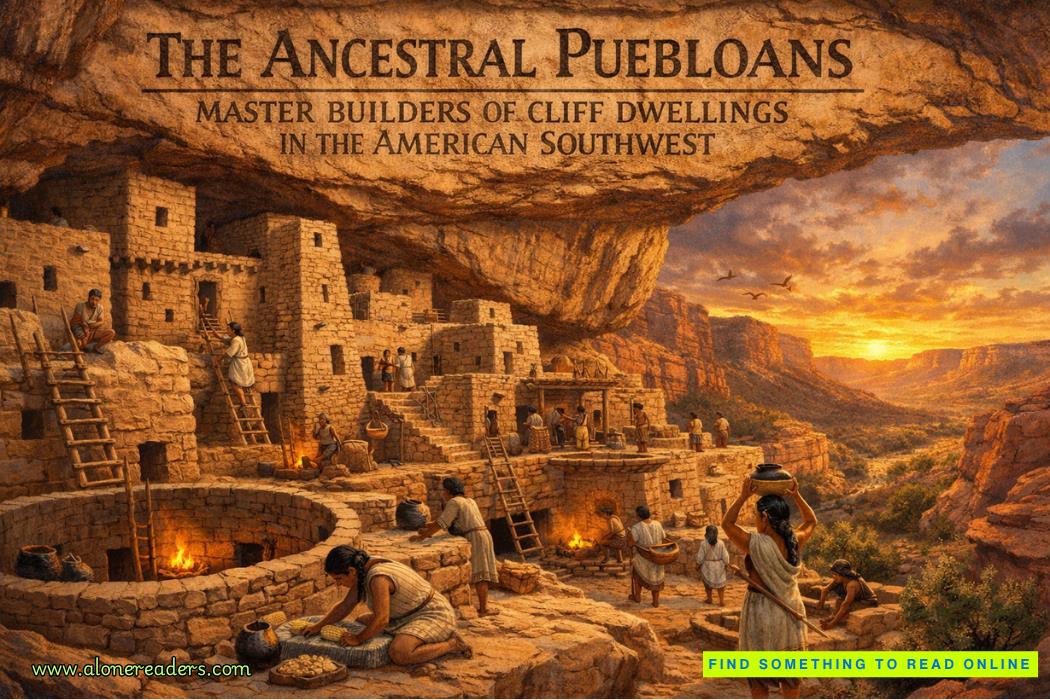
The story of the Ancestral Puebloans, often referred to in older literature as the “Anasazi,” represents one of the most remarkable chapters in the history of ancient North America. Across the arid plateaus and canyon systems of the American Southwest, these early people constructed extraordinary stone communities embedded directly into towering cliffs, creating architectural achievements that still astonish archaeologists and engineers today. Their settlements, many of which remain preserved in locations such as Mesa Verde, Chaco Canyon, and Canyon de Chelly, reveal a civilization that combined sophisticated environmental knowledge, advanced masonry techniques, and complex social organization. Far from being primitive desert dwellers, the Ancestral Puebloans were innovators whose settlements demonstrate careful urban planning, astronomical awareness, and a profound understanding of the challenging landscape in which they lived.
The roots of the Ancestral Puebloan culture stretch back nearly two thousand years. Early ancestors of the culture emerged around the first centuries CE, evolving from earlier Archaic and Basketmaker societies that inhabited the Colorado Plateau. These early communities initially lived in pit houses—semi-subterranean dwellings designed to moderate temperature extremes in the desert climate. Over time, as agriculture became more stable and populations increased, these societies transitioned from scattered hamlets into permanent villages constructed from stone and adobe, marking the emergence of the cultural tradition archaeologists now identify as the Ancestral Puebloans. Their name reflects their legacy, as modern Pueblo peoples of the Southwest trace cultural and spiritual heritage back to these ancient builders.
Agriculture formed the foundation of their society. In an environment defined by unpredictable rainfall and harsh seasonal extremes, the Ancestral Puebloans developed highly adaptive farming techniques that allowed them to cultivate crops such as maize, beans, and squash. These crops, often referred to as the “Three Sisters,” provided a nutritionally balanced diet and could be grown together in mutually supportive agricultural systems. The people built terraces along hillsides, constructed check dams to control water runoff, and planted crops in areas where rainfall naturally accumulated. Such strategies allowed them to transform a dry and rugged environment into productive farmland. This agricultural stability supported growing populations and encouraged the construction of increasingly complex settlements.
Perhaps the most extraordinary expression of Ancestral Puebloan ingenuity appeared between the ninth and thirteenth centuries, when communities began constructing large masonry villages within cliff alcoves carved into canyon walls. These cliff dwellings are among the most visually striking architectural achievements in ancient North America. Entire villages, some containing hundreds of rooms, were built into natural sandstone recesses, creating compact settlements protected from wind, rain, and potential enemies. The choice of cliff locations was not accidental; the alcoves offered shade during the intense summer heat while trapping warmth during winter months, creating a natural climate control system.
The construction methods used by the Ancestral Puebloans reveal remarkable craftsmanship. Builders shaped sandstone blocks with stone tools and bonded them with mortar made from mud and ash. Walls were carefully aligned and reinforced to support multiple stories, often rising three or four levels high. Wooden beams known as vigas were inserted into the walls to support floors and roofs, while smaller sticks and layers of clay formed the ceiling structures. Despite being constructed without metal tools or wheeled transport, these buildings have endured for centuries, demonstrating an exceptional level of engineering knowledge and structural understanding.
Inside the cliff dwellings, daily life unfolded in tightly organized clusters of rooms. Individual chambers served specific purposes: living spaces, storage rooms for crops, workshops for toolmaking, and communal areas for food preparation. Many dwellings included small windows and doorways designed in distinctive T-shaped forms, which may have served both functional and symbolic purposes. The compact arrangement of these rooms reflects the cooperative nature of Puebloan society, where extended families likely lived together in interconnected residential blocks.
At the center of many villages stood the kiva, a circular ceremonial chamber partially built below ground. The kiva served as the spiritual heart of the community, hosting rituals, gatherings, and decision-making councils. Entry into these sacred spaces was typically through a ladder descending from the roof, reinforcing their symbolic connection between the earthly world and the spiritual realm below. Within the kiva, features such as fire pits, ventilation shafts, and ritual niches reveal an architectural design deeply intertwined with religious traditions. These ceremonial structures demonstrate that the Ancestral Puebloans were not only skilled builders but also people whose architecture reflected complex cosmological beliefs.
Beyond the dramatic cliff dwellings, the Ancestral Puebloans also constructed large regional centers that functioned as hubs of trade, administration, and ceremonial life. Among the most significant of these centers was Chaco Canyon in present-day New Mexico. Here, between the ninth and twelfth centuries, massive stone complexes known as “great houses” were constructed with hundreds of rooms arranged around open plazas. Some buildings rose four or five stories high and contained dozens of kivas. The scale and precision of Chaco architecture suggest centralized planning and the ability to mobilize large workforces.
Chaco Canyon also reveals the existence of an extensive regional network. Straight roads radiated outward from the canyon across the desert landscape, connecting distant settlements. These roads were engineered with impressive precision, sometimes cut directly through rock or elevated across uneven terrain. Archaeologists believe they served both practical and ceremonial functions, facilitating trade and pilgrimage between communities scattered across the Southwest. Through these connections, the Ancestral Puebloans maintained an exchange system that brought turquoise, shells, macaw feathers, and other exotic materials from distant regions.
Trade and craftsmanship played an important role in Puebloan society. Skilled artisans produced intricately painted pottery, finely woven textiles, and turquoise jewelry, many of which were traded across wide areas. Pottery designs often featured geometric patterns and symbolic motifs that varied between regions, reflecting both artistic expression and cultural identity. These objects were not merely decorative; they served practical purposes in food storage, cooking, and ritual ceremonies. The presence of luxury goods and imported materials indicates a society engaged in long-distance trade networks spanning much of the American Southwest and beyond.
The location of many Puebloan structures also demonstrates a profound awareness of the sky. Archaeological evidence suggests that certain buildings and windows were aligned with solar and lunar events, such as solstices and equinoxes. In some locations, shafts of sunlight illuminate specific architectural features on particular days of the year, indicating that the Ancestral Puebloans incorporated astronomical knowledge directly into their architectural design. This knowledge would have been crucial for agricultural planning, helping communities track seasonal cycles and determine the optimal times for planting and harvesting.
Despite centuries of prosperity and architectural innovation, the Ancestral Puebloan civilization experienced a dramatic transformation during the late thirteenth century. Around the 1200s, many of the major cliff dwelling communities were suddenly abandoned. Entire settlements that once bustled with activity were left empty, their stone walls standing silent against the canyon cliffs. For generations, scholars have debated the causes behind this remarkable migration.
Environmental stress appears to have played a major role. Tree-ring studies indicate that the Southwest experienced a series of severe and prolonged droughts during the late thirteenth century, drastically reducing agricultural productivity. As water sources dwindled and crops failed, communities dependent on fragile farming systems would have struggled to sustain their populations. In addition to climate pressures, archaeological evidence suggests that social tensions and resource competition may have intensified as communities fought over limited farmland and water.
Rather than representing a sudden collapse, however, the abandonment of cliff dwellings likely reflects a strategic migration. Many groups appear to have relocated southward and eastward toward regions with more reliable water sources, eventually forming the pueblos that still exist today in New Mexico and Arizona. Oral traditions among modern Pueblo peoples describe migrations guided by spiritual teachings and ancestral instructions, reinforcing the idea that the movement was a deliberate cultural transition rather than a disappearance.
Today, the legacy of the Ancestral Puebloans survives not only in the ruins of their remarkable architecture but also in the living cultures of the Pueblo peoples who continue to inhabit the Southwest. Their traditions, languages, ceremonies, and agricultural practices maintain deep connections to the ancestral communities that once thrived within the canyon cliffs. Modern archaeological research increasingly emphasizes collaboration with these descendant communities, recognizing that their cultural knowledge offers valuable insight into the interpretation of ancient sites.
The preserved cliff dwellings themselves remain among the most breathtaking archaeological landscapes in North America. Visitors who stand before these towering stone villages embedded within canyon walls often experience a profound sense of wonder. The structures appear almost impossible—entire communities balanced within rock alcoves hundreds of feet above canyon floors. Yet these dwellings were not simply defensive refuges or temporary shelters. They were thriving homes where families lived, cooked, worshiped, and raised children for generations.
What makes the Ancestral Puebloans particularly remarkable is the combination of engineering skill, environmental adaptation, and spiritual worldview expressed in their architecture. Their buildings were not isolated monuments but carefully integrated components of a larger cultural system that balanced human needs with the rhythms of the natural world. Cliff dwellings, kivas, plazas, roads, and agricultural terraces together formed an interconnected landscape of habitation, ceremony, and survival.
In many ways, the Ancestral Puebloans represent one of the most sophisticated pre-Columbian civilizations of North America. Their achievements challenge outdated assumptions that complex urban societies existed only in regions such as Mesoamerica or the Andes. Instead, the canyonlands of the American Southwest reveal a culture capable of large-scale construction, regional governance, long-distance trade, and advanced astronomical observation.
Even centuries after their abandonment, the stone villages of the Ancestral Puebloans continue to captivate the modern imagination. Archaeologists still study the intricacies of their masonry, the patterns of their pottery, and the astronomical alignments of their structures in an effort to better understand how these communities flourished in such an unforgiving landscape. Each new discovery reveals additional layers of complexity, reminding us that ancient civilizations often possessed knowledge systems far more sophisticated than previously recognized.
Ultimately, the cliff dwellings of the Ancestral Puebloans stand as enduring symbols of human ingenuity and resilience in the face of environmental challenge. They demonstrate how a society, armed only with stone tools, deep cultural traditions, and collective cooperation, could create architectural masterpieces that still command admiration a millennium later. Far from being a forgotten people, the Ancestral Puebloans remain a living chapter in the human story—one written in sandstone walls, sacred kivas, and the enduring cultural memory of the Pueblo peoples who continue to honor their ancestral past.



 The Hundred Days Offensive: How the Allies Defeated Germany in World War I
 The Second Battle of the Marne: The Turning Point of World War I in 1918
 The Spring Offensive of 1918: Germany's Final Gamble to Win World War I
 The Treaty of Brest-Litovsk: How Russia Left World War I
 The Russian Revolution and World War I: How War Brought Down the Tsar
 The Zimmermann Telegram Explained: Germany's Secret Offer to Mexico in World War I