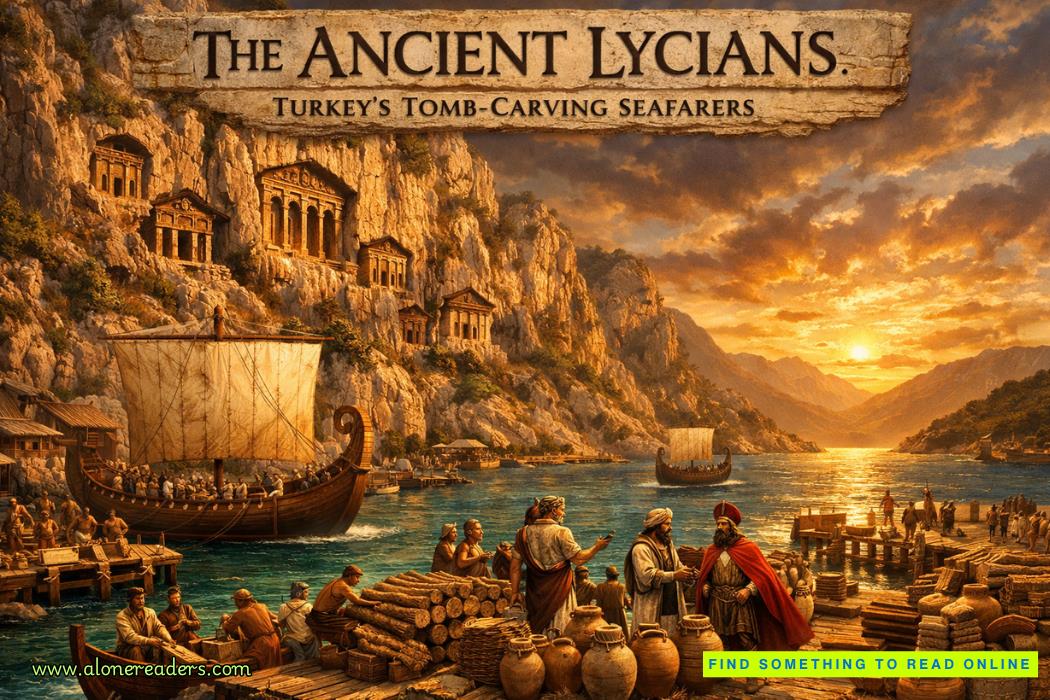
The ancient Lycians were one of the most intriguing and distinctive civilizations of the eastern Mediterranean, flourishing along the rugged southwestern coast of modern-day Turkey between roughly the second millennium BCE and the Roman era. Nestled between steep mountains and the turquoise waters of the Mediterranean, Lycia produced a society that was simultaneously maritime, fiercely independent, artistically innovative, and politically sophisticated. Despite their proximity to powerful neighbors such as the Greeks, Persians, and Romans, the Lycians maintained a unique cultural identity that manifested in their language, their political institutions, and above all in their breathtaking rock-cut tombs carved into sheer cliffs overlooking ancient cities and harbors.
To understand the Lycians, one must first understand the geography that shaped them. Lycia occupied a narrow coastal region bordered by the Taurus Mountains to the north and the Mediterranean Sea to the south. The terrain was rugged, dominated by limestone ridges, steep valleys, and short coastal plains. This environment created a network of small but strategically positioned city-states rather than a single centralized kingdom. Cities such as Xanthos, Patara, Myra, Tlos, and Pinara were separated by mountains yet connected by sea routes, encouraging maritime commerce and navigation. The sea was not merely a boundary but a highway, and the Lycians became highly skilled sailors who integrated their economy into the wider Mediterranean world.
The origins of the Lycian people are still debated, but linguistic and archaeological evidence suggests that they were part of the Anatolian branch of Indo-European cultures. Their language, known today as Lycian, belonged to the same family as Luwian and Hittite. Ancient Greek writers referred to the Lycians as Termilae before they adopted the name Lycians, and myths later connected them to legendary figures such as Sarpedon, a hero who fought in the Trojan War. These myths reflect how deeply embedded the Lycians were within the broader mythological imagination of the eastern Mediterranean.
One of the most remarkable aspects of Lycian culture was their reputation as formidable seafarers. The Mediterranean coastline of Lycia contained numerous natural harbors, and the Lycians took full advantage of these maritime advantages. Their ships traveled across the Aegean and eastern Mediterranean trading timber, agricultural products, and crafted goods. The forests of the Taurus Mountains supplied abundant cedar and pine, highly valued for shipbuilding throughout antiquity. Lycian sailors transported this timber to shipyards in Greek cities and other Mediterranean ports, making Lycia an essential supplier for maritime economies.
Ancient sources even associate the Lycians with episodes of maritime warfare and piracy, which were common features of Mediterranean life in the Bronze and Iron Ages. Egyptian records from the reign of Ramesses III describe encounters with the so-called Sea Peoples, a loose coalition of seafaring groups who raided coastal settlements across the eastern Mediterranean around the twelfth century BCE. Some scholars believe that the Lycians, or groups closely related to them, may have participated in these movements. Whether traders, mercenaries, or raiders, the Lycians clearly possessed extensive naval experience and maritime networks.
While their reputation as sailors connected them to the sea, the Lycians are perhaps even more famous for the extraordinary tombs they carved into the cliffs of their cities. These monuments remain among the most visually striking archaeological features of ancient Anatolia. Entire cliff faces were transformed into necropolises where elaborately carved facades imitated wooden houses, temples, and elaborate architectural forms. The tombs were often positioned high above the ground, overlooking cities, valleys, or harbors.
The reason for this unusual placement was deeply tied to Lycian religious beliefs. The Lycians believed that the souls of the dead were transported to the afterlife by winged creatures or divine messengers. Placing tombs high on cliffs symbolically brought the deceased closer to the sky, making it easier for these supernatural beings to carry them away. Thus, death itself was imagined as a journey upward, a passage from the earthly world to a celestial realm.
The tomb architecture itself reveals fascinating details about Lycian craftsmanship. Many rock-cut tombs replicate the appearance of wooden houses, complete with beams, rafters, and door panels carved directly into stone. This imitation suggests that the Lycians originally built houses of timber and translated those designs into their funerary monuments. Some tombs resemble temples with columns and pediments influenced by Greek architectural styles, demonstrating how Lycian art absorbed external influences while retaining its own character.
Among the most famous examples is the Harpy Tomb at Xanthos, a tall pillar monument crowned with a burial chamber decorated with relief sculptures. The carvings depict winged figures carrying away small human forms, reinforcing the belief in supernatural beings escorting the souls of the dead. These sculptures combine local Lycian themes with stylistic elements drawn from Greek art, illustrating the cultural crossroads in which Lycia existed.
Equally impressive are the rock-cut tombs of Myra, where dozens of intricately carved facades cling to vertical cliffs above the ancient city. Viewed from below, these tombs appear like a suspended city carved into the mountain itself. Their scale and complexity demonstrate not only advanced stoneworking techniques but also the wealth and social stratification of Lycian society. Only elite families could afford such monumental burial places, turning the cliffs into visual statements of power and prestige.
Yet Lycian civilization was not defined solely by its tombs. The Lycians also developed one of the most remarkable political systems of the ancient world: the Lycian League. This federation of city-states represented an early form of democratic governance that fascinated later observers. Each city in the league had representation in a central assembly where collective decisions were made regarding diplomacy, defense, and shared policies.
Cities were represented according to their size and importance, with larger cities receiving more votes than smaller ones. This weighted system balanced power among the member states while still allowing a collective political structure. The league selected officials and coordinated regional governance in ways that were highly unusual for the ancient world.
Centuries later, political thinkers admired this system. The structure of the Lycian League was noted for its sophistication and balance of representation. It demonstrated that complex federal governance existed long before the modern era. For a region often overshadowed by larger empires, Lycia produced a political model that stood out in the history of ancient governance.
Despite their independence, the Lycians inevitably came under the influence of larger imperial powers. During the sixth century BCE, the expanding Persian Empire conquered much of Anatolia, including Lycia. Rather than destroying Lycian institutions, the Persians allowed many local structures to continue, integrating the region into their imperial administrative system while permitting considerable autonomy.
The city of Xanthos provides one of the most dramatic episodes from this period. According to historical accounts, when Persian forces besieged the city, the inhabitants chose to fight to the death rather than surrender. The story tells of citizens burning their own families and possessions before launching a final suicidal assault against the invaders. Whether embellished or not, the tale reflects the reputation of the Lycians as fiercely independent and resistant to domination.
After the Persian era, Lycia experienced a period of increased interaction with the Greek world, particularly during the campaigns of Alexander the Great in the fourth century BCE. When Alexander moved through Anatolia defeating Persian forces, many Lycian cities surrendered peacefully, recognizing the strategic advantage of aligning with the Macedonian conqueror. Greek culture began to influence Lycian art, architecture, and urban planning, yet the core identity of the region persisted.
The Hellenistic period that followed Alexander’s death saw Lycia pass through the hands of various successor kingdoms before eventually falling under Roman influence. Under Roman rule, the Lycian League continued to function as a regional political institution, demonstrating the durability of its governance system. Roman authorities recognized the effectiveness of the league and allowed it to remain largely intact.
Economically, Lycia thrived during these centuries due to its strategic location along Mediterranean trade routes. Agricultural production included olives, grapes, and grains cultivated on terraced hillsides. Coastal ports served as hubs for maritime commerce linking Anatolia with the Greek islands, Egypt, and the Levant. The combination of agricultural resources, maritime trade, and skilled craftsmanship created a stable and prosperous regional economy.
Religion in Lycia reflected a mixture of indigenous traditions and external influences. Local deities coexisted with Greek gods, often blending into hybrid forms. Sanctuaries and temples were scattered throughout the region, many located in dramatic natural landscapes such as mountain passes or coastal promontories. These sacred sites reinforced the connection between the Lycian people and the powerful natural environment that surrounded them.
Burial customs remained central to Lycian identity throughout these cultural transitions. Even as Greek and Roman influences expanded, the tradition of rock-cut tombs persisted. Some later tombs incorporated classical architectural features such as columns and pediments, showing how Lycian elites adapted new artistic trends while maintaining their ancestral burial traditions. The cliffs continued to serve as monumental archives of memory, preserving the identities of generations of Lycian families.
Language also played an important role in preserving Lycian identity. Inscriptions discovered on monuments and tombs reveal a written language distinct from Greek, using a unique alphabet derived from but adapted to Anatolian phonetics. These inscriptions provide valuable insights into Lycian political institutions, personal names, and social structures.
Over time, however, the Lycian language gradually disappeared as Greek became the dominant language of administration and culture across the eastern Mediterranean. By the early centuries of the Roman Empire, Lycian inscriptions became increasingly rare. Cultural assimilation slowly replaced the distinct linguistic traditions that had once defined the region.
Today, the legacy of the Lycians remains visible in the dramatic archaeological landscapes of southwestern Turkey. Cities such as Xanthos, Patara, and Myra contain ruins that reveal layers of Lycian, Greek, and Roman history intertwined within the same urban spaces. Yet the most iconic reminders of Lycian civilization remain the cliff tombs themselves. These monumental carvings continue to captivate archaeologists, historians, and travelers alike.
Standing before these tombs, one cannot help but imagine the society that created them: a people who navigated the Mediterranean, carved their homes for eternity into the mountains, and built political institutions centuries ahead of their time. Their civilization demonstrates how regional cultures could develop remarkable achievements even while surrounded by powerful empires.
The Lycians remind us that ancient history is not solely the story of massive empires like Rome or Persia. It is also the story of smaller societies whose creativity, resilience, and cultural uniqueness shaped the broader Mediterranean world. In Lycia, cliffs became monuments, the sea became a highway of opportunity, and a federation of cities experimented with political cooperation long before modern democracies emerged.
The cliffs of Lycia still hold their silent city of the dead high above the Mediterranean. Carved in stone yet inspired by wooden homes and celestial beliefs, these tombs embody the spirit of a civilization that refused to vanish quietly into history. Through their seafaring traditions, artistic innovation, and political ingenuity, the ancient Lycians left behind a legacy that continues to fascinate scholars and travelers thousands of years later.



 The Hundred Days Offensive: How the Allies Defeated Germany in World War I
 The Second Battle of the Marne: The Turning Point of World War I in 1918
 The Spring Offensive of 1918: Germany's Final Gamble to Win World War I
 The Treaty of Brest-Litovsk: How Russia Left World War I
 The Russian Revolution and World War I: How War Brought Down the Tsar
 The Zimmermann Telegram Explained: Germany's Secret Offer to Mexico in World War I