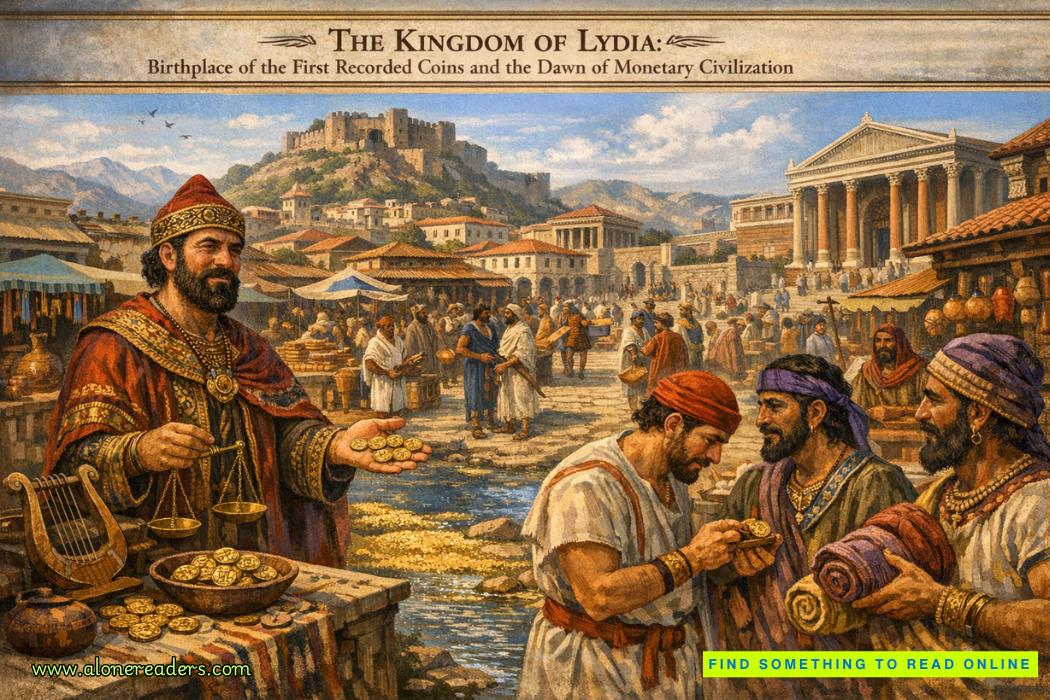
The ancient Kingdom of Lydia occupies a remarkable yet often underappreciated place in the history of human civilization. Located in western Anatolia, in what is now modern-day Turkey, Lydia emerged during the early first millennium BCE as one of the most prosperous and technologically innovative societies of the ancient world. Though its political existence lasted only a few centuries before falling to the expanding Persian Empire, Lydia’s legacy endured far beyond its borders. The civilization is remembered above all for one revolutionary innovation: the creation of the first recorded coins, an invention that permanently transformed trade, economic organization, and state authority across the Mediterranean and beyond.
Before Lydia’s innovation, commerce in most ancient societies relied primarily on barter or on the exchange of weighed precious metals. Traders conducted transactions using lumps of silver, gold, or other valuable materials, which had to be weighed carefully each time a purchase occurred. This method was cumbersome and vulnerable to manipulation. Merchants could shave small amounts off precious metals, mix them with cheaper alloys, or dispute their value. Such systems required constant verification and created friction in long-distance trade networks that stretched from Mesopotamia to the Aegean.
It was within this environment of expanding commerce and regional interaction that Lydia emerged as an economic powerhouse. The kingdom was strategically positioned along major trade routes connecting the Greek city-states of the Aegean coast with the interior of Anatolia and the Near East. Caravans carrying textiles, metals, wine, ceramics, and luxury goods regularly passed through Lydian territory. This geographical advantage allowed Lydia to accumulate wealth and influence, but it also demanded a more efficient economic system capable of supporting increasingly complex commercial exchanges.
One of the most significant natural resources that shaped Lydia’s destiny was the Pactolus River, a small but historically famous waterway flowing through the Lydian capital of Sardis. The sands of the Pactolus were rich in electrum, a naturally occurring alloy of gold and silver. In ancient mythology, this abundance was explained by the legend of King Midas, whose golden touch supposedly washed away in the river, leaving behind glittering deposits of precious metal. While the myth is symbolic, the reality was equally remarkable: Lydia possessed access to a natural supply of precious metal that could easily be collected and refined.
The availability of electrum created the perfect conditions for experimentation in metallurgy and monetary systems. By the late 7th century BCE, Lydian authorities began producing small pieces of electrum that were standardized in weight and stamped with official symbols. These pieces were the world’s earliest known coins—not merely lumps of metal, but state-issued currency guaranteed by the authority of the kingdom.
The earliest coins were typically bean-shaped pieces of electrum bearing simple designs impressed into their surfaces. Many featured the image of a lion’s head, a symbol associated with the Lydian royal dynasty. The stamp served a crucial purpose: it certified that the metal had been weighed and approved by the state. Instead of weighing metal each time they traded, merchants could now exchange these stamped pieces directly, trusting that their value had already been verified.
This development represented a profound shift in economic thinking. Coinage transformed precious metal from a commodity into a standardized medium of exchange backed by political authority. In essence, Lydia pioneered the concept of state-controlled money—an idea that would eventually underpin the entire global financial system.
The origins of this innovation are often associated with the Mermnad dynasty, particularly the reigns of kings such as Alyattes and his famous successor Croesus. Alyattes ruled Lydia during the late 7th and early 6th centuries BCE, a period marked by both military expansion and economic consolidation. During his reign, the earliest electrum coins began circulating, initially within royal administrative systems and gradually spreading into broader commercial use.
Under Alyattes, Lydia strengthened its control over the trade networks of western Anatolia. The kingdom’s influence extended to the Ionian Greek cities along the coast, including Miletus and Ephesus. These cities were among the most active commercial hubs in the Mediterranean, and the introduction of coinage quickly gained traction within their markets. Greek merchants recognized the efficiency of the Lydian system and soon began minting their own coins inspired by the Lydian model.
The innovation reached its peak under King Croesus, one of the most famous rulers of antiquity. Croesus, who reigned from approximately 595 to 546 BCE, became legendary for his immense wealth. Even in modern language, the phrase “rich as Croesus” remains a symbol of extraordinary prosperity.
Croesus did more than simply inherit Lydia’s wealth—he refined its monetary system. During his reign, Lydia introduced the first true bimetallic coinage system, separating electrum into distinct gold and silver coins with standardized purity. This change solved a major problem associated with electrum: because the natural alloy varied in its ratio of gold to silver, its intrinsic value could fluctuate. By minting pure gold and silver coins with guaranteed metal content, Croesus created a more stable and reliable monetary structure.
The resulting coins, known as Croeseids, became some of the most influential currency designs in ancient history. They featured carefully crafted images, including confronting lion and bull motifs, and circulated widely across the Mediterranean world. For the first time, money was not merely a piece of precious metal—it was a political instrument issued by a centralized authority with clearly defined value.
The economic consequences of this innovation were profound. Coins allowed markets to function with far greater efficiency. Prices could be standardized, taxes could be collected more easily, and soldiers could be paid with portable currency rather than bulky goods or weighed metals. Trade networks expanded rapidly as merchants adopted the convenience of coinage.
The spread of coinage also stimulated urban growth and economic specialization. Markets became more sophisticated, and professions that depended on precise transactions—such as banking, accounting, and money-changing—began to emerge. Lydia’s innovation thus contributed to the development of complex financial systems that would later flourish in Greek and Roman economies.
The influence of Lydian coinage extended far beyond Anatolia. Greek city-states quickly adopted the practice, producing their own distinctive currencies such as the famous Athenian silver tetradrachms. Within a few centuries, coinage had spread throughout the Mediterranean basin, reaching Persia, Egypt, and eventually the Roman Republic.
Ironically, Lydia itself did not remain politically independent long enough to enjoy the full long-term benefits of its innovation. In 546 BCE, the kingdom was conquered by Cyrus the Great, founder of the Persian Empire. According to historical accounts, Croesus attempted to resist the Persian advance but was ultimately defeated after the fall of Sardis.
Yet even in defeat, Lydia’s legacy continued to shape the economic structures of the Persian Empire. The Persians adopted coinage as a central component of their administrative system, minting gold darics and silver sigloi that circulated across their vast territories. This imperial adoption ensured that Lydia’s monetary concept would influence economies stretching from the Mediterranean to Central Asia.
Beyond its economic contributions, Lydia also possessed a distinctive culture that blended Anatolian traditions with influences from neighboring Greek societies. The capital city of Sardis was one of the most impressive urban centers of the ancient world. Archaeological excavations reveal monumental architecture, advanced metallurgy workshops, and complex urban planning that reflected Lydia’s prosperity.
Sardis was also a center of craftsmanship and luxury production. Lydian artisans were renowned for their work with precious metals, textiles, and jewelry. The kingdom’s wealth enabled the patronage of temples, public works, and artistic achievements that rivaled those of contemporary Greek cities.
Religion in Lydia combined indigenous Anatolian beliefs with elements borrowed from Greek mythology. Deities such as Cybele were worshipped alongside Greek gods like Artemis and Apollo. This cultural blending illustrates the kingdom’s position as a bridge between Eastern and Western civilizations, facilitating not only trade but also the exchange of ideas and artistic traditions.
Despite its relatively brief historical prominence, Lydia played a crucial role in shaping the economic foundations of later civilizations. The concept of coinage introduced by the Lydians established several principles that remain central to modern monetary systems: standardization, state authority, and public trust in currency.
Perhaps the most remarkable aspect of Lydia’s achievement is how fundamentally it altered human interaction with value and exchange. Before coins, wealth was often cumbersome and ambiguous, tied to physical commodities that required constant verification. With the introduction of stamped currency, value became portable, recognizable, and widely accepted.
This transformation accelerated the development of markets, taxation systems, and state economies. It allowed governments to organize large armies, finance infrastructure, and integrate distant territories through standardized commerce. In many ways, the invention of coinage can be seen as one of the foundational technologies of civilization itself.
Today, archaeologists and historians continue to study Lydian coins not only as artifacts of ancient craftsmanship but as symbols of a turning point in economic history. The small electrum pieces struck in Sardis more than twenty-six centuries ago represent the beginning of a financial revolution that eventually shaped global trade networks, imperial economies, and modern monetary systems.
The story of Lydia reminds us that some of the most transformative innovations arise not from massive empires but from relatively small societies positioned at the crossroads of cultural exchange. Lydia’s strategic location, natural resources, and administrative creativity combined to produce an idea whose impact far outlasted the kingdom itself.
In the quiet ruins of Sardis, where ancient marketplaces once buzzed with merchants exchanging newly minted coins, the legacy of Lydia’s innovation still resonates. From the first stamped electrum pieces to the complex currencies of the modern world, the fundamental concept remains the same: a trusted symbol of value backed by authority and shared belief.
Thus, the Kingdom of Lydia stands not merely as a forgotten ancient civilization, but as the birthplace of one of humanity’s most enduring economic inventions—the coin. Its legacy continues to echo every time a coin changes hands, linking the modern world to a remarkable chapter of ancient ingenuity.




 The Hundred Days Offensive: How the Allies Defeated Germany in World War I
 The Second Battle of the Marne: The Turning Point of World War I in 1918
 The Spring Offensive of 1918: Germany's Final Gamble to Win World War I
 The Treaty of Brest-Litovsk: How Russia Left World War I
 The Russian Revolution and World War I: How War Brought Down the Tsar
 The Zimmermann Telegram Explained: Germany's Secret Offer to Mexico in World War I










