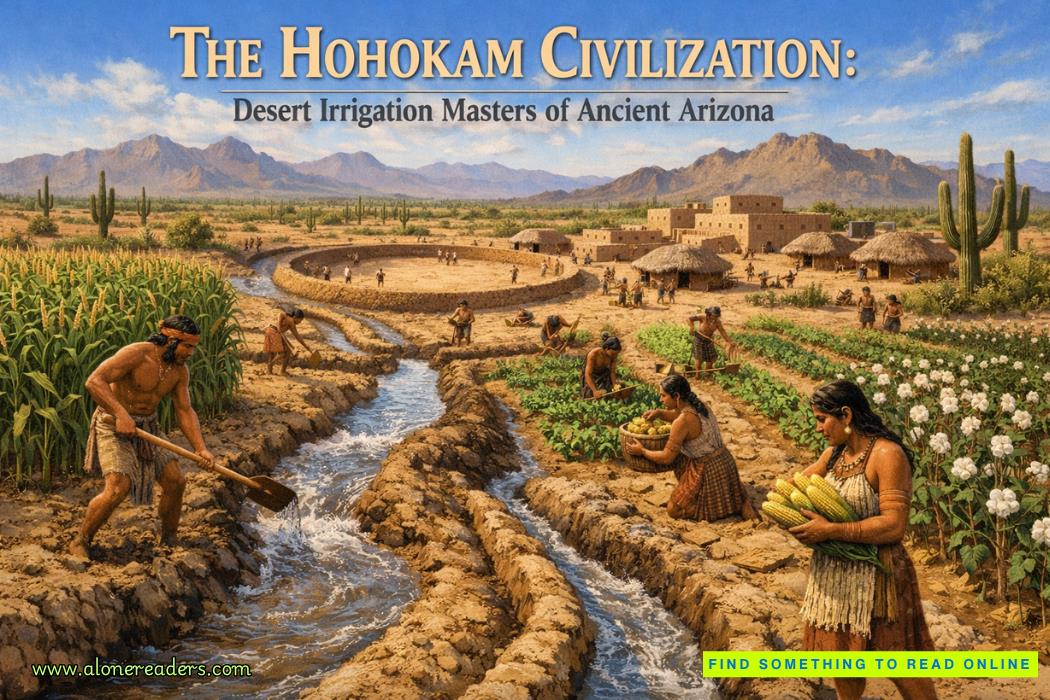
The deserts of the American Southwest appear harsh and unforgiving to modern observers. Vast stretches of arid land, sparse rainfall, and scorching summer temperatures seem to make large-scale human settlement nearly impossible without modern technology. Yet more than a thousand years ago, a remarkable civilization flourished in this landscape. The Hohokam civilization, centered in what is now southern and central Arizona, built one of the most sophisticated irrigation systems in the ancient Americas. Through ingenuity, cooperation, and deep environmental knowledge, these desert dwellers transformed the arid valleys of the Sonoran Desert into productive agricultural landscapes that supported thousands of people for centuries.
The Hohokam were not merely survivors in a desert environment; they were masters of desert engineering and water management. Their society flourished for more than a millennium, from roughly 300 BCE to around 1450 CE. During that time they developed a complex culture distinguished by extensive canal networks, distinctive pottery, far-reaching trade connections, ceremonial ballcourts, and thriving agricultural communities. Their achievements demonstrate that even in some of the harshest landscapes on Earth, human creativity and collective effort can produce thriving civilizations.
The name “Hohokam” itself comes from the language of the O’odham people, whose descendants still inhabit parts of Arizona today. The word roughly translates to “those who have gone” or “the ancient ones,” reflecting the deep cultural memory of a people who lived long before European contact. Archaeologists adopted the term in the twentieth century to describe the archaeological culture responsible for the impressive canal systems and settlements found throughout the Phoenix Basin and surrounding valleys.
The earliest Hohokam communities began as small farming villages along the Salt and Gila rivers. These waterways flowed through the desert but were highly seasonal, often flooding during certain periods and shrinking drastically during others. The early inhabitants quickly realized that survival depended on harnessing this unpredictable water supply. Over time they began digging simple irrigation channels to divert river water into nearby fields. What started as modest agricultural experiments eventually evolved into one of the largest and most sophisticated irrigation systems ever built by a pre-industrial society.
By the height of their civilization between about 800 and 1200 CE, the Hohokam had constructed hundreds of miles of irrigation canals across the Phoenix Basin. Some of these canals were enormous by ancient standards—stretching for more than ten miles and reaching widths of up to twenty meters. The canals diverted water from the Salt and Gila rivers and distributed it across large agricultural fields where crops could thrive despite the surrounding desert.
What makes the Hohokam irrigation system particularly impressive is its engineering precision. The canals were carefully graded to maintain a gentle slope, allowing water to flow steadily without eroding the channel walls. If the slope was too steep, water would rush too quickly and damage the canal. If it was too shallow, the water would stagnate. Achieving the correct gradient across miles of desert terrain required detailed planning and sophisticated knowledge of hydrology, even without modern surveying tools.
These irrigation systems transformed the desert landscape into a productive agricultural zone capable of supporting large populations. The Hohokam cultivated a variety of crops including maize, beans, squash, cotton, tobacco, and agave. Cotton was particularly important, as it allowed them to produce textiles that were both practical and valuable in trade networks. The reliable food supply generated by irrigated farming enabled villages to grow into large communities and eventually complex regional centers.
Agriculture was not the only area in which the Hohokam demonstrated remarkable innovation. Their settlements reveal a society with a rich cultural life and sophisticated craftsmanship. Early Hohokam homes were typically pit houses, semi-subterranean dwellings built by digging a shallow depression into the ground and constructing a roof supported by wooden beams. This design helped regulate indoor temperatures, keeping homes cooler during the intense desert heat and warmer during cooler nights.
As the civilization developed, some settlements evolved into large villages containing dozens or even hundreds of homes arranged around central courtyards and communal spaces. Certain sites grew into major regional hubs that coordinated irrigation networks and trade activities. Among the most notable of these centers were Snaketown, Pueblo Grande, and Casa Grande, each providing important archaeological insights into Hohokam life.
One of the most intriguing features of many Hohokam settlements is the presence of ceremonial ballcourts. These oval-shaped depressions, often surrounded by earthen embankments, resemble ballcourts used in ancient Mesoamerican cultures such as those of central Mexico. Archaeologists believe these structures served as gathering places for ritual ballgames, ceremonies, and community events. The existence of ballcourts suggests cultural connections between the Hohokam and civilizations farther south, hinting at long-distance cultural exchange across the deserts and mountains of North America.
Trade networks were indeed an important component of Hohokam society. Archaeological evidence shows that they participated in extensive exchange systems reaching across much of the American Southwest and into Mesoamerica. Shells from the Gulf of California were transported hundreds of miles inland and transformed into intricate jewelry and ornaments. Turquoise, obsidian, and copper artifacts also circulated through regional trade routes.
Some of the most striking evidence of these connections is the discovery of copper bells and macaw feathers, both of which originated far to the south in Mesoamerican regions. These items were likely prestige goods used by community leaders or in ceremonial contexts. Their presence demonstrates that the Hohokam were not an isolated desert culture but part of a broader network of trade and cultural interaction that spanned thousands of kilometers.
Hohokam pottery represents another remarkable aspect of their culture. Their ceramics are easily recognizable for their distinctive red-on-buff designs, created by painting geometric patterns and stylized animal figures onto a light-colored clay surface. These vessels were both functional and artistic, used for cooking, storage, and ceremonial purposes. The designs often featured repeating patterns, spirals, birds, and abstract shapes that reflect both aesthetic creativity and symbolic meaning.
The production of pottery and shell jewelry suggests the presence of skilled artisans within Hohokam communities. Craft specialization likely developed as agricultural productivity increased, allowing certain individuals to focus on artistic and technical pursuits rather than farming alone. This specialization contributed to the cultural richness of Hohokam society and strengthened regional trade relationships.
While agriculture and craft production formed the backbone of the Hohokam economy, social organization played an equally important role in sustaining their civilization. Building and maintaining hundreds of miles of irrigation canals required coordinated labor and effective leadership. Communities had to organize large workforces to dig canals, repair damage after floods, and manage the distribution of water to different agricultural plots.
This level of cooperation suggests a well-structured social system capable of mobilizing collective effort. Although the exact nature of Hohokam governance remains uncertain, many archaeologists believe local leaders or councils oversaw canal management and community decision-making. Water distribution likely required careful scheduling and negotiation among farmers to ensure fair access to irrigation resources.
Environmental knowledge was another key factor in Hohokam success. Living in the Sonoran Desert demanded a deep understanding of seasonal patterns, soil conditions, and plant cycles. The Hohokam adapted their farming practices to the unique challenges of the region, planting crops at times that maximized the limited water supply and utilizing floodwaters when available.
In addition to agriculture, they gathered wild plants and hunted desert animals to supplement their diet. Mesquite beans, cactus fruit, and agave were valuable food sources that thrived in the desert environment. These resources provided nutritional diversity and helped communities survive periods when agricultural yields were lower.
Despite their remarkable achievements, the Hohokam civilization eventually declined and disappeared as a distinct cultural entity around the fifteenth century. Archaeologists have debated the reasons for this transformation for decades. Evidence suggests that multiple factors likely contributed to the gradual abandonment of major settlements.
One possible cause was environmental stress linked to prolonged droughts and river flooding cycles. Over time, sediment buildup in canals may have reduced their efficiency, making irrigation increasingly difficult to maintain. Major floods could also destroy canal systems, requiring extensive labor to rebuild them. Repeated environmental disruptions may have strained the social systems that sustained large agricultural communities.
Population pressure may have also played a role. As settlements grew, the demand for water and farmland increased. Competition for limited resources could have led to social tensions or migration to new regions where farming conditions were more favorable.
Another theory suggests that shifts in regional trade networks and cultural interactions may have altered the economic foundations of Hohokam society. If long-distance trade declined or political alliances changed, communities dependent on exchange networks might have faced new challenges.
Archaeological evidence indicates that many Hohokam settlements were gradually abandoned rather than destroyed by sudden catastrophe. People likely migrated to other areas of the Southwest, merging with neighboring cultures such as the O’odham, Pueblo, and other indigenous groups whose descendants remain in the region today. In this sense, the Hohokam did not truly vanish; their cultural legacy continued through the communities that followed.
One of the most remarkable aspects of Hohokam history is that their irrigation achievements continue to influence modern Arizona. The city of Phoenix and surrounding communities still rely on canal routes originally established by Hohokam engineers more than a thousand years ago. In fact, several modern irrigation canals follow the same paths as the ancient ones, demonstrating how effective the original designs were.
This continuity represents a powerful testament to the ingenuity of the Hohokam people. Their ability to transform a desert landscape into a productive agricultural region laid the foundation for one of the fastest-growing metropolitan areas in the United States today. Modern infrastructure in the Phoenix Basin owes a surprising debt to the engineering knowledge of this ancient civilization.
The story of the Hohokam civilization challenges common assumptions about ancient societies in North America. Too often, discussions of ancient civilizations focus primarily on monumental stone cities or large empires in other parts of the world. Yet the Hohokam demonstrate that innovation, organization, and environmental adaptation can produce complex societies even without massive stone architecture or imperial armies.
Their civilization was defined not by towering pyramids but by water management systems that sustained life in an unforgiving environment. The canals they built represent one of the greatest engineering achievements in the ancient Americas. Through careful planning and collective effort, the Hohokam harnessed the unpredictable waters of desert rivers and turned barren landscapes into fertile agricultural fields.
Today, archaeologists continue to study Hohokam sites across Arizona to better understand how this civilization functioned and why it ultimately transformed. Each excavation reveals new details about daily life, trade networks, and technological innovations that helped desert communities thrive for centuries.
Perhaps the most enduring lesson of the Hohokam civilization is the demonstration that human societies can adapt creatively to even the most challenging environments. Their story is one of resilience, collaboration, and technological ingenuity. In a world increasingly concerned with sustainable water management and climate adaptation, the achievements of these ancient desert engineers remain strikingly relevant.
Long before modern dams, pumps, and concrete canals reshaped the American Southwest, the Hohokam people proved that careful environmental knowledge and cooperative engineering could sustain thriving communities in the desert. Their legacy remains etched across the landscape of Arizona, hidden beneath modern cities and fields yet still flowing through the canals that once carried life-giving water across the Sonoran Desert.



 The Hundred Days Offensive: How the Allies Defeated Germany in World War I
 The Second Battle of the Marne: The Turning Point of World War I in 1918
 The Spring Offensive of 1918: Germany's Final Gamble to Win World War I
 The Treaty of Brest-Litovsk: How Russia Left World War I
 The Russian Revolution and World War I: How War Brought Down the Tsar
 The Zimmermann Telegram Explained: Germany's Secret Offer to Mexico in World War I










