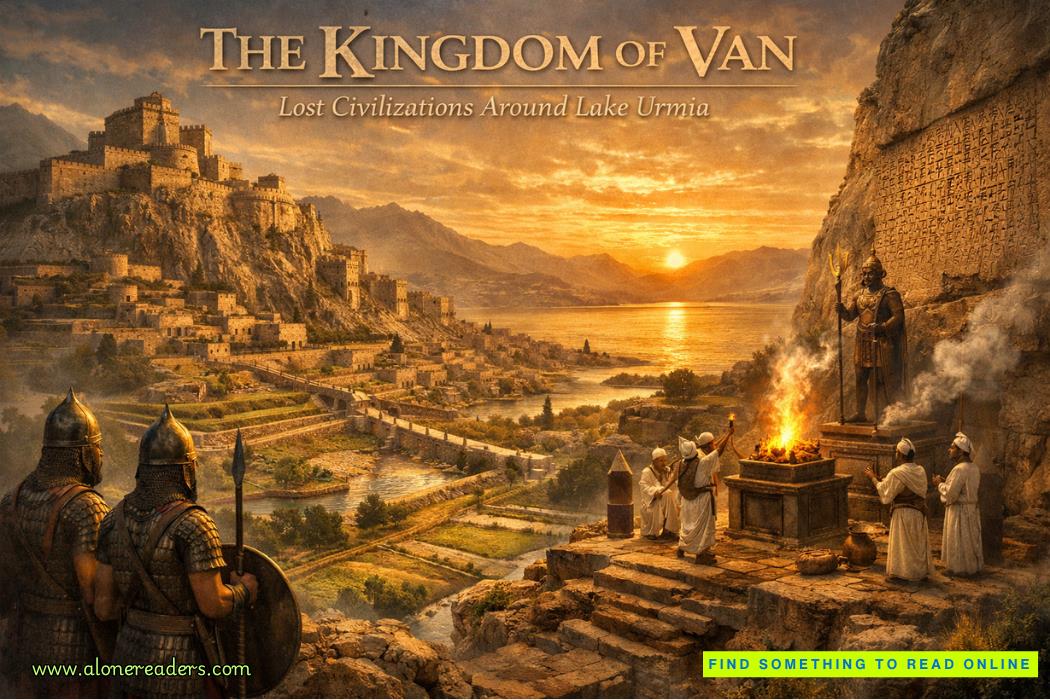
The ancient Near East is often dominated by narratives of empires such as Assyria, Babylon, and Persia, yet hidden among these giants lies a civilization that once rivaled them in power, sophistication, and ambition—the Kingdom of Van, more commonly known to historians as Urartu. Centered around the mountainous regions surrounding Lake Van and extending toward Lake Urmia, this civilization flourished between the 9th and 6th centuries BCE. Today, it stands as one of the most intriguing and underappreciated lost civilizations, its legacy preserved in ruins, inscriptions, and fragments of engineering brilliance scattered across modern-day eastern Turkey and northwestern Iran.
The geographical setting of the Kingdom of Van played a decisive role in shaping its identity. The region around Lake Urmia, characterized by rugged mountains, fertile valleys, and strategic highlands, provided both natural defenses and agricultural opportunities. Unlike the riverine civilizations of Mesopotamia, Urartu developed in a landscape that demanded adaptability and engineering ingenuity. This led to the construction of complex irrigation systems, fortified cities, and terraced agriculture that transformed otherwise harsh terrain into productive land. The proximity to Lake Urmia also connected the kingdom to trade routes extending into the Iranian plateau, facilitating cultural and economic exchange.
The rise of Urartu cannot be understood without examining its political context. During the early first millennium BCE, the Assyrian Empire was expanding aggressively, exerting pressure on smaller states in the region. In response, various tribal and regional groups coalesced into a centralized kingdom under strong leadership. The emergence of Urartu was thus both a reaction to external threats and a manifestation of internal consolidation. By the 9th century BCE, the kingdom had established itself as a formidable power, capable of challenging Assyria militarily and politically.
At the heart of this civilization was its capital, Tushpa, located near the eastern shore of Lake Van. The city was strategically positioned beneath a massive rock outcrop that served as a natural fortress. Urartian rulers carved inscriptions directly into these rock faces, leaving behind records of their achievements, conquests, and religious dedications. These inscriptions, written in a form of cuneiform, provide crucial insights into the administrative and ideological structure of the kingdom. They reveal a society that was highly organized, deeply religious, and intensely focused on royal authority and divine legitimacy.
Religion played a central role in Urartian society, with a pantheon dominated by the chief god Haldi. Temples dedicated to Haldi were often constructed in elevated locations, symbolizing the connection between the divine and the earthly realm. Rituals, offerings, and state-sponsored religious ceremonies reinforced the authority of the king, who was considered the chosen representative of the gods. This fusion of religion and governance created a system where political power was inseparable from spiritual endorsement, ensuring loyalty and cohesion within the kingdom.
One of the most remarkable aspects of the Kingdom of Van was its engineering prowess. In a region where water management was critical, the Urartians developed sophisticated irrigation networks that rivaled those of their contemporaries. Canals, some extending for dozens of kilometers, transported water from mountain sources to agricultural fields and urban centers. These systems were not only functional but also durable, with some remnants still visible today. The ability to harness and control water resources allowed Urartu to sustain a growing population and maintain economic stability, highlighting their advanced understanding of environmental management.
In addition to irrigation, the Urartians were skilled builders of fortresses and urban centers. Their cities were characterized by thick stone walls, rectangular layouts, and elevated citadels that provided both administrative control and military defense. The construction techniques employed in these structures demonstrate a high level of architectural sophistication. Massive stone blocks were carefully fitted together, often without the use of mortar, creating durable and imposing edifices that have withstood the test of time. These fortifications were not merely defensive structures but also symbols of state power and territorial dominance.
The economy of the Kingdom of Van was diverse and robust, supported by agriculture, animal husbandry, and trade. The fertile lands around Lake Urmia enabled the cultivation of crops such as barley, wheat, and grapes, while livestock provided meat, wool, and labor. Trade networks connected the kingdom to neighboring regions, allowing for the exchange of goods such as metals, textiles, and ceramics. Archaeological findings indicate that Urartian artisans produced high-quality metalwork, particularly in bronze and iron, showcasing their technological expertise and artistic sensibility.
Despite its strengths, the Kingdom of Van faced persistent challenges, particularly from the Assyrian Empire. The relationship between the two powers was marked by cycles of conflict and competition. Assyrian records often depict Urartu as a significant adversary, and military campaigns were frequently launched against its territories. However, Urartu was not merely a passive target; it actively engaged in warfare, expanding its influence and defending its borders. This ongoing rivalry shaped the political landscape of the region and contributed to the kingdom’s militarization and strategic planning.
The decline of the Kingdom of Van remains one of the most debated aspects of its history. By the late 7th century BCE, the kingdom began to weaken, eventually disappearing from historical records. Several factors have been proposed to explain this decline, including internal instability, economic strain, and external invasions. The rise of new powers, such as the Medes and the Scythians, likely played a role in destabilizing the region. Additionally, environmental changes and disruptions to trade routes may have undermined the kingdom’s economic foundation. The collapse of Urartu was not a sudden घटना but rather a gradual process of fragmentation and transformation.
What makes the story of the Kingdom of Van particularly compelling is the extent to which it has been overshadowed by more prominent civilizations. For centuries, its existence was largely forgotten, its ruins misattributed or ignored. It was only through modern archaeological efforts that the significance of Urartu began to emerge. Excavations around Lake Urmia and Lake Van have uncovered artifacts, inscriptions, and architectural remains that paint a vivid picture of a civilization that was both innovative and resilient. These discoveries have not only expanded our understanding of the ancient Near East but also challenged traditional narratives that prioritize a limited set of dominant cultures.
The cultural legacy of the Kingdom of Van extends beyond its immediate historical context. Elements of its architecture, engineering, and administrative practices influenced subsequent civilizations in the region. The emphasis on fortified settlements, water management, and centralized authority can be seen in later Persian and Armenian developments. In this sense, Urartu serves as a bridge between ancient Mesopotamian traditions and later imperial systems, highlighting the continuity and evolution of human societies.
Lake Urmia itself, as part of this broader cultural landscape, holds a symbolic significance. It represents not only a geographical landmark but also a nexus of human activity, interaction, and transformation. The civilizations that flourished around its shores contributed to a shared heritage that transcends modern political boundaries. Today, as the lake faces environmental challenges, its historical importance serves as a reminder of the fragility and resilience of both nature and civilization.
The rediscovery of the Kingdom of Van underscores the importance of looking beyond well-established historical narratives. It invites us to consider the complexity and diversity of ancient societies, recognizing that many civilizations have been lost not because they lacked significance, but because their stories were not preserved in dominant traditions. The study of Urartu challenges us to reconstruct these narratives, piecing together fragments of evidence to reveal a more comprehensive understanding of the past.
Ultimately, the Kingdom of Van stands as a testament to human ingenuity, adaptability, and ambition. Its achievements in engineering, governance, and culture demonstrate that even in challenging environments, societies can thrive and innovate. At the same time, its decline serves as a cautionary tale about the vulnerabilities that all civilizations face. By examining the rise and fall of Urartu, we gain not only historical knowledge but also insights into the enduring patterns of human development and collapse.
In the broader context of forgotten ancient civilizations, the Kingdom of Van occupies a unique and significant position. It is a reminder that history is not a fixed narrative but an evolving field of discovery, shaped by new findings and perspectives. As research continues and more evidence emerges, the story of this lost civilization will undoubtedly become clearer, offering deeper insights into a world that once thrived along the shores of Lake Urmia and beyond.



 The Hundred Days Offensive: How the Allies Defeated Germany in World War I
 The Second Battle of the Marne: The Turning Point of World War I in 1918
 The Spring Offensive of 1918: Germany's Final Gamble to Win World War I
 The Treaty of Brest-Litovsk: How Russia Left World War I
 The Russian Revolution and World War I: How War Brought Down the Tsar
 The Zimmermann Telegram Explained: Germany's Secret Offer to Mexico in World War I










