The Rus’ expansion across Eastern Europe was not an accident of migration, nor merely a byproduct of Viking restlessness. It was a calculated movement shaped by geography, driven by commerce, and ultimately crystallized into political authority. At the heart of this transformation lay a powerful and often underestimated force: rivers. These waterways were not passive features of the landscape; they were arteries of movement, exchange, and control, binding together distant regions into a dynamic network that would give birth to one of the most influential early medieval polities—Kievan Rus.
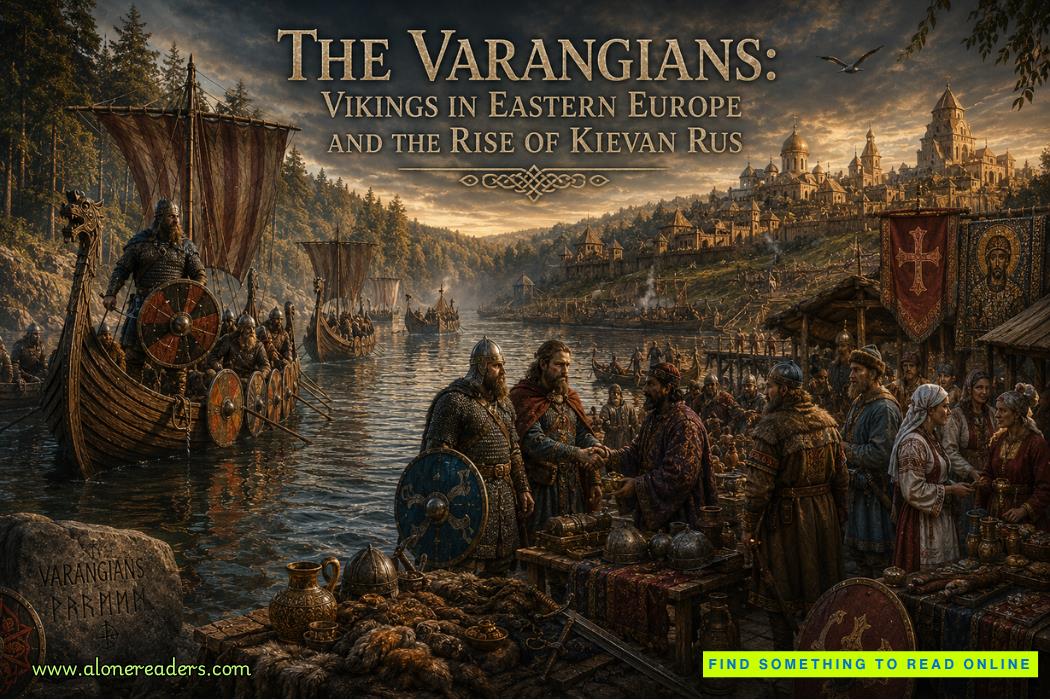
The story begins with the Varangians, Scandinavian adventurers who moved eastward from the Baltic during the 8th and 9th centuries. Unlike their western counterparts, who raided and settled in England and Francia, these eastern Vikings entered a world dominated by forests, river systems, and dispersed Slavic and Finnic tribes. Their success depended not on brute force alone, but on their ability to understand and master the geography of water. Rivers such as the Volga, Dnieper, and Western Dvina became their highways, allowing them to penetrate deep into the interior of the continent.
What made these rivers uniquely suited for expansion was their interconnectivity. The river systems of Eastern Europe formed a vast network linking the Baltic Sea to the Black Sea and the Caspian Sea. Through a series of portages—short overland crossings between rivers—Varangian traders could move goods across enormous distances. This created two primary routes: the Volga trade route, leading to the Islamic Caliphates, and the Dnieper route, which connected to the Byzantine Empire. These routes were not merely commercial pathways; they were strategic lifelines that defined the direction and success of Rus expansion.
Trade was the engine that powered this expansion. The Rus were not initially empire builders; they were merchants. They dealt in furs, honey, wax, and slaves—commodities highly valued in both the Islamic world and Byzantium. In return, they acquired silver coins, luxury goods, and cultural influences. The influx of silver, particularly from Abbasid dirhams, transformed the Rus economy. Hoards of these coins have been discovered across Eastern Europe, indicating not only wealth accumulation but also the integration of the Rus into a broader economic system. This flow of wealth created incentives for settlement, control, and eventually governance.
However, trade routes required protection. Rivers could be navigated, but they were also vulnerable. Rapids, especially along the Dnieper, posed natural hazards, while rival tribes and competing groups threatened caravans. To secure these routes, the Rus began establishing fortified settlements at key points. These were not random outposts; they were strategically positioned nodes of control, often located near portages or river junctions. Over time, these settlements evolved into urban centers—Novgorod in the north and Kiev in the south being the most prominent.
Kiev, in particular, became the focal point of Rus political power. Its location along the Dnieper made it a critical hub for trade with Byzantium. Control of Kiev meant control of the southern trade route, and thus access to immense wealth and diplomatic influence. When Oleg of Novgorod seized Kiev in the late 9th century, he effectively unified the northern and southern routes, laying the foundation for a centralized polity. This was a turning point: the Rus were no longer just traders; they were rulers.
The emergence of political authority among the Rus was deeply tied to their role as intermediaries. They did not produce the goods they traded; instead, they facilitated exchange between distant cultures. This position gave them leverage. By controlling access to trade routes, they could impose tribute on local populations and regulate commerce. Slavic tribes, initially independent, were gradually incorporated into this system. The Rus elite became a ruling class, extracting resources while maintaining order along the river routes, though always through a balance of coercion and cooperation.
The relationship between trade and power is especially evident in the Rus’ dealings with Byzantium. The Dnieper route led directly to Constantinople, one of the wealthiest cities in the world. Rus traders and warriors frequently traveled there, sometimes as merchants, sometimes as raiders. Over time, this relationship evolved into a more structured form. Treaties were established, granting the Rus favorable trading rights in exchange for military service. The Varangian Guard, an elite unit of the Byzantine army composed largely of Rus warriors, stands as a testament to this connection. This was not merely diplomacy; it was a fusion of economic and military power.
Religion also played a role in consolidating political authority. The conversion of Vladimir the Great to Christianity in 988 was not only a spiritual decision but a strategic one. By adopting Byzantine Christianity, the Rus aligned themselves culturally and politically with a powerful empire. This move helped legitimize the ruling elite and provided a unifying framework for a diverse population. It marked the transition from a loosely connected network of trade centers to a more cohesive state.
Yet, the expansion of the Rus was not without its tensions. The very rivers that enabled growth also imposed limitations. Seasonal changes could disrupt navigation, while the vast distances between settlements made centralized control difficult. Local elites often retained significant autonomy, leading to periodic fragmentation. Moreover, the reliance on trade meant that shifts in external markets, such as changes in the Islamic world’s demand for goods, could have profound effects on the Rus economy.
Despite these challenges, the legacy of the Rus expansion is unmistakable. It reshaped the political and cultural landscape of Eastern Europe. The river based network they established became the backbone of regional interaction for centuries. Cities like Kiev and Novgorod emerged as centers of power, culture, and religion. The blending of Scandinavian, Slavic, and Byzantine elements created a unique civilization that would influence the development of Russia, Ukraine, and Belarus.
One of the most striking aspects of this history is how geography dictated destiny. The Rus did not impose a rigid structure upon the land; they adapted to it. Their ships were designed for both river and sea travel, allowing them to move seamlessly between different environments. Their settlements were placed with an acute awareness of strategic advantage. In many ways, their success lay in their ability to read the landscape, not as an obstacle, but as an opportunity.
The concept of political power in the Rus world was therefore inseparable from control over movement. Unlike land based empires that relied on roads and fortifications, the Rus operated within a fluid environment. Power was exercised through mobility, access, and connectivity. To dominate a river was to dominate the region it served. This form of power was both dynamic and fragile, requiring constant maintenance and negotiation.
In examining the Rus expansion, it becomes clear that it was not a linear process of conquest. It was a complex interplay of trade, geography, and adaptation. The rivers were not just routes; they were the foundation upon which an entire political and economic system was built. The Rus did not simply travel these waterways; they transformed them into instruments of influence.
By the eleventh century, the network established by the Rus had reached its peak. Trade flourished, cities thrived, and political structures became more defined. Yet, the seeds of decline were also present. Internal divisions, shifting trade patterns, and external pressures would eventually weaken the system. Nevertheless, the achievements of the Rus during their expansion remain a powerful example of how environment and human ambition can intersect to create lasting historical change.
What makes this story particularly compelling is its relevance to broader themes in history. The Rus expansion illustrates how economic incentives can drive political organization, how geography can shape cultural identity, and how connectivity can lead to both unity and fragmentation. It challenges the notion of the Viking Age as purely one of raiding and violence, revealing a more nuanced picture of exploration, adaptation, and state formation.
In the end, the rivers of Eastern Europe were more than just waterways. They were the stage upon which the Rus forged their identity, built their power, and connected distant worlds into a single, flowing system of exchange and authority.




 The Hundred Days Offensive: How the Allies Defeated Germany in World War I
 The Second Battle of the Marne: The Turning Point of World War I in 1918
 The Spring Offensive of 1918: Germany's Final Gamble to Win World War I
 The Treaty of Brest-Litovsk: How Russia Left World War I
 The Russian Revolution and World War I: How War Brought Down the Tsar
 The Zimmermann Telegram Explained: Germany's Secret Offer to Mexico in World War I