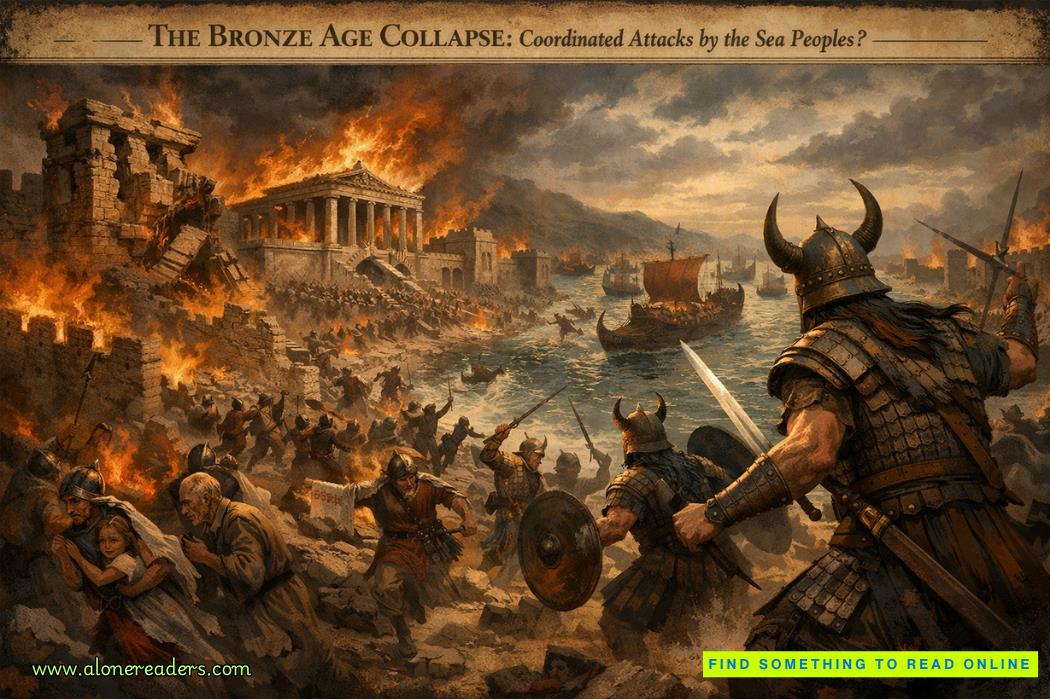
The end of the Late Bronze Age remains one of the most dramatic and puzzling turning points in ancient history. Around 1200 BCE, a network of powerful civilizations that had dominated the eastern Mediterranean for centuries suddenly disintegrated within a few decades. Kingdoms that had once flourished through trade, diplomacy, and warfare collapsed into ruin. Great cities were burned, palace administrations disappeared, and international commerce abruptly halted. Historians refer to this transformation as the Bronze Age Collapse, a period when the interconnected world of the Late Bronze Age fragmented into isolated regional societies.
What makes this collapse so fascinating is not simply that civilizations fell—such events had occurred many times before—but that multiple major powers collapsed almost simultaneously. The once mighty Hittite Empire vanished entirely. Mycenaean palace centers in Greece were destroyed or abandoned. Cities along the Levantine coast such as Ugarit were burned to the ground. Even Egypt, one of the most resilient civilizations of antiquity, barely survived the turmoil. Such widespread destruction has led historians and archaeologists to ask a provocative question: was this collapse the result of coordinated attacks by a mysterious coalition known as the Sea Peoples?
The Late Bronze Age world was highly interconnected. Powerful states including Egypt, the Hittite Empire, Assyria, Babylonia, and the Mycenaean kingdoms maintained a complex diplomatic and economic network stretching across the eastern Mediterranean. Royal letters exchanged between kings reveal a system in which rulers referred to one another as “brother,” sent luxury gifts, and negotiated marriages between royal families. Trade routes transported copper from Cyprus, tin from distant regions, precious textiles, ivory, and exotic goods across the sea and through caravan networks. This interconnected system depended on political stability and reliable trade flows.
Bronze itself—an alloy of copper and tin—was the backbone of military and economic power. Since tin deposits were rare and widely dispersed, the Bronze Age economy required long-distance trade networks. Weapons, armor, tools, and ceremonial objects were produced from bronze across the Mediterranean. When these supply chains were disrupted, entire societies faced crisis. The collapse of international trade therefore had devastating consequences, compounding political instability and social upheaval.
Within this fragile but sophisticated system emerged a group that would later become legendary: the Sea Peoples. Egyptian inscriptions from the reigns of pharaohs such as Merneptah and Ramesses III describe mysterious invaders arriving by land and sea, attacking cities and threatening the borders of Egypt. These inscriptions depict groups with unfamiliar names—Sherden, Peleset, Denyen, Tjekker, Shekelesh, and others. They are portrayed as formidable warriors traveling with families, carts, and ships, suggesting migrations rather than simple pirate raids.
Egyptian reliefs carved into temple walls vividly depict these battles. Warships clash in naval combat while archers fire arrows from crowded decks. Enemy warriors wear distinctive helmets adorned with horns or feathered crests. The inscriptions accompanying these images claim that a massive coalition of foreign peoples swept across the Mediterranean, destroying kingdoms and attempting to invade Egypt itself. Ramesses III proudly recorded that he defeated them in both naval and land battles, preserving Egypt from the same fate that befell other regions.
This Egyptian narrative forms the foundation of the theory that the Sea Peoples played a decisive role in the Bronze Age Collapse. According to this interpretation, waves of coordinated invasions swept through the eastern Mediterranean, overwhelming established states that were already under strain. Archaeological evidence seems to support at least part of this picture. Many cities destroyed during the collapse show signs of violent destruction—burned layers, collapsed walls, and weapons scattered across ruins. Ugarit, once a thriving trading port, was abandoned after catastrophic attacks that ended its role in international commerce.
Clay tablets discovered at Ugarit reveal desperate pleas for assistance. In one letter, the king of Ugarit writes urgently to a neighboring ruler, warning that enemy ships have appeared and that the city’s defenses are unprepared. Another message suggests that Ugarit’s military forces were away on campaign when the attackers arrived, leaving the city vulnerable. Soon afterward, the city was destroyed and never rebuilt as a major political center. These fragments of correspondence offer chilling glimpses into the chaos of the era.
The theory of coordinated Sea Peoples attacks suggests that multiple migrating groups moved simultaneously across the Mediterranean, striking coastal cities and destabilizing entire regions. Some scholars propose that these groups originated in the Aegean or Anatolia, perhaps displaced by earlier conflicts or environmental crises. Others speculate that they included displaced Mycenaean warriors or refugees from collapsing kingdoms. In this scenario, the Sea Peoples were not a single ethnic group but a loose coalition united by opportunity and necessity.
What makes the theory particularly intriguing is the synchronization of destruction across vast geographic areas. Archaeological sites from Greece to Anatolia and the Levant reveal destruction layers dating roughly to the same period. Mycenaean palace centers such as Pylos and Mycenae experienced devastating fires. Hittite administrative centers disappeared. Coastal trading cities ceased functioning almost overnight. This pattern suggests that the collapse unfolded rapidly, spreading like a shockwave through the interconnected system of Bronze Age states.
Yet historians remain cautious about attributing the entire collapse solely to the Sea Peoples. Many scholars emphasize that complex societies rarely collapse because of a single cause. Instead, multiple stresses may have weakened the system long before the final catastrophes occurred. Environmental changes, earthquakes, famine, and internal rebellions may all have contributed to the breakdown of political authority. In such a fragile environment, even relatively small groups of invaders could trigger cascading failures.
Evidence of climate change during the late second millennium BCE suggests that prolonged droughts may have devastated agricultural production across parts of the eastern Mediterranean. Reduced harvests would have strained palace economies that relied on collecting and redistributing grain. Food shortages could lead to population movements, social unrest, and conflict between neighboring regions. Under these conditions, migrations by displaced populations might appear in historical records as sudden invasions.
Another factor may have been the vulnerability of highly centralized palace systems. Many Bronze Age societies were governed by elite administrative networks that controlled resources, labor, and trade through palace bureaucracies. While efficient in stable conditions, such systems could collapse quickly if administrative centers were destroyed. When palaces burned, record-keeping systems vanished, supply chains failed, and regional authority fragmented into smaller local powers.
The collapse of the Hittite Empire illustrates this vulnerability. For centuries the Hittites had dominated Anatolia with a sophisticated bureaucracy and powerful military. Yet by the early twelfth century BCE, the empire disappeared entirely from historical records. Its capital city, Hattusa, was abandoned and destroyed. Although invading forces may have contributed to the collapse, internal instability and economic strain likely weakened the empire long before the final destruction occurred.
Similarly, the Mycenaean world of Greece experienced dramatic upheaval. The grand palace complexes that had controlled trade and administration were destroyed or abandoned. Literacy in the Linear B script disappeared for centuries. Settlements shrank, and many regions entered what historians sometimes call a “dark age” of reduced population and limited cultural production. Whether these changes were caused by foreign invasions, internal revolts, or economic breakdown remains debated.
Despite these uncertainties, the legend of the Sea Peoples continues to captivate historians and the public alike. Egyptian inscriptions describe them as unstoppable raiders who had already destroyed powerful kingdoms before arriving at Egypt’s borders. One inscription claims that “no land could stand before their arms.” Such dramatic language has fueled speculation that the Sea Peoples formed a massive migratory coalition capable of overwhelming established states.
Some modern interpretations even suggest that the Sea Peoples may represent a large-scale movement of displaced populations triggered by systemic collapse across the Mediterranean. As trade networks failed and food shortages intensified, communities may have migrated in search of stability and resources. These migrations could appear in Egyptian records as coordinated invasions, even if they were actually waves of refugees and opportunistic raiders moving through a destabilized world.
Archaeology provides intriguing clues supporting the idea of migration. In the southern Levant, new pottery styles and settlement patterns appear shortly after the collapse. Some scholars associate these cultural changes with the arrival of groups such as the Peleset, often linked to the Philistines mentioned in later biblical traditions. These communities established new urban centers along the coast, suggesting that migrants may indeed have settled in regions previously dominated by other cultures.
Yet even if migrations occurred, the question remains whether the Sea Peoples acted in a coordinated campaign or whether their attacks were simply the final symptom of a collapsing international system. The Late Bronze Age world functioned like a tightly interconnected network. When one region experienced crisis, the effects quickly spread to others. Trade disruptions in one area could lead to shortages elsewhere, triggering political instability and further conflict.
This interconnected fragility has led some historians to compare the Bronze Age Collapse to modern systemic crises. Just as global supply chains today depend on stability and coordination, the Bronze Age economy relied on a delicate balance of trade, diplomacy, and resource distribution. When that balance failed, the consequences cascaded across the entire system.
The mystery of the Sea Peoples therefore remains partly unresolved. They undoubtedly played a role in the upheavals of the late thirteenth and early twelfth centuries BCE, as evidenced by Egyptian records and archaeological destruction layers. Yet whether they were the primary cause of the Bronze Age Collapse or merely one factor among many continues to be debated.
What is certain is that the collapse transformed the Mediterranean world. The centralized palace economies of the Bronze Age disappeared, giving way to smaller regional societies. Trade networks slowly reemerged over centuries, eventually laying the foundations for new civilizations such as classical Greece and the kingdoms of the Iron Age Near East.
In this sense, the Bronze Age Collapse represents both an ending and a beginning. It marked the dramatic fall of a complex international order that had dominated the eastern Mediterranean for centuries. Yet from the ruins emerged new cultures, technologies, and political systems that would shape the course of ancient history.
The image of mysterious fleets appearing on the horizon, cities burning, and empires falling continues to capture the imagination because it evokes a moment when the stability of an entire world vanished almost overnight. Whether the Sea Peoples were organized conquerors, displaced migrants, or opportunistic raiders exploiting a collapsing system, their story remains intertwined with one of history’s greatest unsolved mysteries.
More than three thousand years later, the Bronze Age Collapse still challenges historians to reconstruct the fragile networks that once connected ancient civilizations. It reminds us that even the most powerful societies depend on complex systems that can fail unexpectedly. And it leaves open a haunting question: were the Sea Peoples the architects of destruction, or simply the visible face of a deeper and more complex collapse?




 The Hundred Days Offensive: How the Allies Defeated Germany in World War I
 The Second Battle of the Marne: The Turning Point of World War I in 1918
 The Spring Offensive of 1918: Germany's Final Gamble to Win World War I
 The Treaty of Brest-Litovsk: How Russia Left World War I
 The Russian Revolution and World War I: How War Brought Down the Tsar
 The Zimmermann Telegram Explained: Germany's Secret Offer to Mexico in World War I