The story of the Lost Colony of Roanoke stands as one of the most unsettling enigmas in early American history, a disappearance so complete that it borders on the uncanny. In 1587, a group of English settlers arrived on Roanoke Island, off the coast of what is now North Carolina, under the sponsorship of Sir Walter Raleigh. Their goal was to establish a permanent English foothold in the New World. Instead, they vanished without a trace, leaving behind only fragments of clues, decades of speculation, and a mystery that continues to fuel historical debate and conspiracy theories centuries later.
The Roanoke settlement was not England’s first attempt at colonization, but it was the most ambitious to date. This group included not only soldiers and laborers but also women and children, signaling an intent to build a lasting community rather than a temporary outpost. Among them was Virginia Dare, the first known English child born in the Americas, a symbolic figure whose fate would become inseparable from the colony’s disappearance. The settlement was overseen by John White, an artist and cartographer whose visual records remain some of the most valuable sources on early English-Native American contact.
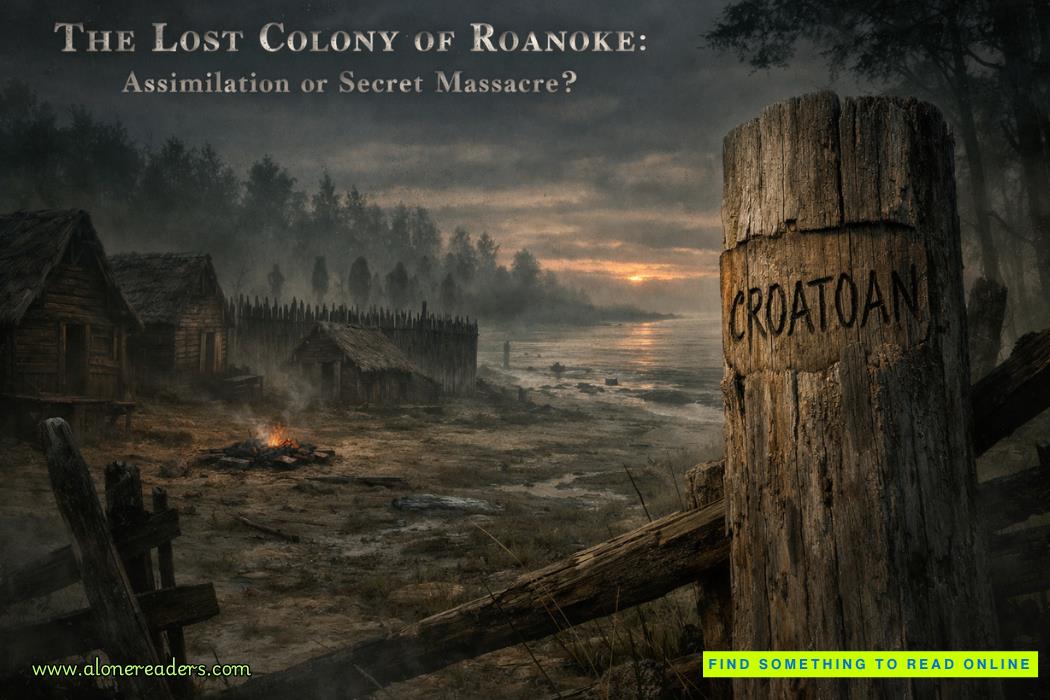
Shortly after establishing the colony, White was forced to return to England to secure supplies. Political turmoil and war with Spain delayed his return for nearly three years. When he finally came back in 1590, he found the settlement abandoned. Homes had been dismantled rather than destroyed, no bodies were found, and there were no signs of a struggle. The only clear message was the word CROATOAN carved into a wooden post, and the letters CRO etched into a nearby tree. White had previously agreed with the colonists that such markings would indicate their destination if they relocated. Yet storms and failing ships prevented him from following the trail, leaving the meaning of that message unresolved.
The theory of peaceful assimilation has long been the most widely accepted explanation among historians. According to this view, the colonists, weakened by disease, hunger, and isolation, may have sought refuge among nearby Native American tribes. The Croatoan people, who lived on present-day Hatteras Island, were known to be more friendly toward the English than other regional groups. Linguistic hints, later reports of European features among certain tribes, and accounts of Native Americans with gray eyes or English-style customs have all been cited as circumstantial evidence that the colonists were absorbed into local societies.
Supporters of the assimilation theory argue that the lack of violence at the site is telling. The structures were carefully taken down, suggesting an organized departure rather than a panicked escape. If the colonists were under attack, there would likely have been burned buildings, scattered possessions, or human remains. Instead, the site looked deliberately cleared. From a survival standpoint, assimilation would have been a rational decision. Alone and resupplied only sporadically, the colonists had little chance of enduring without local support.
However, assimilation does not fully explain why no definitive records of the colonists’ presence emerged later. While there were rumors among later English settlers, including those at the Jamestown Colony, none produced concrete proof. Some Native American leaders reportedly claimed that Europeans had once lived among their ancestors and were later killed, but these accounts were secondhand and filtered through colonial politics. The absence of physical artifacts conclusively linked to the Roanoke settlers remains a significant gap in the assimilation narrative.
This uncertainty has given rise to darker interpretations. The secret massacre theory posits that the colonists were killed, either by hostile Native American groups, by rival European powers, or even through internal conflict. Tensions between settlers and indigenous populations were common in the late sixteenth century, and English accounts often understated or omitted violent encounters. A massacre could have been intentionally concealed or gradually erased from the landscape, especially if survivors were taken captive or dispersed.
One variation of this theory suggests that political rivalries played a role. Spain, which claimed vast territories in the Americas, viewed English colonies as a direct threat. Spanish forces were known to eliminate foreign settlements when possible. A covert Spanish attack, followed by the removal or burial of evidence, is not outside the realm of historical plausibility. Yet Spanish records, which are extensive in many areas, contain no clear reference to such an operation against Roanoke.
Another possibility is conflict with neighboring tribes who initially tolerated the English presence but later turned hostile due to resource pressure or retaliation for earlier violence. The first Roanoke expedition in the 1580s had already strained relationships through raids and misunderstandings. If the colonists were attacked, the lack of remains could be explained by burial practices, scavenging, or relocation of captives. Over time, the physical traces of violence could have disappeared in the harsh coastal environment.
More controversial theories blend assimilation and massacre into a single narrative. In this view, some colonists may have integrated into Native communities, while others were killed or died from disease. Over generations, memories of these events could have merged into fragmented oral traditions that later Europeans misinterpreted or ignored. This hybrid explanation aligns with the complexity of human behavior in crisis situations, where survival, fear, and pragmatism often coexist.
Archaeological efforts have added both clarity and confusion to the debate. Excavations on Roanoke Island and nearby sites have uncovered European artifacts dating to the correct period, including tools and personal items. Some of these finds suggest English presence beyond the original settlement. Yet none can be conclusively tied to the entire colony, and critics argue that trade and later contact could explain their presence. Archaeology has narrowed the possibilities, but it has not delivered a definitive answer.
The mystery persists in part because it sits at the intersection of history and myth. The Lost Colony has become a symbol of early colonial vulnerability, a reminder that European expansion was not an inevitable march but a fragile experiment fraught with uncertainty. Each theory reflects broader themes: assimilation speaks to cultural exchange and adaptation, while massacre underscores violence, imperial rivalry, and the darker consequences of colonization.
Modern interpretations often reveal as much about contemporary anxieties as about the past itself. The idea of a secret massacre resonates with narratives of suppressed truths and hidden crimes, while assimilation challenges older assumptions about rigid cultural boundaries. The endurance of the Roanoke mystery lies in its refusal to conform neatly to a single explanation.
What makes Roanoke uniquely compelling is not just the disappearance, but the silence that followed. No survivor accounts, no definitive burial sites, no written confession or discovery ever emerged. History rarely leaves such clean voids. Whether the colonists chose to abandon their English identity to survive, were quietly erased by violence, or met a fate that combined both elements, their story remains unresolved.
In the end, the Lost Colony of Roanoke may never yield a final answer. The evidence is fragmentary, the sources incomplete, and the passage of time unforgiving. Yet this very uncertainty has elevated Roanoke from a failed colonial venture to one of history’s most enduring puzzles. It stands as a haunting question mark at the dawn of American history, inviting each generation to reconsider what survival, loss, and truth really mean in the shadowed margins of the past.



 The Hundred Days Offensive: How the Allies Defeated Germany in World War I
 The Second Battle of the Marne: The Turning Point of World War I in 1918
 The Spring Offensive of 1918: Germany's Final Gamble to Win World War I
 The Treaty of Brest-Litovsk: How Russia Left World War I
 The Russian Revolution and World War I: How War Brought Down the Tsar
 The Zimmermann Telegram Explained: Germany's Secret Offer to Mexico in World War I