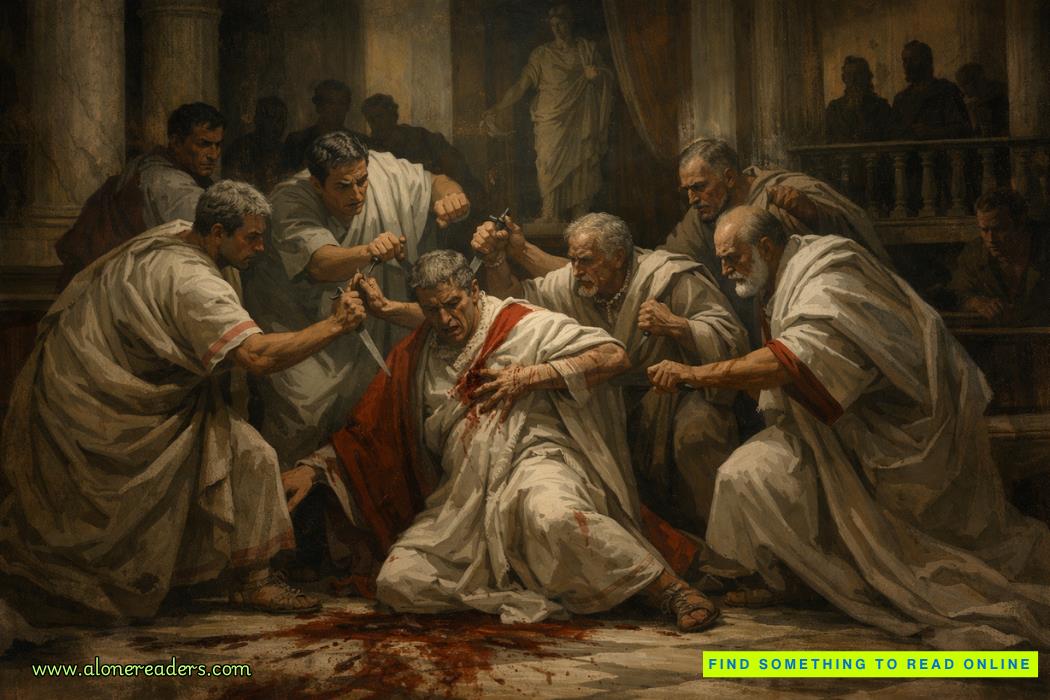
The assassination of Julius Caesar on the Ides of March in 44 BCE stands as one of the most dramatic political murders in recorded history. Popular memory often condenses this event into a single, emotionally charged moment: Caesar, betrayed by his trusted ally Marcus Junius Brutus, uttering words of disbelief as daggers fall. Yet this simplified narrative obscures a far more complex and unsettling reality. The murder of Caesar was not the impulsive act of a few idealistic republicans, but the outcome of a deep, multilayered conspiracy involving political elites, personal rivals, ideological extremists, and possibly silent beneficiaries who never held a blade.
By the time of his death, Caesar had accumulated unprecedented power. He was dictator perpetuo, master of Rome’s legions, and architect of reforms that unsettled the traditional senatorial order. For Rome’s aristocracy, this concentration of authority represented an existential threat. The Republic, already weakened by decades of civil war, factionalism, and corruption, was now balanced on a knife’s edge. While Brutus and Gaius Cassius Longinus are remembered as the ideological face of resistance, they were only the visible tip of a far larger coalition.
The group that assassinated Caesar reportedly numbered more than sixty senators. This alone suggests coordination far beyond a personal grievance. These men came from different political factions, some former supporters of Caesar, others long-time opponents. What united them was not republican purity, but fear. Caesar’s clemency toward former enemies, often portrayed as generosity, was interpreted by many as a strategic tool that left them indebted, humiliated, and permanently vulnerable. In Roman political culture, mercy could be more dangerous than punishment.
Brutus himself embodies the contradictions of the conspiracy. Publicly, he was celebrated as a descendant of the legendary founder of the Republic, Lucius Junius Brutus. Privately, he was a man shaped by debts, personal loyalties, and philosophical ideals that often clashed with political reality. Ancient accounts reveal that Brutus was hesitant, even conflicted, and required sustained persuasion by Cassius and others. This raises a crucial question: if Brutus had to be convinced, who was doing the convincing, and why?
Cassius emerges as a more overtly driven figure. A seasoned soldier and fierce rival of Caesar, he harbored long-standing resentment. Yet even Cassius lacked the stature needed to legitimize the assassination in the eyes of Rome. This is where Brutus became essential, not as mastermind, but as symbolic shield. His participation transformed murder into supposed moral duty. The elevation of Brutus after the fact, both in Roman rhetoric and later literature, conveniently narrowed blame and simplified a conspiracy that was anything but simple.
Beyond the named assassins, there existed a broader circle of passive conspirators. These were senators, equestrians, and power brokers who did not wield knives but created the conditions that made assassination possible. The Senate’s decision to heap excessive honors upon Caesar—statues among the gods, a golden chair, lifelong dictatorship—has often been interpreted as flattery. Yet many historians argue these honors were deliberately provocative, designed to push Caesar into a position where he appeared monarchical, thus justifying violent removal. If true, this represents a subtler, more insidious form of conspiracy.
Equally suspicious is the behavior of those who stood aside on the day itself. The assassination occurred in the Theatre of Pompey, not the Senate House proper. Security was minimal. Caesar’s loyal veterans were absent. Warnings, including ominous signs and personal alerts, failed to result in meaningful protection. Whether through negligence or quiet agreement, key officials allowed Caesar to walk unguarded into a trap. Inaction, in this case, was as decisive as action.
The role of Rome’s intellectual elite also deserves scrutiny. Figures like Cicero did not participate directly, yet their writings reveal deep hostility toward Caesar’s dominance. Cicero later distanced himself from the assassins’ failures, but his philosophical endorsement of tyrannicide helped legitimize the act in elite discourse. This ideological groundwork softened public resistance to murder as a political tool. Words, as much as daggers, shaped the outcome.
One of the most overlooked aspects of the conspiracy is the question of who benefited most from Caesar’s death. The immediate aftermath was chaos. The assassins lacked a coherent plan for governance. The Republic was not restored. Instead, Rome plunged into further civil wars that ultimately elevated Augustus as emperor. This outcome raises the possibility that some actors anticipated, or at least accepted, imperial transition rather than genuine republican revival. If so, Caesar’s death may have served as a necessary sacrifice to clear the path for a new order.
The conduct of Mark Antony further complicates the picture. Antony was close to Caesar, yet he was conveniently delayed on the morning of the assassination. His survival allowed him to shape the narrative afterward, most famously through his funeral oration. Whether Antony was merely outmaneuvered or intentionally spared remains a matter of debate. What is certain is that his actions ensured the conspirators’ failure and redirected popular anger against them.
Ancient sources, written largely by members or beneficiaries of the senatorial class, have shaped our understanding of these events. Their tendency to isolate blame onto a few moralized figures masks the uncomfortable truth that Caesar’s assassination was a collective elite decision, not a heroic last stand by republicans. The focus on Brutus serves history by providing a tragic protagonist, but it also functions as misdirection.
When viewed through the lens of political conspiracy, the assassination appears less like an act of idealism and more like a preemptive strike by a threatened ruling class. Caesar was dangerous not because he was uniquely tyrannical, but because he exposed the fragility and hypocrisy of the Republican system. He centralized power, yes, but he also revealed how easily Rome’s institutions could be manipulated by wealth, lineage, and violence. Killing him did not save the Republic; it merely postponed its collapse.
In this light, the “hidden plotters” are not shadowy unknown figures waiting to be named, but a network of interests that included senators seeking relevance, creditors protecting fortunes, generals calculating future wars, and intellectuals rationalizing bloodshed. Brutus, far from being the central villain or hero, becomes a tragic instrument, elevated precisely because his image could conceal the collective guilt of many.
The enduring fascination with Caesar’s assassination lies in this very ambiguity. It forces us to confront an uncomfortable reality about political violence: it is rarely the work of isolated fanatics. More often, it emerges from consensus, silence, and complicity. The daggers in the Senate were held by individuals, but the motive was institutional, woven into the fabric of Roman power itself.
Seen this way, the question is no longer whether there were plotters beyond Brutus, but how many of them history has allowed to remain invisible.




 The Hundred Days Offensive: How the Allies Defeated Germany in World War I
 The Second Battle of the Marne: The Turning Point of World War I in 1918
 The Spring Offensive of 1918: Germany's Final Gamble to Win World War I
 The Treaty of Brest-Litovsk: How Russia Left World War I
 The Russian Revolution and World War I: How War Brought Down the Tsar
 The Zimmermann Telegram Explained: Germany's Secret Offer to Mexico in World War I