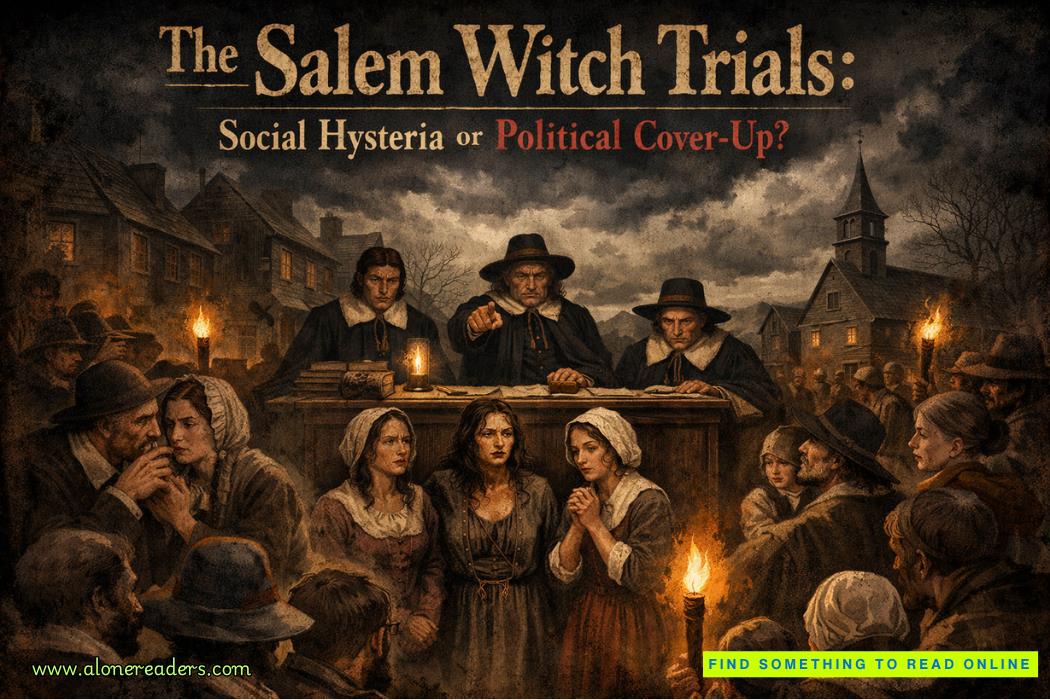
In the late seventeenth century, the small Puritan settlement of Salem Village in colonial Massachusetts became the epicenter of one of the most infamous episodes of mass accusation and judicial tragedy in American history. The Salem Witch Trials of 1692–1693 resulted in the arrest of more than two hundred people accused of witchcraft, the execution of twenty individuals, and the imprisonment of many others under harsh conditions. For centuries historians, psychologists, and conspiracy theorists alike have debated a fundamental question about the trials: were they merely the product of collective hysteria within a deeply religious society, or did deeper political and social forces manipulate the accusations as a deliberate cover-up for conflicts of power and influence within the Puritan community?
To understand the origins of the Salem Witch Trials, one must first examine the cultural environment of Puritan New England. The Puritans believed they were engaged in a spiritual struggle against evil forces. Their worldview was shaped by the conviction that the Devil actively worked within the world through witches and supernatural agents, seeking to undermine God’s chosen people. In such a theological framework, accusations of witchcraft were not irrational fantasies but perceived as legitimate threats to the spiritual survival of the community. The fear of invisible enemies combined with strict moral codes, creating an atmosphere where unusual behavior, illness, or misfortune could easily be interpreted as evidence of demonic influence.
The events that triggered the Salem hysteria began in the winter of 1692 when several young girls in the household of Reverend Samuel Parris began displaying strange symptoms. They screamed uncontrollably, contorted their bodies, and claimed to be tormented by invisible spirits. Physicians, unable to find a medical explanation, concluded that the girls were suffering from supernatural affliction caused by witchcraft. Under pressure from adults, the girls soon named several individuals whom they accused of tormenting them through magical means. Among the first accused were Tituba, an enslaved woman of Caribbean origin, Sarah Good, a homeless beggar, and Sarah Osborne, an elderly woman who had become socially unpopular in the village.
Once the accusations began, they spread with astonishing speed. More villagers came forward claiming they had been bewitched or attacked by spectral apparitions. The legal system of colonial Massachusetts allowed the use of “spectral evidence,” meaning that a person could be convicted based on testimony that their spirit had appeared in dreams or visions to harm someone. In a society already predisposed to believe in supernatural warfare between good and evil, such testimony was taken seriously. The result was a wave of arrests that rapidly engulfed the community.
The social dynamics of Salem Village played a critical role in the escalation of accusations. The village was deeply divided by economic rivalries, land disputes, and religious disagreements. Some families supported the authority of Reverend Parris, while others opposed his leadership and questioned his demands for higher compensation. These tensions created factions within the village that had been simmering for years before the witchcraft accusations erupted. When individuals began naming witches, they often accused people from rival families or those who were socially marginalized.
Many historians argue that the Salem Witch Trials represent a classic case of mass social hysteria fueled by fear, religious zeal, and community conflict. According to this interpretation, the trials were not orchestrated conspiracies but rather the tragic outcome of a society under psychological stress. Colonial New England in the late seventeenth century faced numerous crises. There were ongoing wars with Native American tribes on the frontier, outbreaks of disease, economic uncertainty, and political instability following the revocation of the Massachusetts colonial charter by the English Crown. These pressures created a climate of anxiety in which supernatural explanations for misfortune became increasingly persuasive.
In such an environment, the accusations of witchcraft offered a means of explaining suffering and restoring a sense of moral order. When the afflicted girls claimed that invisible witches were responsible for their torment, their stories resonated with a community already primed to believe in spiritual warfare. The legal system, influenced by theological doctrine, accepted these claims as credible evidence. What followed was a self-reinforcing cycle in which accusations generated more accusations, and fear spread from household to household.
Yet despite the compelling case for mass hysteria, another interpretation has persisted among some researchers and conspiracy theorists. According to this alternative view, the Salem Witch Trials may have served as a political cover-up for deeper struggles within the colonial leadership of Massachusetts. Proponents of this theory point to the intense factionalism that divided the colony’s political and religious elites during the period.
In 1692 Massachusetts was undergoing significant political transformation. The colony had recently lost its original charter and was reorganized under a new royal government appointed by the English Crown. This transition created power struggles between different factions seeking to influence the new political order. Some historians suggest that the witchcraft crisis conveniently diverted attention from these conflicts, allowing certain leaders to consolidate authority while the public focused on the alleged supernatural threat.
Supporters of the political conspiracy theory often highlight the role of Governor William Phips, who established the special Court of Oyer and Terminer to prosecute the accused witches. The court operated with extraordinary powers and accepted controversial forms of evidence. Critics argue that the trials allowed colonial authorities to demonstrate their commitment to maintaining order and religious purity at a time when their political legitimacy was uncertain.
Another element frequently cited by conspiracy theorists is the pattern of accusations within Salem Village itself. Many of those accused of witchcraft belonged to families involved in disputes over land ownership or economic competition. Some scholars believe that the trials may have been used as a tool to eliminate rivals and redistribute property. Once someone was convicted of witchcraft, their assets could be confiscated, potentially benefiting neighbors or political allies.
For example, the wealthy farmer George Burroughs, a former minister of Salem Village, was accused of witchcraft and eventually executed. Burroughs had conflicts with several influential families in the region, and some historians argue that these disputes may have contributed to the accusations against him. Similarly, other victims of the trials were individuals who had previously challenged the authority of local leaders or were involved in contentious property disagreements.
While these cases suggest that personal motives may have influenced some accusations, it remains difficult to prove the existence of a coordinated political conspiracy behind the entire episode. The evidence available from court records and contemporary documents indicates that many participants genuinely believed they were confronting a real threat of witchcraft. The judges, ministers, and accusers often expressed deep religious conviction and fear of demonic influence.
Nevertheless, the political context of the trials cannot be ignored. The instability of colonial governance and the divisions within the Puritan leadership created conditions in which accusations could easily be exploited for strategic purposes. Even if the trials were not intentionally engineered as a cover-up, they may have served as an instrument through which existing power struggles were fought indirectly.
Another intriguing theory proposed by some researchers involves environmental factors. A hypothesis advanced in the twentieth century suggested that the strange behavior of the afflicted girls might have been caused by ergot poisoning, a condition resulting from consuming rye contaminated with a fungus that produces hallucinogenic compounds. Symptoms of ergot poisoning can include convulsions, hallucinations, and sensations of burning or crawling on the skin. If the girls had unknowingly ingested contaminated grain, their symptoms might have appeared supernatural to observers unfamiliar with the medical cause.
Although the ergot theory offers a possible explanation for the girls’ behavior, many historians remain skeptical because the pattern of accusations and testimonies does not fully match what would be expected from poisoning alone. The accusations were selective and often targeted individuals with whom the accusers had social conflicts, suggesting that cultural and psychological factors played a larger role.
By the late summer of 1692 the trials had reached their peak, with numerous executions carried out on Gallows Hill. However, doubts about the legitimacy of the proceedings began to grow among influential members of the clergy and government. The use of spectral evidence became increasingly controversial, and some ministers warned that innocent people might be condemned based on unreliable testimony. Eventually Governor Phips intervened, dissolving the Court of Oyer and Terminer and prohibiting further arrests.
In the months that followed, many of the remaining prisoners were released, and the hysteria gradually subsided. The colony later acknowledged that the trials had been a grave injustice. In the years after the crisis, several judges publicly expressed remorse, and the Massachusetts government eventually issued formal apologies and compensation to the families of victims.
The legacy of the Salem Witch Trials has endured for more than three centuries because the episode reveals how fear, belief, and power can combine to produce devastating consequences. Whether interpreted as a case of mass hysteria or as a politically manipulated event, the trials demonstrate the fragility of justice in times of crisis. When communities become convinced that hidden enemies threaten their survival, the temptation to abandon rational evidence and due process can become overwhelming.
Modern scholars generally conclude that the Salem Witch Trials were likely the result of multiple overlapping forces rather than a single cause. Religious ideology, social tensions, political uncertainty, and psychological contagion all contributed to the escalation of accusations. Individual motives—ranging from personal revenge to genuine fear—intertwined with institutional decisions that allowed unreliable evidence to determine life-and-death verdicts.
The debate over whether the trials were driven primarily by hysteria or by calculated political maneuvering continues to fascinate historians and conspiracy theorists alike. What remains undeniable is that the events of 1692 illustrate the profound dangers of unchecked suspicion and ideological certainty. In Salem Village, neighbors turned against neighbors, and a community consumed by fear lost its ability to distinguish accusation from truth.
Today the story of the Salem Witch Trials serves as a powerful historical warning. It reminds modern societies that panic, misinformation, and the manipulation of public fear can still threaten justice and social stability. Whether interpreted as a tragic mistake or a hidden struggle for power, the trials remain one of the most haunting examples of how easily a community can descend into persecution when reason is overshadowed by fear.




 The Hundred Days Offensive: How the Allies Defeated Germany in World War I
 The Second Battle of the Marne: The Turning Point of World War I in 1918
 The Spring Offensive of 1918: Germany's Final Gamble to Win World War I
 The Treaty of Brest-Litovsk: How Russia Left World War I
 The Russian Revolution and World War I: How War Brought Down the Tsar
 The Zimmermann Telegram Explained: Germany's Secret Offer to Mexico in World War I










