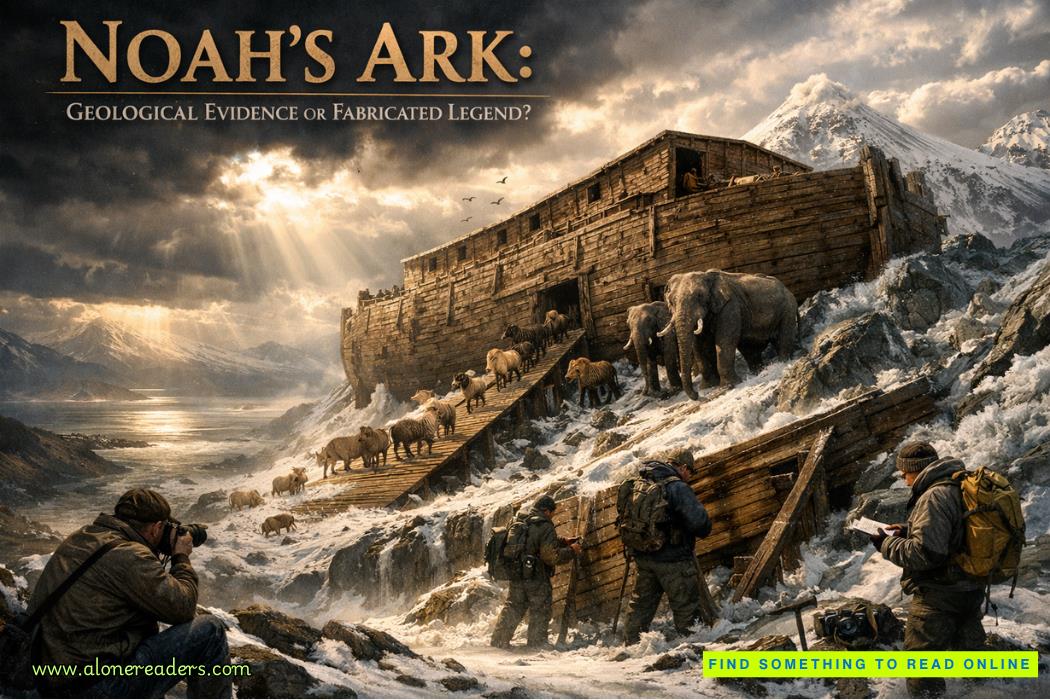
Few stories in human history have achieved the cultural reach and enduring intrigue of the tale of Noah’s Ark and the Great Flood. For thousands of years, the narrative has been passed down through sacred texts, oral traditions, and religious teachings, becoming one of the most widely recognized accounts in the world. According to the biblical Book of Genesis, humanity had fallen into deep corruption and moral decay. In response, God resolved to cleanse the earth through a catastrophic flood while sparing one righteous man—Noah—his family, and pairs of every animal species aboard a massive ark constructed according to divine instructions.
The narrative describes a vessel of extraordinary proportions: 300 cubits long, 50 cubits wide, and 30 cubits high, roughly translating to about 135 meters long, depending on the cubit measurement used. The ark was built from gopher wood, sealed with pitch, and designed with multiple decks to house animals, supplies, and Noah’s family. Rain poured for forty days and nights, and floodwaters covered the entire earth, destroying all terrestrial life not sheltered within the ark. After many months, the waters receded and the ark came to rest on the mountains of Ararat, where Noah and the surviving creatures repopulated the earth.
For believers, this account represents a literal historical event, evidence of divine judgment and redemption. For skeptics, however, the story is regarded as a symbolic myth or theological allegory, reflecting humanity’s ancient attempts to explain natural disasters and moral order. Between these two perspectives lies a fascinating debate involving geology, archaeology, comparative mythology, and historical interpretation.
One of the most compelling aspects fueling the ongoing controversy is the claim that physical evidence of Noah’s Ark may exist. Over the past century, numerous expeditions have ventured into the rugged terrain of eastern Turkey near Mount Ararat, the mountain traditionally associated with the ark’s resting place. The region’s glaciers, remote valleys, and unstable political environment have made exploration difficult, but this has not stopped adventurers, archaeologists, and treasure hunters from searching for remnants of the legendary vessel.
Several alleged discoveries have captured global attention. One of the most famous is the Durupınar formation, a boat-shaped geological structure discovered in 1948 by a Turkish Kurdish farmer after heavy rains exposed a large outline in the soil. Located about 30 kilometers south of Mount Ararat, the formation measures approximately the same length as the biblical ark description. In the 1970s and 1980s, amateur researcher Ron Wyatt claimed the site was the petrified remains of Noah’s Ark, citing ground-penetrating radar scans and unusual rock patterns as evidence.
Supporters of the theory argue that the formation’s symmetrical boat-like shape and internal patterns resembling ribs or structural beams suggest it may be the fossilized outline of a massive wooden vessel. Some researchers have even claimed to detect traces of iron rivets or metal fittings within the site, interpreting them as remnants of ancient construction.
However, most professional geologists strongly disagree with these interpretations. Detailed scientific analyses have concluded that the Durupınar structure is a natural geological formation created by mudflows and erosion, not an ancient ship. The symmetrical appearance, they argue, results from natural sediment layering and tectonic activity common in the region. According to mainstream geological consensus, there is no credible evidence that the formation is artificial or man-made.
Another source of fascination involves reports of mysterious wooden structures high on Mount Ararat itself. Over the years, several explorers have claimed to glimpse large, dark shapes protruding from glaciers, resembling the remains of a ship. Photographs and testimonies have occasionally surfaced, fueling speculation that the ark may be trapped beneath ice or volcanic rock.
In 2010, a Chinese evangelical exploration group known as Noah’s Ark Ministries International announced that they had discovered wooden compartments on Mount Ararat at an altitude of more than 4,000 meters. They released photographs and video footage showing wooden beams and chamber-like structures preserved in ice. According to their claims, carbon dating suggested the wood was thousands of years old, potentially aligning with the biblical flood timeline.
The announcement generated global headlines, yet it was met with immediate skepticism from scientists and historians. Critics pointed out that independent verification was never allowed, and several Turkish scholars accused the team of staging the discovery using wood transported to the site. Without controlled archaeological excavation or peer-reviewed analysis, the claims remain widely dismissed by the scientific community.
Beyond the search for the ark itself, another major area of investigation concerns whether a global flood ever occurred in human history. If the biblical narrative is historically accurate, geological records should show clear evidence of a worldwide flood event destroying terrestrial ecosystems simultaneously.
Modern geology, however, presents a different picture. Layers of sedimentary rock across the planet reveal a complex history spanning hundreds of millions of years. These layers contain fossils arranged in consistent chronological sequences, indicating that life evolved gradually over vast time scales. A sudden global flood within the last several thousand years would have disrupted this pattern dramatically.
Additionally, the logistical challenges of the ark story raise significant questions. The ark would need to house millions of species, including insects, reptiles, mammals, and birds. Maintaining sufficient food, fresh water, waste management, and ventilation for such an enormous population within a wooden vessel presents daunting practical challenges. Critics argue that the logistics would have been nearly impossible using ancient technology.
Despite these objections, proponents of the ark’s historical reality propose alternative interpretations. Some argue that the biblical text refers not to every species on Earth but to “kinds” of animals, suggesting that far fewer creatures were required aboard the ark. Others propose that many animals may have been represented by juveniles or eggs, reducing space and food requirements.
Another line of argument centers on the possibility that the flood described in Genesis was not global but a massive regional catastrophe remembered and later expanded through storytelling. Geological research indicates that several enormous floods occurred in the ancient Near East during the period when early civilizations were developing.
One of the most discussed examples is the Black Sea deluge hypothesis, which suggests that around 5600 BCE rising Mediterranean waters burst through the Bosporus Strait, rapidly flooding the Black Sea basin. Some researchers believe this catastrophic event may have inspired ancient flood traditions passed down through generations.
Interestingly, flood narratives appear in many cultures across the world. The ancient Mesopotamian Epic of Gilgamesh, written more than a thousand years before the biblical text was compiled, contains a remarkably similar story of a righteous man building a massive boat to survive a divine flood. In that version, the hero Utnapishtim saves animals and humans from destruction before his vessel comes to rest on a mountain.
Similar flood myths exist in Greek, Hindu, Chinese, and Indigenous American traditions. The widespread presence of these stories suggests that catastrophic flooding was a recurring experience in ancient societies, leaving deep impressions on cultural memory.
From a historical perspective, the biblical account may represent a theological adaptation of older Mesopotamian flood traditions, reshaped to convey moral and spiritual lessons within the Hebrew religious framework. Rather than documenting a literal global catastrophe, the story may have served as a powerful narrative about justice, survival, and divine covenant.
Yet the persistence of ark searches and geological debates demonstrates that the story continues to occupy a unique space between faith and science. For many believers, the absence of definitive archaeological proof does not diminish the narrative’s truth. Faith traditions often interpret sacred texts through spiritual meaning rather than empirical evidence.
At the same time, historians and scientists emphasize the importance of methodical investigation and verifiable evidence. Archaeology requires controlled excavation, peer-reviewed research, and reproducible results. Extraordinary claims—such as the discovery of the remains of a massive prehistoric vessel on a mountain—require equally extraordinary proof.
The fascination with Noah’s Ark also reflects a broader human desire to connect ancient stories with tangible reality. Discovering physical evidence of the ark would not only validate one of the world’s most famous narratives but also provide insight into the cultural and environmental history of early civilizations.
Even without definitive proof, the story continues to inspire exploration, debate, and imagination. Mount Ararat remains a symbol of mystery, its icy slopes hiding secrets that may never be fully uncovered. Each new expedition and claim of discovery rekindles global curiosity about whether a fragment of the legendary vessel might still lie buried beneath layers of ice and volcanic rock.
Ultimately, the question of whether Noah’s Ark represents geological evidence or a fabricated legend may never be conclusively answered. The narrative occupies a unique intersection where religion, mythology, archaeology, and science meet. It invites both skepticism and wonder, encouraging humanity to examine how ancient traditions shape modern understanding of history.
What remains undeniable is the enduring power of the story itself. For millennia, the tale of a man, a boat, and a world-changing flood has captured human imagination across cultures and generations. Whether interpreted as literal history, symbolic myth, or cultural memory of ancient disasters, Noah’s Ark continues to stand as one of the most compelling and debated narratives ever recorded.




 The Hundred Days Offensive: How the Allies Defeated Germany in World War I
 The Second Battle of the Marne: The Turning Point of World War I in 1918
 The Spring Offensive of 1918: Germany's Final Gamble to Win World War I
 The Treaty of Brest-Litovsk: How Russia Left World War I
 The Russian Revolution and World War I: How War Brought Down the Tsar
 The Zimmermann Telegram Explained: Germany's Secret Offer to Mexico in World War I