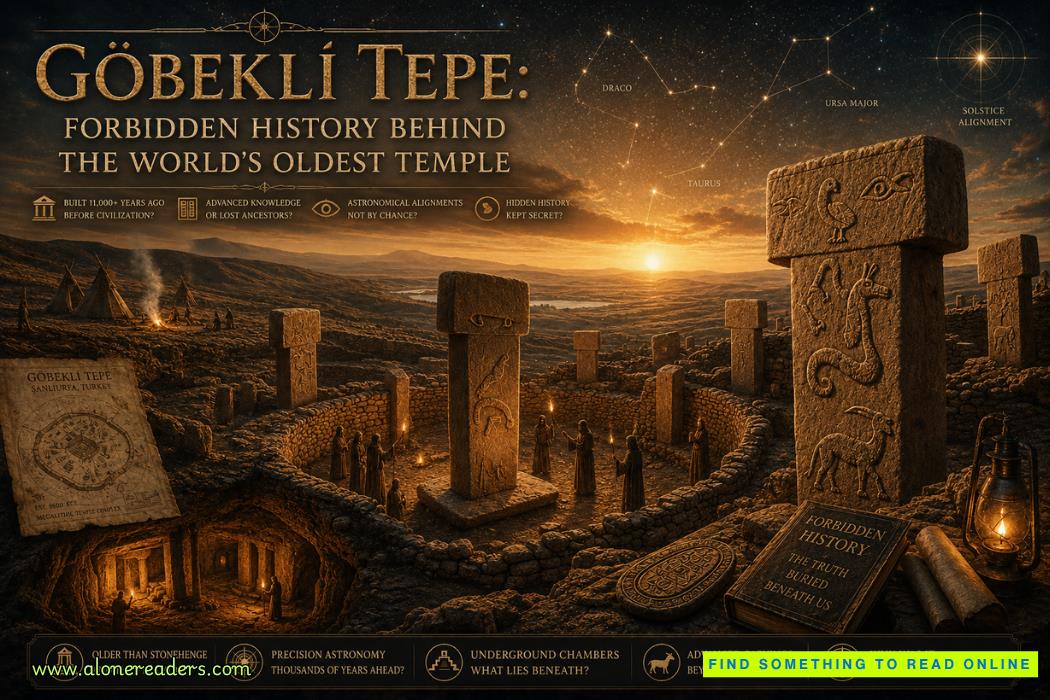
Long before the pyramids of Egypt rose above the desert sands, before Stonehenge marked the skies of prehistoric Britain, and even before the earliest cities of Mesopotamia emerged from the Fertile Crescent, an astonishing complex of stone monuments stood upon a hill in what is now southeastern Turkey. Known today as Göbekli Tepe Excavations, the site has radically transformed humanity’s understanding of prehistoric civilization. Often described as the world’s oldest known temple, Göbekli Tepe has become one of the most controversial archaeological discoveries of the modern era, not only because of its immense age but because of the disturbing questions it raises about the origins of organized society, religion, and advanced human knowledge.
Official archaeological dating places Göbekli Tepe at approximately 9600 BCE, meaning the earliest structures were erected more than 11,000 years ago. This timeline alone is enough to shock historians. According to conventional historical models, humanity at that time consisted primarily of small bands of nomadic hunter-gatherers struggling for survival after the end of the last Ice Age. Agriculture was supposedly in its infancy, cities did not yet exist, and complex organized religion had not fully developed. Yet Göbekli Tepe appears to contradict nearly every assumption embedded within that narrative.
The site consists of massive circular enclosures built from carefully carved limestone pillars, some weighing more than 15 tons. Many of these pillars are shaped like giant “T” forms and decorated with intricate carvings of animals including foxes, snakes, boars, vultures, lions, scorpions, and birds. Some pillars also display abstract symbols, humanoid arms, belts, and loincloths, suggesting that the stones themselves may represent stylized human or divine figures. What makes the site extraordinary is not only the craftsmanship but the organizational sophistication required to build it. Transporting and erecting these enormous stones would have required coordinated labor, engineering knowledge, and social structures far beyond what conventional historians previously attributed to hunter-gatherer populations.
This contradiction has made Göbekli Tepe fertile ground for alternative historians and conspiracy theorists who argue that mainstream archaeology has either misunderstood or deliberately downplayed the implications of the site. Among these theories is the belief that Göbekli Tepe represents evidence of a forgotten advanced civilization that existed before recorded history and was later destroyed by catastrophic events. Supporters of this theory often connect Göbekli Tepe to legends of Atlantis, lost Ice Age civilizations, or mysterious global cultures supposedly erased by floods, comet impacts, or sudden climate collapse.
One of the most influential ideas associated with Göbekli Tepe involves the concept of “forbidden history.” According to this perspective, certain discoveries challenge deeply rooted academic paradigms so severely that institutions become resistant to fully accepting them. Proponents argue that Göbekli Tepe threatens the traditional linear model of civilization, where agriculture leads to permanent settlements, which then lead to organized religion and monumental architecture. Instead, Göbekli Tepe appears to suggest the reverse possibility: that religion or spiritual gathering may have come first, motivating humans to organize socially and eventually develop agriculture to support increasingly complex ritual centers.
This reversal is profoundly important because it changes the philosophical story of civilization itself. Rather than humans gradually becoming spiritual after achieving material stability, Göbekli Tepe implies that spiritual or symbolic motivations may have been the primary force that pushed humanity toward civilization. In other words, belief may have built civilization before survival economics did.
The mystery deepens further when examining the site’s deliberate burial. Around 8000 BCE, long after the site had been used for centuries, the enclosures were intentionally filled with massive amounts of soil, debris, animal bones, and tools. This was not the result of natural collapse. The structures were carefully buried by human hands. Archaeologists still debate why this occurred. Some researchers believe it was a ritual closure process. Others speculate the builders wanted to preserve the sacred complex from enemies, environmental disaster, or cultural transition. Conspiracy theorists often interpret the burial as evidence that the builders possessed knowledge they wanted hidden from future generations.
The astronomical theories surrounding Göbekli Tepe have added another layer of fascination. Some researchers claim the pillars and enclosures may align with celestial bodies or constellations. Particular attention has focused on carvings involving vultures, scorpions, and other symbolic animals that some believe correspond to zodiac constellations. One controversial interpretation argues that Göbekli Tepe records a cosmic catastrophe, possibly linked to a comet impact around 10,800 BCE during the Younger Dryas period, a sudden climatic cooling event that dramatically altered Earth’s environment.
According to this theory, fragments from a comet struck Earth, causing widespread devastation, extinctions, fires, and abrupt climate change. Supporters claim certain carvings at Göbekli Tepe function as symbolic astronomical records of this disaster. If true, the site would not merely be a temple but a prehistoric archive documenting one of humanity’s greatest forgotten catastrophes. Critics argue that such interpretations rely heavily on symbolic speculation and lack definitive proof, but the theories continue to attract public fascination because they connect archaeology with ancient flood myths and apocalyptic legends found across many cultures.
Another controversial aspect involves the apparent sophistication of the stonework itself. While mainstream archaeologists maintain that prehistoric humans were fully capable of such engineering using stone tools and coordinated labor, alternative researchers question whether conventional explanations sufficiently account for the precision and scale involved. Some theorists argue that knowledge from an earlier advanced civilization may have survived the Ice Age and been transmitted to the builders of Göbekli Tepe. Others go even further, suggesting extraterrestrial involvement or lost technologies, although such claims remain highly speculative and unsupported by mainstream evidence.
Despite the sensationalism surrounding some conspiracy theories, Göbekli Tepe genuinely has forced archaeology to reconsider long-standing assumptions. Prior to its discovery, monumental architecture was believed to emerge only after the development of agriculture and urban societies. Yet Göbekli Tepe predates these developments by thousands of years. The discovery has therefore encouraged scholars to rethink how complex social organization emerged among prehistoric humans.
Excavations led by German archaeologist Klaus Schmidt brought international attention to the site after the mid-1990s. Schmidt became convinced that Göbekli Tepe was not a settlement but a ritual center visited by groups from surrounding regions. He described it as a “cathedral on a hill,” emphasizing its spiritual significance. Importantly, relatively few domestic structures were initially discovered at the site compared to the monumental enclosures, strengthening the argument that Göbekli Tepe served ceremonial rather than residential purposes.
However, newer excavations have complicated this interpretation. Evidence of domestic activity, food preparation, and water management systems suggests the site may have supported longer-term occupation than previously believed. This ambiguity has intensified debates about the true nature of the community that built Göbekli Tepe. Were they nomadic pilgrims? Early settlers? Priestly elites? Survivors of an older culture? The uncertainty continues to fuel speculation.
The animal imagery carved into the pillars remains among the site’s most haunting features. Unlike later agricultural civilizations that prominently depicted domesticated animals, Göbekli Tepe’s carvings focus heavily on wild and often dangerous creatures. Snakes coil across pillars, vultures spread their wings, predators stalk prey, and scorpions appear in threatening poses. Some scholars interpret this imagery as evidence of shamanistic beliefs or ritual interaction with the natural world. Others suggest the carvings may symbolize death, transformation, protection, or cosmic forces.
Particularly controversial are theories involving excarnation rituals, where vultures consume the bodies of the dead before burial. Some carvings appear to depict headless human figures alongside birds, leading researchers to speculate that Göbekli Tepe may have functioned partly as a mortuary ritual site. If true, this would connect the temple to ancient beliefs about death, the soul, and the transition between worlds.
The location of Göbekli Tepe also contributes to its significance. Situated within the Fertile Crescent, the region is considered one of the birthplaces of agriculture and early civilization. Nearby sites reveal evidence of early wheat domestication and evolving human settlement patterns. Some researchers believe the need to feed large groups gathering at Göbekli Tepe may have accelerated the development of agriculture itself. In this interpretation, religion did not emerge from farming societies; rather, farming emerged to sustain religious societies.
This idea fundamentally reshapes conventional history. If true, temples may have created civilization instead of civilization creating temples.
The phrase “forbidden history” surrounding Göbekli Tepe is also driven by public frustration with how slowly paradigm shifts occur within academic institutions. Many people view the site as evidence that mainstream historical narratives are incomplete or overly rigid. Social media, documentaries, and alternative history books have amplified these perceptions, often presenting Göbekli Tepe as proof that humanity’s past is far older and stranger than officially acknowledged.
However, it is important to distinguish between legitimate scientific uncertainty and unsupported sensationalism. Archaeologists do not deny Göbekli Tepe’s revolutionary significance. In fact, many scholars openly describe the site as one of the most important archaeological discoveries ever made. The disagreement lies not in whether Göbekli Tepe is extraordinary, but in how far its implications should extend. Mainstream researchers generally argue that the site demonstrates the underestimated capabilities of prehistoric humans rather than evidence of vanished super-civilizations.
Still, unanswered questions remain immense. Only a fraction of Göbekli Tepe has been excavated. Ground-penetrating surveys suggest numerous additional structures remain buried beneath the soil. Every new excavation season reveals more complexity, more symbolism, and more architectural sophistication. This incompleteness leaves room for speculation and ensures the site’s mysteries will continue captivating both scholars and the public for decades.
The psychological appeal of Göbekli Tepe conspiracy theories is also worth understanding. Human beings are naturally drawn to hidden histories, forgotten knowledge, and lost civilizations. Such stories challenge established authority and offer the tantalizing possibility that ancient humans possessed wisdom modern societies have forgotten. In an age where institutional trust has weakened globally, discoveries like Göbekli Tepe easily become symbols of suppressed truths and hidden narratives.
Yet perhaps the real wonder of Göbekli Tepe does not require extraterrestrials, secret civilizations, or forbidden technologies. Perhaps the most astonishing reality is that prehistoric humans themselves were capable of far more imagination, organization, spirituality, and ambition than modern society once believed. The builders of Göbekli Tepe existed at the dawn of civilization, yet they envisioned something monumental enough to gather communities, move mountains of stone, and create sacred architecture whose meaning still echoes across eleven millennia.
Whether viewed through the lens of archaeology, spirituality, or conspiracy theory, Göbekli Tepe stands as one of humanity’s greatest enigmas. It occupies the blurred boundary between history and myth, science and speculation, evidence and imagination. Its towering pillars silently challenge the arrogance of modern assumptions, reminding humanity that the distant past may be far more complex than textbooks once suggested.
The enduring fascination of Göbekli Tepe lies precisely in this uncertainty. It is a place where the known world of archaeology collides with the unknown possibilities of forgotten history. Every carved stone, every buried chamber, and every mysterious symbol invites deeper questions about who we are, where civilization truly began, and how much of humanity’s earliest story may still remain hidden beneath the earth.



 The Hundred Days Offensive: How the Allies Defeated Germany in World War I
 The Second Battle of the Marne: The Turning Point of World War I in 1918
 The Spring Offensive of 1918: Germany's Final Gamble to Win World War I
 The Treaty of Brest-Litovsk: How Russia Left World War I
 The Russian Revolution and World War I: How War Brought Down the Tsar
 The Zimmermann Telegram Explained: Germany's Secret Offer to Mexico in World War I










