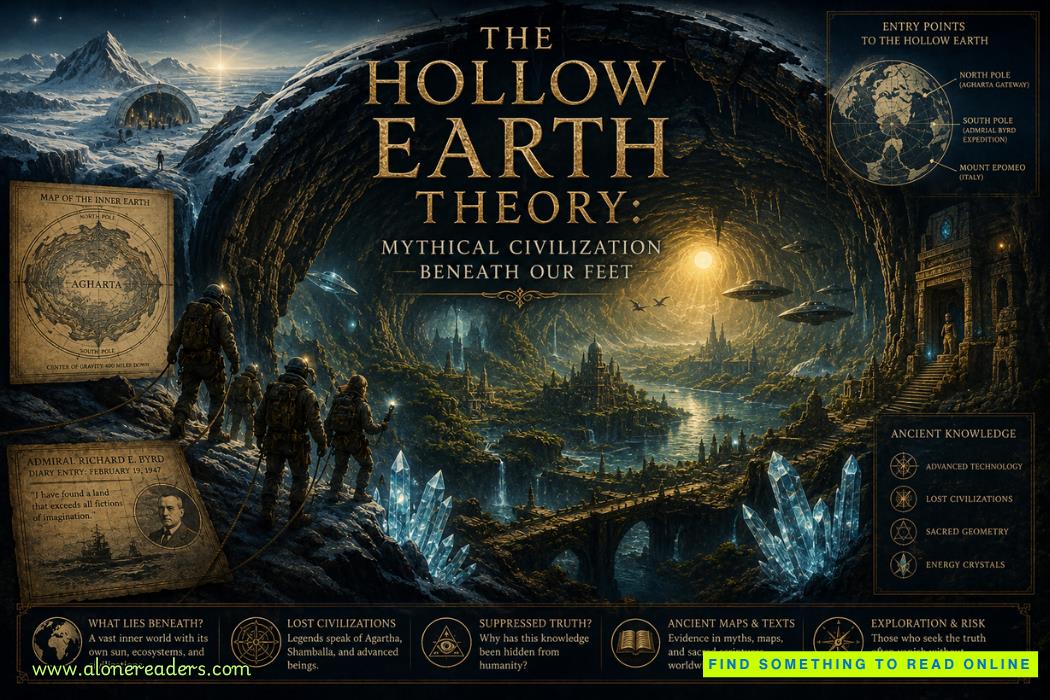
The idea that an entire world might exist beneath the surface of the Earth has fascinated humanity for centuries. Long before modern geology explained the structure of the planet, myths, legends, religious traditions, and speculative theories imagined hidden realms below the ground where mysterious beings, forgotten civilizations, or supernatural entities lived in secret. Among these ideas, the Hollow Earth Theory became one of the most enduring and controversial concepts in the history of pseudoscience and conspiracy culture. According to this theory, the Earth is not entirely solid but contains enormous hollow spaces inside, sometimes inhabited by advanced civilizations, ancient races, or lost human societies hidden from the surface world.
What makes the Hollow Earth Theory particularly fascinating is that it exists at the intersection of mythology, speculative science, exploration history, political conspiracy, occult belief, and science fiction. Over time, it evolved from philosophical speculation into a global conspiracy narrative involving hidden entrances at the poles, secret Nazi expeditions, alien civilizations, and underground kingdoms such as Agartha and Shambhala. Even in the modern era, despite overwhelming scientific evidence disproving the theory, the concept continues to survive through books, films, internet communities, and conspiracy movements.
The roots of the Hollow Earth concept stretch deep into ancient history. Many early civilizations imagined the underworld not merely as a place of the dead but as an entire hidden realm beneath human civilization. Ancient Greek mythology described Hades as a vast underground domain ruled by the god of the same name. Norse mythology spoke of subterranean worlds such as Svartalfheim, home of dwarves and dark beings. Hindu and Buddhist cosmologies described underground realms inhabited by serpent-like beings known as Nagas. These myths were not scientific theories, yet they established the enduring human imagination of worlds beneath the Earth’s crust.
During the seventeenth and eighteenth centuries, European thinkers began attempting to explain the planet’s structure through speculative scientific models. One of the earliest formal Hollow Earth proposals came from astronomer Edmond Halley, famous for calculating the orbit of Halley’s Comet. In 1692, Halley suggested that the Earth might consist of multiple concentric shells separated by atmospheres and possibly inhabited internally. He proposed this partly to explain unusual variations in Earth’s magnetic field. Although his theory was based on limited scientific understanding of the era, it represented one of the first attempts to frame Hollow Earth ideas within scientific reasoning rather than mythology alone.
In the nineteenth century, the theory gained greater attention through the efforts of American military officer John Cleves Symmes Jr. Symmes passionately argued that the Earth was hollow and contained massive openings at both the North and South Poles. He claimed these polar holes provided access to the planet’s inner world. Symmes became so convinced of his theory that he lectured publicly across the United States and attempted to organize expeditions to locate these entrances. His ideas attracted followers and transformed Hollow Earth speculation into a genuine social movement. Although mainstream scientists rejected his claims, Symmes helped popularize the image of enormous polar gateways leading into hidden civilizations beneath the surface.
The nineteenth century was also an era of rapid exploration and imperial expansion. Large portions of the Arctic and Antarctic remained unknown to the public, creating fertile ground for speculation. Since few people had seen the polar regions directly, conspiracy theories about hidden entrances beneath the ice seemed plausible to some audiences. Reports of strange magnetic anomalies, unusual weather patterns, and unexplored territories fueled the imagination further. The mystery of the poles became central to Hollow Earth mythology.
Literature played an enormous role in spreading the theory into popular culture. French novelist Journey to the Center of the Earth imagined explorers descending into vast subterranean caverns filled with prehistoric creatures and hidden oceans. Although Verne’s work was fiction, it deeply influenced how people visualized underground worlds. Later writers expanded these concepts further, portraying entire advanced civilizations hidden beneath the Earth. These stories blurred the boundary between entertainment and speculative belief, especially among readers already fascinated by unexplored regions and occult mysteries.
One of the most influential mythical underground civilizations associated with Hollow Earth lore is Agartha. According to occult traditions emerging in the nineteenth and early twentieth centuries, Agartha was a hidden kingdom located beneath Asia or within the Earth’s interior. It was often described as an advanced utopian civilization possessing extraordinary technology, spiritual wisdom, and ancient knowledge lost to surface humanity. Some versions claimed Agartha was ruled by enlightened masters who secretly guided world events from below.
Related legends also connected Agartha with Shambhala, a mystical kingdom from Tibetan Buddhist tradition. Western occult writers transformed these religious concepts into elaborate conspiracy theories involving hidden tunnels, psychic powers, and secret subterranean networks. Over time, Agartha became central to many Hollow Earth narratives, symbolizing the idea that humanity’s true origins or forgotten wisdom existed beneath the planet rather than upon its surface.
The twentieth century introduced even more sensational versions of the theory. During and after World War II, conspiracy stories began linking the Hollow Earth with Nazi Germany. According to these myths, certain Nazi occult groups believed in subterranean civilizations and launched secret expeditions to Antarctica searching for entrances into the inner Earth. Some conspiracy narratives claimed the Nazis established hidden underground bases beneath Antarctica after the war, where they continued developing advanced technology away from public knowledge.
These stories became increasingly elaborate over time. Some claimed Nazi scientists discovered alien technology inside the Earth. Others alleged that flying saucers emerged from subterranean bases connected to Hollow Earth entrances. Although historians have found no credible evidence supporting such claims, the combination of secret military operations, Antarctica’s isolation, and postwar UFO hysteria created ideal conditions for conspiracy theories to flourish.
The Hollow Earth Theory also became deeply connected to UFO culture during the mid-twentieth century. Some believers proposed that UFOs were not extraterrestrial spacecraft from distant galaxies but vehicles operated by advanced underground civilizations living inside the Earth. In these interpretations, sightings of strange craft near mountains, oceans, or polar regions were interpreted as evidence of subterranean activity rather than alien visitation from outer space.
These ideas expanded further with claims that governments were hiding the truth about underground civilizations. Conspiracy theorists argued that secret organizations, military agencies, or global elites knew about the Earth’s hollow interior but suppressed the information to maintain political control. Some narratives claimed astronauts, polar explorers, or submarine crews had discovered entrances to the inner world but were silenced afterward. The theory gradually evolved from speculative geography into a broader worldview centered on distrust of official science and institutions.
Scientifically, however, the Hollow Earth Theory collapses under overwhelming evidence. Modern geology, seismology, and planetary physics provide detailed understanding of Earth’s internal structure. Seismic waves generated by earthquakes travel through the planet differently depending on the materials they encounter. By studying these waves, scientists have mapped the Earth’s internal layers with remarkable precision. The evidence clearly demonstrates that Earth consists of a solid inner core, liquid outer core, mantle, and crust rather than vast empty cavities.
Gravity measurements also contradict the theory. A hollow planet would behave very differently gravitationally than the Earth we observe. The planet’s density, rotational behavior, magnetic field, and tectonic activity all confirm a largely solid internal structure. Additionally, modern satellite imaging, polar exploration, and deep geological surveys have found no evidence of giant polar openings leading into subterranean worlds.
Yet despite scientific refutation, the Hollow Earth Theory remains culturally powerful. Part of its appeal lies in humanity’s enduring fascination with hidden worlds. Throughout history, unexplored places have often become containers for imagination and fear. When oceans were unmapped, people imagined sea monsters. When jungles were inaccessible, legends of lost cities emerged. When the poles remained mysterious, theories of hidden entrances flourished. The Hollow Earth represents humanity’s psychological attraction to the unknown.
Another reason for the theory’s persistence is its symbolic meaning. In many ways, the underground world functions as a metaphor for hidden truth. The idea that secret civilizations exist beneath everyday reality reflects broader human anxieties about power, knowledge, and control. Conspiracy theories often thrive because they offer alternative explanations for uncertainty, suggesting that hidden forces operate behind visible society. Hollow Earth mythology fits perfectly within this psychological framework.
Popular media has continued reinforcing the concept across generations. Films, novels, television series, comics, and video games frequently portray underground civilizations filled with ancient technology, monsters, or forgotten empires. These fictional portrayals keep the imagery alive even among people who do not literally believe the theory. Massive subterranean landscapes remain visually compelling because they combine exploration, danger, mystery, and wonder in a single concept.
The internet era has given the theory new life. Online communities now share maps of supposed underground tunnel systems, satellite images claimed to reveal polar openings, and speculative interpretations of geological anomalies. Social media algorithms often amplify sensational content, allowing fringe theories to spread rapidly to global audiences. Modern conspiracy culture also tends to merge multiple theories together, connecting Hollow Earth ideas with extraterrestrials, ancient civilizations, secret societies, and government cover-ups into vast interconnected narratives.
Some modern believers reinterpret the theory in less literal ways. Instead of imagining a completely hollow planet, they propose the existence of enormous underground ecosystems, hidden military complexes, or isolated subterranean habitats unknown to the public. Advances in underground engineering, deep cave exploration, and discoveries of microbial life deep beneath Earth’s surface sometimes fuel speculative reinterpretations. However, these scientific realities differ enormously from claims of giant hidden suns or advanced underground kingdoms.
Psychologists and sociologists studying conspiracy theories often note that such beliefs become more attractive during periods of uncertainty and social instability. The Hollow Earth Theory offers a sense of hidden order within a chaotic world. Believers may feel they possess secret knowledge unavailable to ordinary people, creating a powerful sense of identity and intellectual independence. This psychological dimension explains why disproving the theory scientifically does not necessarily eliminate belief in it.
The theory also reflects deeper philosophical questions about humanity’s place in the universe. Surface civilization often perceives itself as technologically advanced and fully informed, yet Hollow Earth narratives challenge that assumption by suggesting that superior civilizations may exist beyond human awareness. In this sense, the myth taps into ancient fears that humanity does not truly understand the world it inhabits.
Interestingly, certain real scientific discoveries unintentionally contribute to public fascination with underground mysteries. Vast cave systems, underground rivers, deep microbial ecosystems, and hidden geological chambers demonstrate that significant portions of Earth remain difficult to explore directly. The discovery of previously unknown subterranean ecosystems sometimes encourages imaginative speculation far beyond scientific evidence. While these discoveries do not support Hollow Earth claims, they remind people that the planet still contains many hidden environments.
The Hollow Earth Theory has also become a fascinating case study in the evolution of misinformation. Over centuries, the theory absorbed elements from mythology, religion, speculative science, fiction, occultism, nationalism, and internet culture. Each era reshaped the myth according to its own anxieties and obsessions. In ancient times, the underworld reflected spiritual cosmology. In the age of exploration, it reflected geographical mystery. During the Cold War, it merged with UFO fears and government secrecy. In the digital era, it became part of global online conspiracy culture.
Today, most people encounter the Hollow Earth concept primarily as entertainment rather than literal belief. Nevertheless, its persistence reveals something important about human imagination. People remain deeply attracted to stories suggesting that extraordinary realities exist beyond ordinary perception. The idea of hidden civilizations beneath our feet combines adventure, mystery, forbidden knowledge, and cosmic wonder into a single enduring narrative.
Ultimately, the Hollow Earth Theory survives not because of scientific credibility but because of its mythological power. It represents humanity’s ancient desire to believe that the world contains hidden dimensions waiting to be discovered. Whether imagined as spiritual kingdoms, advanced civilizations, alien bases, or lost human societies, the underground world continues to symbolize mystery itself. Even in an age of satellites, seismic imaging, and planetary science, the dream of secret realms beneath the Earth refuses to disappear completely.
The enduring popularity of the Hollow Earth Theory demonstrates that myths do not vanish simply because science disproves them. Instead, myths evolve, adapt, and survive because they speak to emotional and psychological needs that facts alone cannot fully replace. The theory remains one of history’s most remarkable examples of how imagination, fear, exploration, and conspiracy can merge into a cultural phenomenon that continues captivating audiences across generations.




 The Hundred Days Offensive: How the Allies Defeated Germany in World War I
 The Second Battle of the Marne: The Turning Point of World War I in 1918
 The Spring Offensive of 1918: Germany's Final Gamble to Win World War I
 The Treaty of Brest-Litovsk: How Russia Left World War I
 The Russian Revolution and World War I: How War Brought Down the Tsar
 The Zimmermann Telegram Explained: Germany's Secret Offer to Mexico in World War I










