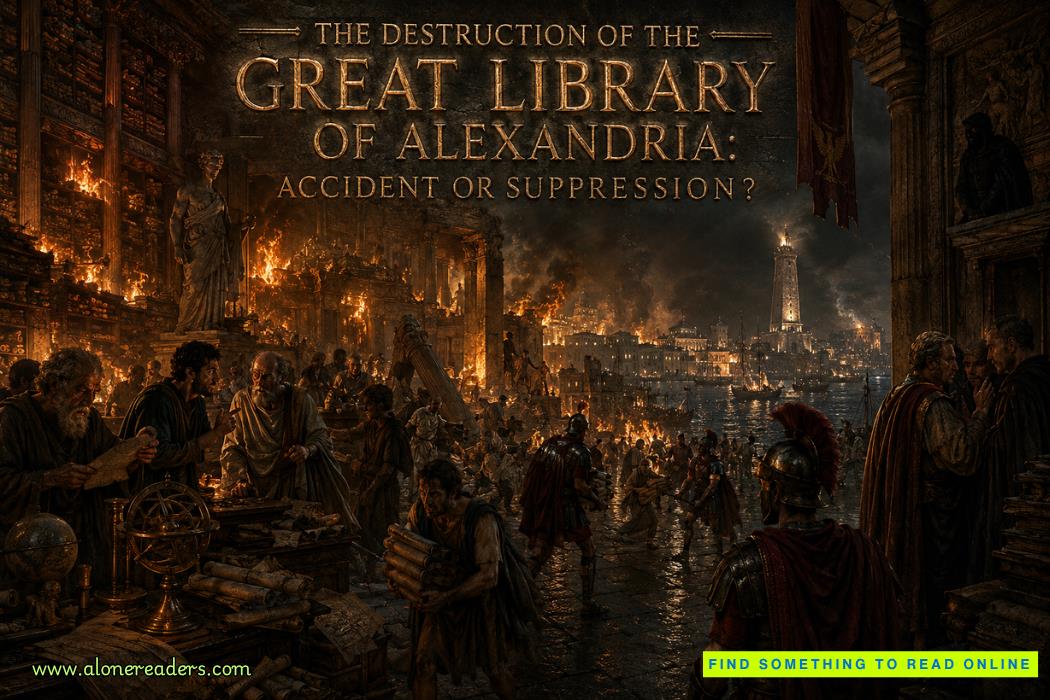
The destruction of the Great Library of Alexandria remains one of the most debated intellectual tragedies in human history. Few events have generated as much speculation, mythmaking, and historical controversy as the disappearance of the ancient world’s most famous center of knowledge. For centuries, historians, philosophers, political thinkers, and conspiracy theorists have asked the same haunting question: Was the library destroyed accidentally through war and neglect, or was it intentionally erased because its knowledge threatened political or religious authority? The mystery persists because the truth is fragmented across incomplete historical records, contradictory testimonies, political propaganda, and centuries of reinterpretation.
The Great Library of Alexandria was not merely a building filled with scrolls. It represented an unprecedented ambition to gather all human knowledge into a single institution. Founded during the reign of the Ptolemaic dynasty in Egypt, likely under Ptolemy I Soter or his son Ptolemy II Philadelphus during the third century BCE, the library became the intellectual heart of the Hellenistic world. Alexandria itself was a city created by Alexander the Great and designed to become a global center of trade, science, philosophy, mathematics, astronomy, medicine, and literature. The library stood at the center of this vision.
Ancient accounts suggest the library may have contained hundreds of thousands of scrolls, though the exact number remains disputed. These scrolls included works from Greece, Egypt, Persia, India, Mesopotamia, and possibly even farther regions. Scholars working within the institution studied mathematics, astronomy, geography, philosophy, engineering, medicine, poetry, and linguistics. The library became associated with legendary intellectuals such as Euclid, Eratosthenes, Aristarchus, and Callimachus. It was effectively the ancient equivalent of a global research university combined with a national archive and scientific institute.
One of the most extraordinary aspects of the library was its aggressive acquisition policy. Ancient writers describe how ships arriving at Alexandria’s harbor were searched for manuscripts. Original texts were confiscated, copied by scribes, and sometimes the copies—not the originals—were returned to their owners. Whether exaggerated or not, these stories illustrate the library’s reputation as a place obsessed with preserving and controlling knowledge. This obsession later fueled conspiracy theories suggesting that certain political or religious authorities may have viewed the library as dangerous.
The most widely known theory about the library’s destruction involves Julius Caesar. In 48 BCE, Caesar became entangled in the Alexandrian War while supporting Cleopatra VII in her struggle for power. During the conflict, Caesar reportedly ordered ships in Alexandria’s harbor to be burned to prevent enemy capture. Ancient historians later claimed that the fire spread from the docks into parts of the city and eventually reached the library. This narrative became deeply influential because it offered a dramatic explanation: one accidental military fire consuming humanity’s greatest collection of knowledge.
However, the historical evidence surrounding Caesar’s responsibility is inconsistent. Some ancient writers mention the destruction of books but not necessarily the main library building itself. Others wrote decades or centuries after the event, raising concerns about reliability. Some historians believe the fire damaged warehouses storing scrolls near the harbor rather than the central library complex itself. There is also evidence suggesting scholarly activity continued in Alexandria after Caesar’s campaign, implying the institution survived at least partially.
This uncertainty opened the door to alternative explanations. Many scholars now believe the library was not destroyed in a single catastrophic event but rather declined gradually over centuries through multiple disasters, political instability, economic deterioration, and ideological conflict. The idea of one dramatic “final destruction” may itself be historically misleading. Instead, the library could have suffered repeated damage until its intellectual infrastructure eventually collapsed.
Another major theory focuses on religious conflict during the late Roman Empire. By the fourth century CE, Christianity had become increasingly dominant within imperial politics. Pagan institutions across the empire faced suppression, closure, or conversion. Alexandria itself became a volatile center of theological struggle where Christian factions, pagan philosophers, and political authorities frequently clashed. In 391 CE, the Roman Emperor Theodosius I issued decrees against pagan worship. Around this period, the Serapeum—a temple complex associated with a secondary branch of the Alexandrian library—was destroyed by Christian mobs.
This event became central to claims that religious extremism deliberately annihilated ancient knowledge. According to this interpretation, the destruction of pagan institutions was not simply political but ideological. Certain early Christian authorities allegedly viewed classical philosophy, scientific inquiry, and non-Christian texts as threats to doctrinal control. The image of fanatics burning irreplaceable manuscripts became one of history’s most enduring narratives about anti-intellectual suppression.
Yet the evidence remains complex. While the Serapeum was certainly destroyed, historians debate whether large portions of the library’s collection still existed there by the late fourth century. Some argue that the institution had already declined significantly by that time due to funding cuts, wars, and political neglect. Others believe valuable texts continued to survive within temple libraries and scholarly circles long after the original institution weakened.
The murder of the philosopher Hypatia in 415 CE further intensified the symbolic connection between Alexandria and intellectual suppression. Hypatia was a mathematician, astronomer, and Neoplatonist philosopher whose brutal killing by a Christian mob shocked the ancient world. Her death later became a powerful symbol of the destruction of classical knowledge by religious fanaticism. Modern conspiracy theories often link her murder directly to the final eradication of the Alexandrian intellectual tradition, portraying her as one of the last defenders of forbidden scientific wisdom.
Some conspiracy-oriented narratives go even further, suggesting that the library contained knowledge far beyond conventional ancient science. According to these theories, the library supposedly preserved advanced engineering principles, lost histories of pre-Ice Age civilizations, astronomical discoveries, or even evidence contradicting official religious narratives. While mainstream historians reject these claims due to lack of evidence, such ideas continue to fascinate the public because the library’s destruction created a vast informational void. Whenever knowledge disappears, imagination rushes in to fill the silence.
One recurring speculation involves the possibility that ancient authorities intentionally suppressed certain texts because they challenged political legitimacy or theological doctrine. Throughout history, governments and religious institutions have often controlled access to information. Book burnings occurred in ancient China under the Qin dynasty, during the Spanish conquest of the Americas, under Nazi Germany, and in many other societies. Because censorship has historical precedent, some theorists argue it is plausible that controversial manuscripts from Alexandria were selectively destroyed or hidden.
The appeal of this theory is psychological as much as historical. The library has become a symbol of humanity’s lost potential. Many people find it difficult to accept that such an extraordinary institution could vanish primarily through neglect, administrative decline, and gradual fragmentation. A deliberate conspiracy feels emotionally more satisfying because it transforms historical tragedy into a dramatic struggle between knowledge and power.
Modern historians, however, generally favor more nuanced explanations. Evidence suggests Alexandria endured centuries of instability. Civil wars, invasions, economic crises, earthquakes, fires, and shifting political priorities repeatedly disrupted the city. Maintaining a massive scholarly institution required continuous state funding, organized administration, and political support. When these conditions deteriorated, the library’s survival became increasingly difficult. Ancient scrolls themselves were fragile. Papyrus deteriorated over time, requiring constant recopying by trained scribes. Without active maintenance, collections naturally decayed.
The transition from scrolls to codices also played a role. As manuscript culture evolved, many older works were never copied into newer formats. Countless texts from antiquity disappeared not through dramatic destruction but because later generations no longer preserved them. This process affected libraries throughout the ancient Mediterranean world, not just Alexandria. The tragedy of the library may therefore reflect broader patterns of historical loss rather than a single targeted act.
Another controversial chapter involves the Arab conquest of Alexandria in the seventh century CE. Later medieval accounts claimed that Muslim forces under Caliph Umar ordered the remaining books of the library destroyed because they either contradicted the Quran or duplicated it and were therefore unnecessary. This story became extremely influential in medieval European narratives. However, most modern historians consider the account unreliable because it appeared centuries after the conquest and lacks support from earlier sources. Many scholars believe it was likely political propaganda developed during later Christian-Muslim conflicts.
Still, the persistence of this narrative illustrates how the destruction of the library became entangled with ideological battles across civilizations. Different groups blamed different enemies depending on their historical context: Romans blamed war, Christians blamed pagans, pagans blamed Christians, Europeans blamed Muslims, and modern conspiracy theorists blame hidden elites or authoritarian institutions. The library’s destruction became less about historical certainty and more about cultural fears regarding who controls knowledge.
The deeper symbolic power of Alexandria lies in what it represents psychologically. Human civilization depends upon the preservation of memory. Libraries are not merely storage spaces for books; they are repositories of accumulated human experience. When libraries burn, societies feel as though part of humanity itself has been erased. The destruction of Alexandria therefore became an archetype for cultural catastrophe—a warning about how fragile civilization truly is.
Some scholars argue that the mythologizing of the library has overshadowed historical reality. Ancient libraries existed elsewhere in Pergamon, Rome, Antioch, and other cities. Knowledge survived through multiple channels despite Alexandria’s decline. Many Greek philosophical and scientific works continued influencing Byzantine, Islamic, and later European scholarship. The idea that all ancient wisdom vanished in a single fire exaggerates Alexandria’s unique role. Nevertheless, the symbolic weight of the library remains unparalleled because it embodied the dream of universal knowledge.
In modern times, the story of Alexandria has gained renewed relevance due to concerns about censorship, digital information control, and the fragility of cultural archives. Today, humanity stores enormous quantities of information electronically, yet digital systems remain vulnerable to cyberattacks, technological obsolescence, authoritarian censorship, and infrastructure collapse. Some historians see Alexandria as an enduring reminder that no civilization should assume its knowledge is permanently secure.
The reconstruction of the Bibliotheca Alexandrina in modern Egypt reflects humanity’s ongoing desire to reclaim that lost intellectual legacy. Opened in 2002 near the site of the ancient library, the new institution serves not only as a library but also as a symbolic act of cultural restoration. It acknowledges both the historical mystery and the enduring aspiration to preserve global knowledge against political, religious, or technological destruction.
Ultimately, the destruction of the Great Library of Alexandria may never be fully explained because the evidence itself was fragmented by time. The library likely suffered multiple phases of decline rather than one apocalyptic moment. Fires, wars, political neglect, ideological conflict, and material decay probably all contributed. Yet the uncertainty surrounding its fate is precisely what transformed it into one of history’s greatest conspiracy theories.
The enduring fascination with Alexandria reveals something profound about human civilization. People instinctively fear the loss of knowledge because knowledge represents continuity between generations. When archives vanish, humanity loses part of its collective memory. The library’s destruction therefore became more than a historical event—it became a metaphor for intellectual vulnerability itself.
Whether destroyed accidentally through war, weakened by centuries of neglect, or partially suppressed by ideological forces, the Great Library of Alexandria stands today as a timeless warning. Civilizations do not merely collapse through military defeat; they also collapse when they fail to protect knowledge, curiosity, and intellectual freedom. The mystery surrounding Alexandria continues because it forces humanity to confront an uncomfortable truth: the survival of knowledge is never guaranteed.





 The Hundred Days Offensive: How the Allies Defeated Germany in World War I
 The Second Battle of the Marne: The Turning Point of World War I in 1918
 The Spring Offensive of 1918: Germany's Final Gamble to Win World War I
 The Treaty of Brest-Litovsk: How Russia Left World War I
 The Russian Revolution and World War I: How War Brought Down the Tsar
 The Zimmermann Telegram Explained: Germany's Secret Offer to Mexico in World War I