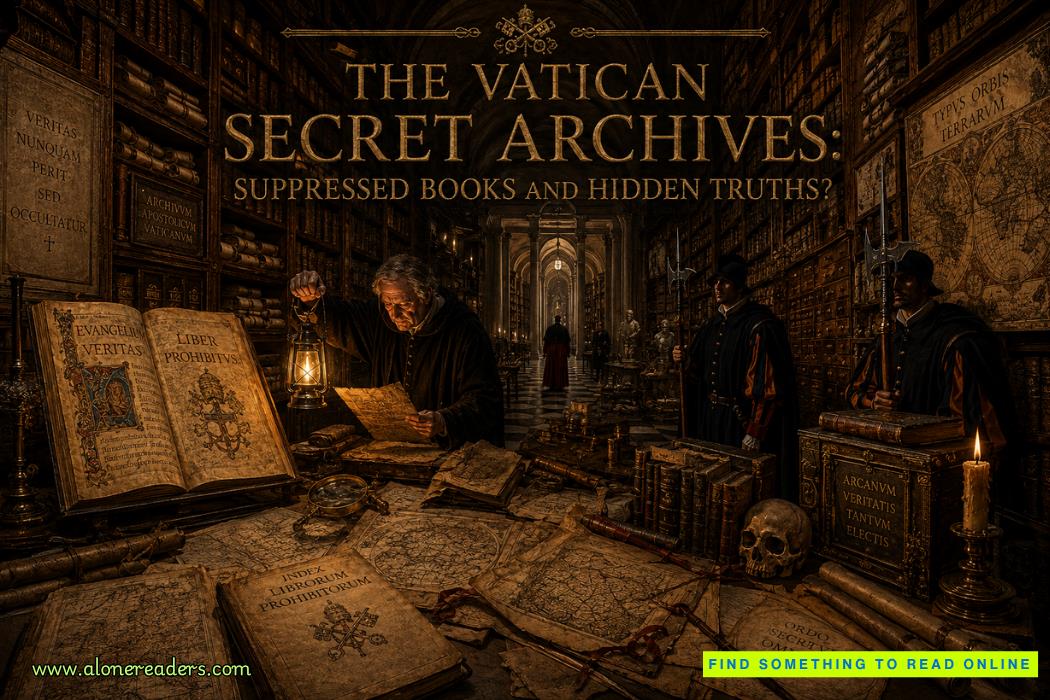
For centuries, few institutions on Earth have inspired as much fascination, suspicion, and speculation as Catholic Church and its vast collection of historical documents commonly known as the Vatican Secret Archives. To believers, historians, and scholars, the archives represent one of the most valuable repositories of human civilization ever assembled. To conspiracy theorists, however, they are something far darker — a hidden vault of suppressed books, forbidden knowledge, erased histories, and truths considered too dangerous for the public. The very phrase “Secret Archives” has fueled countless theories involving lost gospels, extraterrestrial encounters, hidden prophecies, secret scientific discoveries, and evidence capable of rewriting world history itself.
The reality behind the archives is both less sensational and, in many ways, even more intriguing than the myths. Officially renamed the Vatican Apostolic Archive in 2019, the collection contains roughly eighty-five kilometers of shelving filled with documents accumulated over centuries of papal administration. The word “secret” originally derived from the Latin term secretum, meaning “private” rather than hidden or forbidden. Yet this linguistic clarification has done little to diminish public fascination. The restricted nature of the archive, combined with the immense historical power of the Church, naturally invites questions about what lies behind its guarded walls.
The origins of the archive can be traced back to the early centuries of Christianity when Church authorities began preserving correspondence, doctrinal rulings, legal decrees, diplomatic records, and theological manuscripts. Over time, as the Church evolved into one of the most powerful political and religious institutions in Europe, the accumulation of documents became enormous. Popes communicated with kings, emperors, military leaders, scientists, missionaries, and philosophers across continents. Every war, treaty, controversy, heresy trial, and theological dispute generated records. By the medieval period, the Vatican possessed one of the most comprehensive documentary collections in existence.
Part of the mystique surrounding the archives comes from the Church’s historical role in determining which writings were considered orthodox and which were labeled heretical. During the formative centuries of Christianity, numerous gospels, letters, and religious texts circulated among early Christian communities. Some of these writings became part of the official Biblical canon, while others were rejected. This process inevitably created suspicion among later generations. Why were certain texts accepted while others disappeared? Did Church authorities suppress ideas that challenged institutional power? These questions remain central to many conspiracy theories connected to the Vatican archives.
One of the most famous examples involves the so-called Gnostic Gospels. These texts, discovered largely in the twentieth century near Nag Hammadi in Egypt, included alternative Christian writings emphasizing mystical knowledge and spiritual enlightenment. Some conspiracy theorists argue that the Vatican intentionally hid similar documents for centuries because they portrayed Jesus differently from official doctrine. Certain Gnostic texts describe a more symbolic interpretation of resurrection, a different relationship between Jesus and Mary Magdalene, and a spirituality focused on direct personal revelation rather than ecclesiastical authority. To critics of the Church, such writings suggest that early Christianity was far more diverse than traditional narratives acknowledge.
The Church, however, maintains that these texts were never “hidden” within the Vatican for secret suppression but were instead excluded through theological debates common in the ancient world. Early Church leaders argued that many Gnostic writings were composed later than the canonical gospels and reflected beliefs inconsistent with apostolic teaching. Still, the very existence of competing narratives feeds the enduring suspicion that alternative versions of Christian history were deliberately erased.
Another enduring theory concerns the Vatican’s alleged possession of forbidden scientific knowledge. During the Renaissance and Enlightenment periods, the Church often found itself in conflict with emerging scientific ideas. The trial of Galileo Galilei became one of history’s most famous examples of institutional resistance to scientific discovery. Because of this history, some theorists believe the archives contain suppressed evidence about astronomy, ancient technologies, or scientific advancements that contradicted Church teachings. Rumors have circulated for decades claiming that the Vatican possesses documents proving advanced ancient civilizations existed long before recorded history or that medieval scholars uncovered knowledge considered too destabilizing to release publicly.
These theories expanded dramatically during the twentieth century with the rise of UFO culture and extraterrestrial speculation. Some writers claimed the Vatican archives contained evidence of alien encounters, secret communications about unidentified aerial phenomena, or records of non-human intelligence preserved from ancient times. Stories emerged suggesting that Church officials monitored supernatural or extraterrestrial phenomena through secret observatories and classified investigations. The Vatican Observatory itself, one of the oldest astronomical research institutions in the world, became entangled in these narratives. Although there is no verified evidence supporting such claims, the combination of secrecy, religion, and unexplained phenomena proved irresistible to popular imagination.
Prophecies and apocalyptic predictions also occupy a major place in Vatican conspiracy theories. Among the most famous examples is the Third Secret of Fatima, a message reportedly revealed to three Portuguese children in 1917 after visions of the Virgin Mary. The Vatican released portions of the prophecy over decades, but rumors persisted that the Church concealed its most terrifying elements. Some believed the unreleased sections predicted nuclear war, the collapse of the Church, global catastrophe, or the rise of an Antichrist figure. Even after the Vatican officially published what it described as the complete Third Secret in 2000, skeptics continued to argue that crucial passages remained hidden in the archives.
Closely related are theories about the Vatican’s alleged possession of ancient prophetic texts capable of predicting future events. Medieval manuscripts attributed to saints, mystics, and seers are said to describe wars, plagues, political upheavals, and the end of civilization. Because the Church historically collected visionary writings and monitored claims of divine revelation, many assume the archives contain apocalyptic documents never disclosed to the public. The mystery surrounding unpublished manuscripts naturally encourages speculation about what those texts might contain.
Another persistent theory involves lost historical records that could potentially challenge accepted versions of world history. Some researchers claim the Vatican possesses documents relating to ancient civilizations such as Atlantis, lost libraries from antiquity, or evidence of transoceanic contact long before Columbus. Others speculate about records from the destroyed Library of Alexandria or secret manuscripts rescued during wars and invasions. Because the Church maintained diplomatic and missionary networks across multiple continents for centuries, it undeniably accumulated rare texts from diverse cultures. Whether these documents contain revolutionary historical revelations remains unproven, but the possibility itself sustains public curiosity.
The archives also attract attention because of the Church’s involvement in some of history’s most controversial events. Records connected to the Inquisition, the Crusades, witch trials, colonial expansion, and relations with authoritarian regimes are preserved within Vatican collections. Historians have long sought access to documents concerning the Church’s conduct during the Second World War, particularly under Pope Pius XII. Critics accused the Vatican of remaining silent during the Holocaust, while defenders argued the Church worked secretly to save lives. The opening of wartime archives in recent years reignited scholarly debates over the Vatican’s true role during one of humanity’s darkest periods.
The restricted access policy of the Vatican archives significantly contributes to their legendary reputation. Contrary to popular belief, qualified scholars can access portions of the collection, but the process is tightly controlled. Researchers must provide academic credentials, specify their areas of study, and request particular materials. Certain documents remain inaccessible due to fragility, classification policies, or ongoing cataloging. To conspiracy theorists, these restrictions imply the existence of deeply hidden secrets. To archivists, however, such controls are standard practice for preserving irreplaceable historical materials.
Physical descriptions of the archive itself further enhance its aura of mystery. Popular imagination envisions labyrinthine corridors beneath Vatican City filled with locked chambers and ancient volumes chained behind iron gates. In reality, much of the archive resembles a highly organized academic repository. Yet there are undeniably restricted sections inaccessible to ordinary visitors, and the architecture of the Vatican — with its centuries-old halls, underground chambers, and guarded entrances — naturally amplifies the atmosphere of secrecy.
Some conspiracy theories suggest the archives contain direct evidence undermining core religious doctrines. Claims circulate that hidden manuscripts prove Jesus survived crucifixion, married Mary Magdalene, traveled abroad, or taught radically different ideas from official Christianity. Popular novels and films amplified these narratives, portraying the Vatican as an institution willing to suppress dangerous truths to maintain authority. Although historians generally reject these claims due to lack of credible evidence, fictional portrayals have profoundly shaped public perception.
The Index Librorum Prohibitorum, or Index of Forbidden Books, also contributes to the image of the Vatican as a suppressor of knowledge. Established in the sixteenth century, the Index listed books Catholics were forbidden to read because they were considered heretical or morally dangerous. Works by philosophers, scientists, and political thinkers appeared on the list over the centuries. Critics viewed the Index as evidence that the Church sought to control intellectual life and suppress dissenting ideas. Although the Index was abolished in 1966, its historical existence continues to influence modern suspicions regarding censorship and hidden information.
Despite the sensationalism surrounding the archives, historians emphasize that many conspiracies stem from misunderstandings about how large historical institutions function. The Vatican preserves millions of documents because it operated continuously for centuries, not because it necessarily sought to hide forbidden truths. Many unpublished materials remain obscure simply because cataloging and analyzing such a massive collection is an enormous scholarly task. Historians continue discovering forgotten letters, financial records, diplomatic communications, and theological writings that provide valuable insights into the past without revealing earth-shattering conspiracies.
Nevertheless, some genuine mysteries do remain. Scholars acknowledge that numerous documents have been lost, destroyed, misfiled, or never fully studied. Wars, political upheavals, theft, deterioration, and administrative secrecy all affected the preservation of records throughout history. Certain sensitive files may indeed remain classified for political or institutional reasons. Like any powerful organization, the Vatican has historically controlled information to protect authority, manage diplomacy, and navigate crises. This reality creates fertile ground for speculation, especially when combined with centuries of religious influence and political intrigue.
Modern digitization projects have slowly increased scholarly access to portions of the archives, but the sheer scale of the collection ensures that much remains unexplored. Thousands of manuscripts in ancient languages require specialized expertise to interpret. Hidden among routine correspondence and bureaucratic records may be forgotten narratives capable of reshaping historical understanding in subtle but important ways. While sensational claims about aliens, time travel, or suppressed world-changing technologies lack credible evidence, the archives undoubtedly contain untold stories waiting to be rediscovered.
The enduring fascination with the Vatican Secret Archives ultimately reflects humanity’s deeper relationship with secrecy itself. Powerful institutions have always inspired both reverence and suspicion. The idea that hidden rooms contain forbidden knowledge appeals to something ancient in human psychology — the belief that history possesses concealed layers accessible only to a privileged few. In many ways, the archives function as a symbol of humanity’s unresolved tension between faith, authority, knowledge, and truth.
Whether viewed as a priceless scholarly treasure or a vault of suppressed history, the Vatican archives continue to occupy a unique place in global imagination. Their combination of religion, political power, ancient manuscripts, and restricted access guarantees that speculation will persist for generations. Some theories will continue to drift into fantasy, fueled by fiction and popular culture. Others may encourage legitimate historical inquiry into how institutions shape narratives and preserve knowledge. The true significance of the archives may not lie in hidden supernatural revelations, but in the profound reminder that history itself is never entirely complete, transparent, or fully understood.
In the end, the Vatican Secret Archives remain less a single mystery than a mirror reflecting humanity’s endless curiosity about what powerful institutions choose to reveal — and what they choose to keep behind locked doors.




 The Hundred Days Offensive: How the Allies Defeated Germany in World War I
 The Second Battle of the Marne: The Turning Point of World War I in 1918
 The Spring Offensive of 1918: Germany's Final Gamble to Win World War I
 The Treaty of Brest-Litovsk: How Russia Left World War I
 The Russian Revolution and World War I: How War Brought Down the Tsar
 The Zimmermann Telegram Explained: Germany's Secret Offer to Mexico in World War I