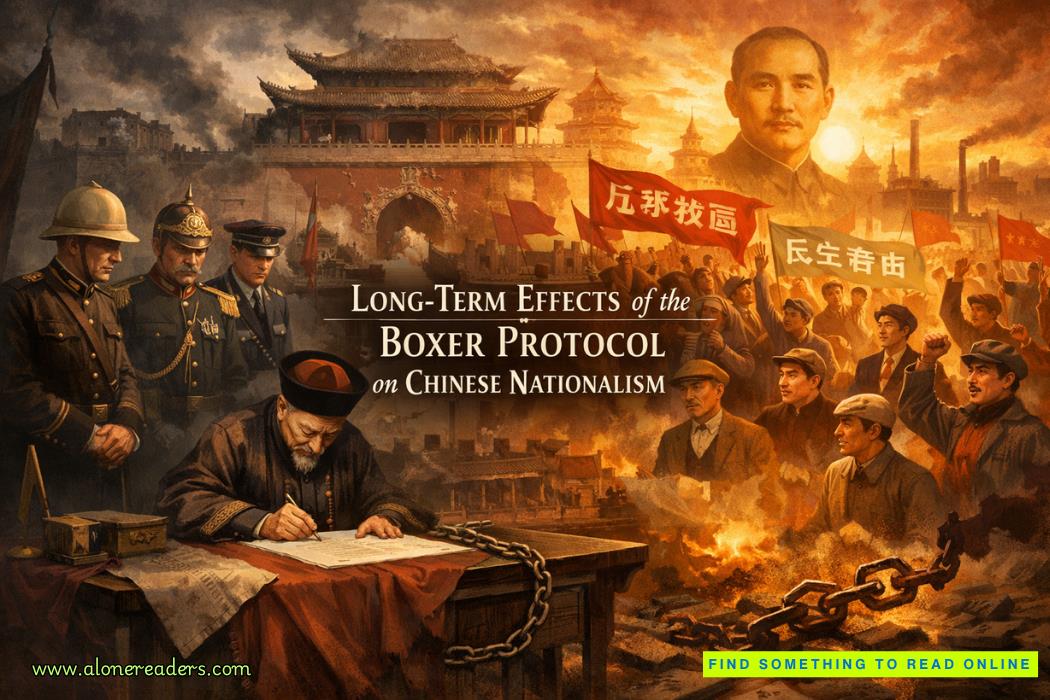
The Boxer Protocol of 1901 was not merely a diplomatic settlement imposed upon a defeated Qing dynasty; it became a transformative psychological rupture in Chinese historical consciousness. What initially appeared as a punitive agreement following the Boxer Uprising evolved into a long-term catalyst for profound ideological, political, and cultural shifts. The treaty’s implications extended far beyond financial indemnities or military concessions, embedding within Chinese society a deeply internalized sense of humiliation, urgency, and ultimately, a redefinition of national identity. Over subsequent decades, the memory and consequences of the Boxer Protocol became foundational in shaping modern Chinese nationalism, influencing reformist movements, revolutionary ideologies, and the collective psyche of a nation struggling to reclaim sovereignty.
At its core, the Boxer Protocol represented a culmination of what many Chinese intellectuals later described as the “Century of Humiliation.” The staggering indemnity imposed—450 million taels of silver, to be paid over 39 years with interest—was not only economically crippling but symbolically devastating. It institutionalized China’s subordination to foreign powers and exposed the Qing dynasty’s inability to defend national sovereignty. This financial burden drained state resources, diverted funds away from domestic development, and reinforced the perception that China was economically and politically exploited by imperialist forces. Over time, this perception became a central narrative in nationalist discourse, shaping how subsequent generations interpreted both domestic governance and foreign relations.
Equally significant was the military humiliation embedded within the treaty’s provisions. Foreign troops were granted the right to station themselves permanently in Beijing and along key strategic routes, particularly between the capital and the coast. This arrangement effectively compromised China’s sovereignty, transforming parts of its own territory into zones of foreign control. For the Chinese populace, this visible presence of foreign military power served as a daily reminder of national weakness. The psychological impact of such occupation cannot be overstated; it created a pervasive sense of vulnerability and resentment, which later became a driving force behind anti-imperialist nationalism.
The Boxer Protocol also accelerated the delegitimization of the Qing dynasty. Although the Qing court had initially attempted to suppress foreign influence, its eventual capitulation exposed its inability to govern effectively in the face of external pressure. Reform-minded elites and intellectuals increasingly viewed the dynasty as an obstacle rather than a protector of national interests. This shift in perception was critical, as it laid the groundwork for the emergence of revolutionary movements. The dynasty was no longer seen as the embodiment of the state; instead, the concept of the “nation” began to transcend imperial authority. This ideological transformation marked a fundamental shift from dynastic loyalty to nationalist consciousness.
In the years following the Boxer Protocol, China witnessed the rise of reformist nationalism, particularly through the Qing government’s own attempts at modernization. Recognizing the existential threat posed by foreign domination, the Qing initiated a series of reforms known as the “New Policies.” These included efforts to modernize the military, overhaul the education system, and restructure administrative institutions. Ironically, the very treaty that exposed the dynasty’s weakness also forced it to adopt reforms that would ultimately undermine its own legitimacy. The introduction of modern education, in particular, played a crucial role in fostering nationalist sentiment, as students were exposed to new political ideas, including constitutionalism, republicanism, and the concept of popular sovereignty.
The educational reforms catalyzed the emergence of a new intellectual class, many of whom became vocal critics of both foreign imperialism and domestic autocracy. Influenced by Western political thought and Japan’s successful modernization, these intellectuals began to articulate a vision of China as a modern nation-state rather than a traditional empire. The memory of the Boxer Protocol served as a powerful rhetorical tool in their arguments, symbolizing the consequences of stagnation and weakness. As a result, nationalism became increasingly intertwined with the demand for systemic change, creating a feedback loop in which humiliation fueled reform, and reform intensified nationalist consciousness.
Perhaps the most profound long-term effect of the Boxer Protocol was its role in catalyzing revolutionary nationalism. Figures such as Sun Yat-sen capitalized on widespread dissatisfaction, using the treaty as evidence of the Qing dynasty’s failure to protect the nation. Revolutionary groups framed their struggle not merely as a political movement but as a national salvation effort. The overthrow of the Qing dynasty in 1911 can thus be understood, in part, as a direct consequence of the nationalist sentiments intensified by the Boxer Protocol. The revolution marked the end of over two millennia of imperial rule and the beginning of a new era in which the concept of the nation took precedence over dynastic continuity.
The Boxer Protocol also contributed to the redefinition of Chinese identity in relation to the outside world. Prior to the late 19th century, China had traditionally viewed itself as the center of civilization, operating within a tributary system that reinforced its cultural superiority. The humiliations of the Boxer Protocol shattered this worldview, forcing China to confront its relative weakness in a rapidly changing global order. This realization led to a dual response: on one hand, a desire to learn from the West in order to strengthen the nation; on the other, a deep-seated suspicion of foreign influence. This tension between adaptation and resistance became a defining feature of Chinese nationalism in the 20th century.
The economic implications of the Boxer Protocol further reinforced nationalist sentiment. The indemnity payments necessitated increased taxation and financial strain on the population, exacerbating social unrest. At the same time, foreign control over key economic sectors limited China’s ability to develop independently. These conditions fostered a growing awareness of economic sovereignty as a critical component of national strength. Over time, this awareness translated into support for policies aimed at reducing foreign dependence and promoting domestic industrialization. Thus, the economic legacy of the Boxer Protocol played a significant role in shaping the economic dimension of Chinese nationalism.
Another critical aspect of the treaty’s long-term impact was its influence on mass mobilization and popular nationalism. While earlier forms of nationalism had been largely confined to elite circles, the shared experience of humiliation and hardship brought these sentiments into the broader population. Anti-foreign boycotts, student protests, and grassroots movements became increasingly common in the early 20th century. The Boxer Protocol, with its visible and tangible consequences, provided a unifying narrative that could be easily understood and internalized by ordinary citizens. This democratization of nationalism was essential in transforming it into a powerful social force capable of driving large-scale political change.
The memory of the Boxer Protocol continued to resonate throughout subsequent decades, influencing movements such as the May Fourth Movement of 1919. Although the immediate trigger for that movement was the Treaty of Versailles, the underlying grievances were deeply rooted in earlier experiences of humiliation, including the Boxer Protocol. Students and intellectuals invoked these historical injustices to galvanize support for their cause, emphasizing the need for national rejuvenation. In this sense, the Boxer Protocol became part of a broader historical narrative that linked past humiliations to present struggles, reinforcing a sense of continuity in the fight for sovereignty.
Moreover, the treaty’s legacy extended into the ideological domain, shaping the development of both nationalist and communist movements in China. For nationalist leaders, the Boxer Protocol underscored the importance of a strong centralized state capable of resisting foreign aggression. For communist thinkers, it highlighted the exploitative nature of imperialism and the need for a radical restructuring of society. Despite their ideological differences, both movements drew upon the same historical memory, using it to legitimize their respective visions for China’s future. This shared reference point illustrates how the Boxer Protocol functioned as a unifying symbol within diverse strands of Chinese nationalism.
The cultural impact of the Boxer Protocol also deserves attention. Literature, art, and historical writing in the early 20th century frequently revisited the events surrounding the treaty, portraying them as a national tragedy. These cultural representations played a crucial role in shaping collective memory, ensuring that the lessons of the Boxer Protocol were transmitted across generations. By embedding the narrative of humiliation and resistance within cultural discourse, Chinese society was able to sustain a long-term commitment to national rejuvenation. This cultural dimension of nationalism, often overlooked, was instrumental in maintaining the emotional intensity of the movement.
In examining the long-term effects of the Boxer Protocol, it becomes evident that its significance lies not only in its immediate consequences but in its enduring influence on the trajectory of Chinese history. The treaty acted as a catalyst for transformation, accelerating processes that might otherwise have unfolded more gradually. It exposed structural weaknesses, challenged traditional worldviews, and created a sense of urgency that propelled China toward modernization and reform. At the same time, it instilled a deep-seated awareness of the importance of sovereignty, dignity, and national unity.
Ultimately, the Boxer Protocol can be understood as a turning point in the evolution of Chinese nationalism. It marked the transition from a passive acceptance of foreign dominance to an active pursuit of national strength and independence. The legacy of this transformation continues to shape China’s political culture and international outlook even in the modern era. The memory of humiliation, coupled with the determination to overcome it, remains a powerful force in Chinese national identity.
In conclusion, the long-term effects of the Boxer Protocol on Chinese nationalism were multifaceted and profound. It transformed humiliation into a driving force for change, catalyzed the decline of imperial rule, fostered the rise of reformist and revolutionary movements, and reshaped China’s relationship with the world. By embedding the experience of subjugation within the national consciousness, the treaty ensured that the quest for sovereignty would become a central theme in China’s historical narrative. The Boxer Protocol, therefore, stands not merely as a historical event but as a foundational moment in the making of modern Chinese nationalism, illustrating how adversity can be transformed into a powerful impetus for national renewal.



 The Hundred Days Offensive: How the Allies Defeated Germany in World War I
 The Second Battle of the Marne: The Turning Point of World War I in 1918
 The Spring Offensive of 1918: Germany's Final Gamble to Win World War I
 The Treaty of Brest-Litovsk: How Russia Left World War I
 The Russian Revolution and World War I: How War Brought Down the Tsar
 The Zimmermann Telegram Explained: Germany's Secret Offer to Mexico in World War I










