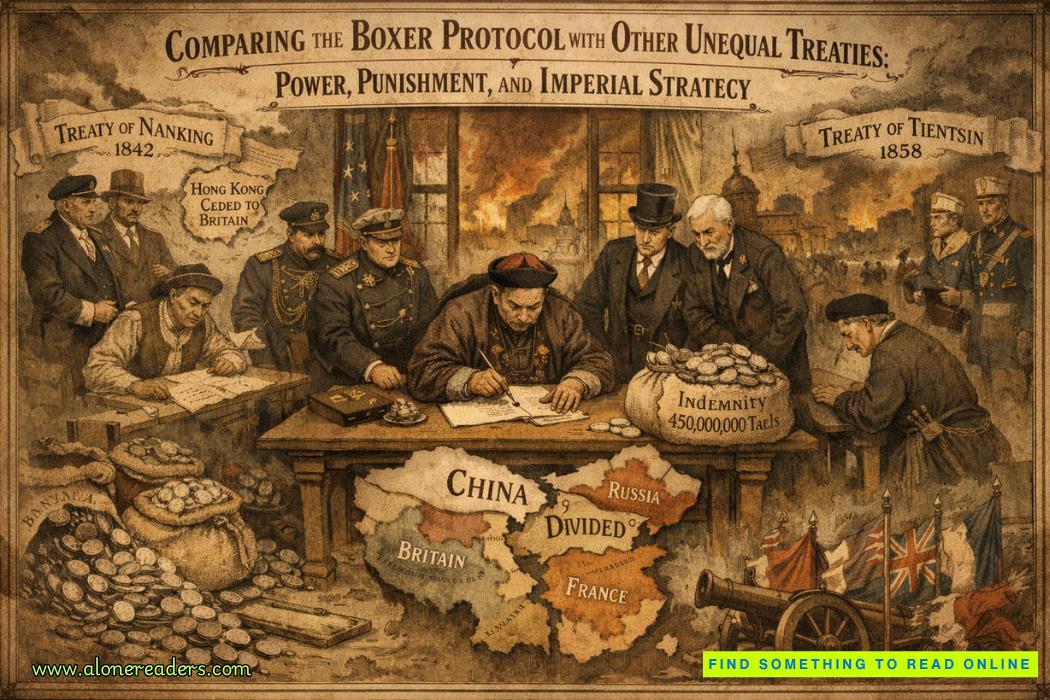
The history of modern China cannot be meaningfully understood without examining the sequence of agreements collectively known as unequal treaties, a framework imposed upon the Qing Empire through military coercion and diplomatic asymmetry. Among these, the Boxer Protocol stands as one of the most severe and structurally transformative instruments of foreign domination. When compared to earlier agreements such as the Treaty of Nanking, the Treaty of Tientsin, and the Treaty of Shimonoseki, the Boxer Protocol reveals a distinct evolution in imperial strategy—from commercial penetration to systemic political subjugation.
At its core, the Boxer Protocol differed not merely in severity but in its intent to institutionalize foreign control within the Chinese state apparatus itself. Earlier treaties, though deeply exploitative, were primarily focused on economic access and diplomatic privilege. The Treaty of Nanking, signed after the First Opium War, compelled China to open five treaty ports, cede Hong Kong to Britain, and grant fixed tariffs favorable to foreign merchants. While this marked the beginning of China’s semi-colonial status, it still preserved a nominal framework of sovereignty. The Qing court retained internal administrative control, and foreign presence remained largely confined to designated coastal zones.
The Treaty of Tientsin expanded this framework further, introducing the legalization of foreign legations in Beijing, the right of foreign travel within China, and the legalization of Christian missionary activity. This agreement represented a shift toward deeper cultural and diplomatic intrusion, yet it still operated within a paradigm of negotiated imbalance rather than outright humiliation. Even as foreign powers gained unprecedented privileges, the Qing government remained the formal governing authority, capable—at least in theory—of shaping domestic policy independent of direct foreign supervision.
The Treaty of Shimonoseki, concluded after China’s defeat in the First Sino-Japanese War, marked a more alarming escalation. Here, the Qing Empire not only paid a massive indemnity but also ceded Taiwan and recognized Korean independence, effectively dismantling its regional influence. Japan’s emergence as an imperial power demonstrated that the logic of unequal treaties was no longer confined to Western nations. However, despite its punitive nature, this treaty still followed a recognizable diplomatic structure: defeat in war, followed by territorial and economic concessions. It did not yet impose sustained foreign occupation within the Chinese capital or permanent military oversight of internal governance.
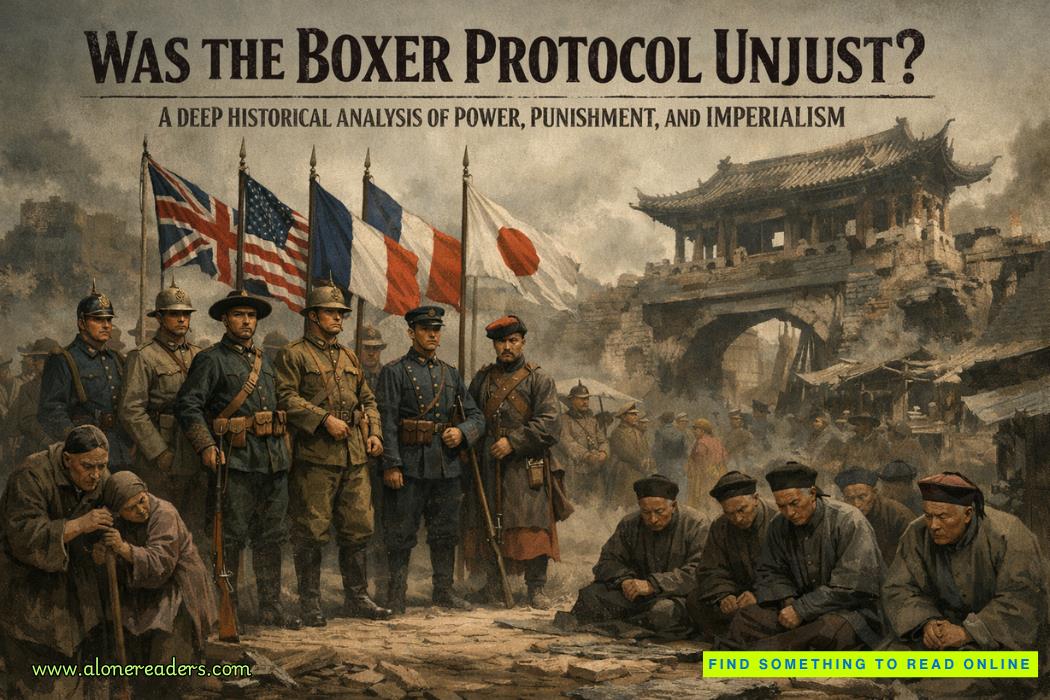
The Boxer Protocol, signed in the aftermath of the Boxer Rebellion, fundamentally altered this trajectory. Unlike previous treaties, it was not merely a settlement between warring states but a punitive framework designed to discipline an entire civilization perceived as resistant to imperial order. The uprising itself, fueled by anti-foreign and anti-Christian sentiment, had resulted in the siege of foreign legations in Beijing. The subsequent intervention by the Eight-Nation Alliance transformed the conflict into a demonstration of overwhelming international force.
What distinguishes the Boxer Protocol most sharply is its unprecedented financial burden. China was required to pay an indemnity of 450 million taels of silver—an amount that, when adjusted for interest over 39 years, effectively doubled. This was not simply compensation for damages; it was a mechanism of long-term economic extraction. Earlier treaties had imposed indemnities, but none approached this scale or duration. The financial strain crippled Qing fiscal stability, forcing increased taxation and further weakening the state’s legitimacy among its own population.
Equally significant was the military dimension of the Boxer Protocol. Foreign troops were granted the right to be permanently stationed in Beijing and along the route to the sea, particularly between Beijing and Tianjin. This provision effectively placed the imperial capital under continuous foreign surveillance. In contrast, earlier treaties had allowed naval access or temporary military presence, but they stopped short of embedding foreign forces within the political heart of the empire. The Boxer Protocol thus represents a transition from external coercion to internal occupation.
Another critical distinction lies in the political symbolism embedded within the protocol’s terms. The Qing government was required to execute or exile officials who had supported the Boxers and to issue formal apologies to foreign powers. Monuments were erected in memory of foreign victims, while Chinese officials were compelled to participate in rituals of contrition. These measures were not merely administrative; they were deliberate acts of humiliation designed to assert cultural and moral superiority. Earlier treaties, even when harsh, did not impose such overt symbolic subordination.
The erosion of sovereignty under the Boxer Protocol also extended into administrative domains. The Qing government was forced to ban anti-foreign organizations and to permit foreign oversight in certain areas of governance. This marked a qualitative shift: foreign powers were no longer satisfied with extracting concessions; they sought to reshape the internal political environment of China to prevent future resistance. In this sense, the Boxer Protocol can be seen as a precursor to more direct forms of colonial governance, even though China was never formally colonized in its entirety.
When compared analytically, the progression from the Treaty of Nanking to the Boxer Protocol illustrates a clear pattern of escalating imperial ambition. The early phase emphasized trade liberalization under coercive conditions. The intermediate phase introduced diplomatic and cultural penetration. The later phase, culminating in the Boxer Protocol, imposed structural constraints on sovereignty itself. This trajectory reflects broader global trends in imperialism during the nineteenth century, where economic interests gradually merged with political domination.
It is also important to consider the international context in which these treaties were negotiated. The Treaty of Nanking emerged from British mercantile interests, particularly the opium trade, and reflected a unilateral imposition by a single dominant power. By the time of the Boxer Protocol, however, imperialism had become a multilateral enterprise. The involvement of the Eight-Nation Alliance—including Britain, France, Germany, Russia, Japan, the United States, Austria-Hungary, and Italy—demonstrated a coordinated effort to maintain access to Chinese markets while suppressing nationalist resistance. This collective enforcement mechanism made the Boxer Protocol far more difficult for China to resist or renegotiate.
Another dimension of comparison lies in the ideological justification of these treaties. Earlier agreements were often framed in terms of “free trade” and diplomatic reciprocity, even if these claims were fundamentally unequal in practice. By contrast, the Boxer Protocol was justified as a civilizing mission, aimed at punishing “barbarism” and ensuring the safety of foreign nationals. This shift in rhetoric reflects a broader transformation in imperial discourse, where domination was increasingly legitimized through moral narratives rather than purely economic arguments.
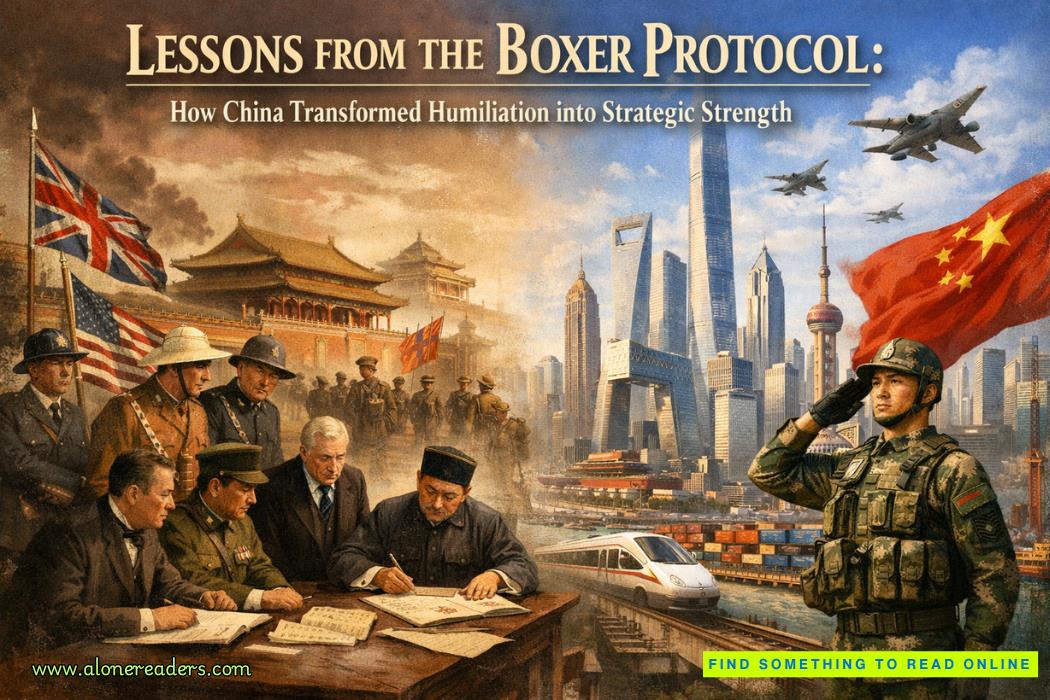
The long-term consequences of the Boxer Protocol were profound. It accelerated the decline of the Qing dynasty, contributing to the revolutionary movements that culminated in the 1911 Revolution. The financial burden and political humiliation deepened popular resentment, not only against foreign powers but also against the Qing government itself. In comparison, earlier treaties had weakened the state but had not yet triggered such a comprehensive crisis of legitimacy. The Boxer Protocol, therefore, represents a tipping point where external pressure and internal instability converged.
Moreover, the protocol had enduring implications for China’s modernization trajectory. The necessity of paying indemnities forced the Qing government to reform its fiscal system and to engage more deeply with global financial networks. While these reforms were often reactive and insufficient, they nonetheless laid the groundwork for later developments in Chinese economic policy. In this sense, the Boxer Protocol can be seen as both a symbol of subjugation and a catalyst for transformation—a paradox that underscores the complexity of historical processes.
When placed alongside other unequal treaties, the Boxer Protocol emerges as the most intrusive and comprehensive mechanism of foreign control imposed on Qing China. It combined economic exploitation, military occupation, political humiliation, and administrative interference into a single framework. Earlier treaties had each introduced elements of this system, but none had integrated them so fully or so aggressively.
Ultimately, the comparison reveals that the Boxer Protocol was not an isolated anomaly but the culmination of a century-long process of imperial encroachment. It represents the point at which the logic of unequal treaties reached its most extreme expression, transforming China from a sovereign empire into a semi-colonial entity constrained by foreign powers at every level. The legacy of this transformation continues to shape historical memory and national identity in China today, where the era of unequal treaties is remembered as a period of profound humiliation and resistance.



 The Hundred Days Offensive: How the Allies Defeated Germany in World War I
 The Second Battle of the Marne: The Turning Point of World War I in 1918
 The Spring Offensive of 1918: Germany's Final Gamble to Win World War I
 The Treaty of Brest-Litovsk: How Russia Left World War I
 The Russian Revolution and World War I: How War Brought Down the Tsar
 The Zimmermann Telegram Explained: Germany's Secret Offer to Mexico in World War I