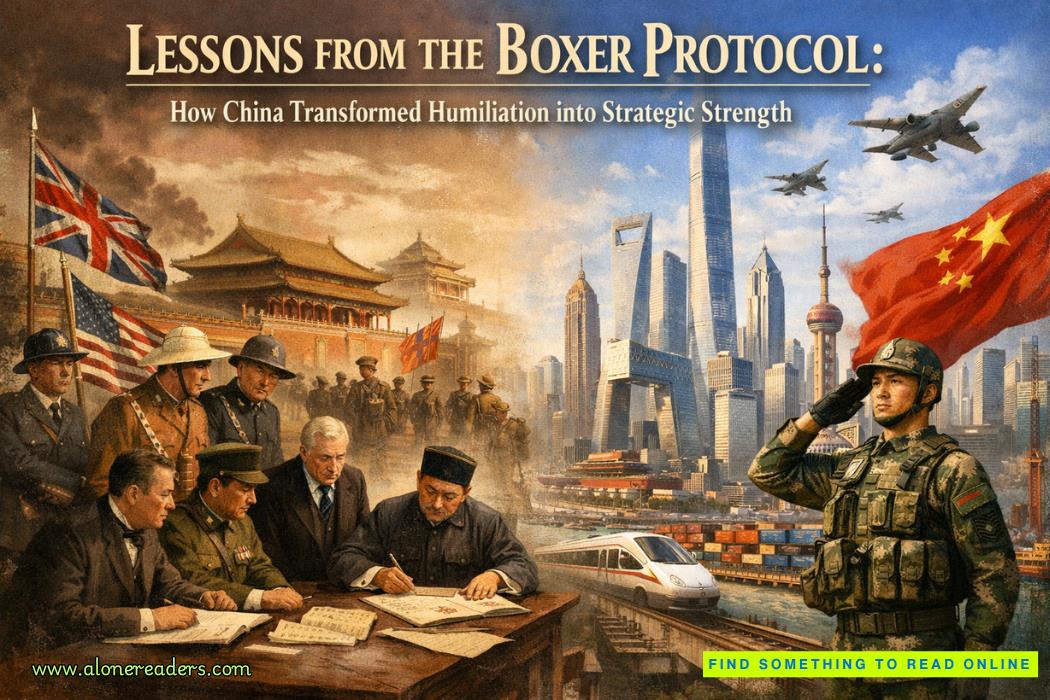
The Boxer Protocol of 1901 stands as one of the most consequential diplomatic impositions in Chinese history, not merely as a treaty of defeat but as a profound turning point that reshaped China’s long-term strategic thinking. Emerging from the violent upheaval of the Boxer Rebellion, the protocol imposed severe indemnities, foreign military presence, and extensive political humiliation upon the Qing dynasty. Yet, the deeper historical significance lies not only in its immediate consequences but in the enduring lessons it carved into the Chinese political consciousness—lessons that continue to influence modern China’s domestic governance, foreign policy, and national identity.
The most immediate and visceral lesson derived from the Boxer Protocol was the catastrophic cost of internal fragmentation and reactionary policymaking. The Qing court’s initial support of the Boxers—motivated by anti-foreign sentiment but lacking strategic coherence—resulted in a disastrous confrontation with a coalition of global powers. This miscalculation demonstrated, with brutal clarity, that ideological fervor without institutional strength and military capability leads to national vulnerability. In modern China, this lesson manifests in a persistent emphasis on centralized authority and political stability. The Chinese Communist Party has consistently framed internal unity as a prerequisite for national survival, a principle deeply rooted in the memory of late Qing disarray.
Equally significant was the realization that technological and military backwardness invited foreign domination. The Boxer Protocol did not merely punish China financially; it institutionalized its subordination through foreign garrisons and strategic control points, particularly in Beijing. The humiliation was not abstract—it was physically embedded in the Chinese capital. This experience fundamentally altered China’s perception of power. Modern China’s relentless pursuit of military modernization and technological advancement can be directly traced to this historical trauma. The development of advanced defense systems, cyber capabilities, and a modern navy reflects a long-term strategic objective: never again to be coerced through technological inferiority.
Another critical lesson concerns the dynamics of international diplomacy and the dangers of isolationism. The Qing dynasty’s failure to effectively engage with global powers left it diplomatically isolated at a time when international alliances were becoming increasingly decisive. The Boxer Protocol, negotiated under duress, underscored the importance of diplomatic competence and international engagement. In contrast, modern China has adopted a far more sophisticated approach to global relations. Through initiatives such as multilateral trade agreements, strategic partnerships, and international organizations, China seeks to shape the global order rather than remain subject to it. The shift from passive victim to active participant in international diplomacy represents one of the most profound transformations influenced by the Boxer Protocol experience.
The financial burden imposed by the indemnities—amounting to hundreds of millions of taels of silver—also offered a harsh lesson in economic sovereignty. The obligation to pay these indemnities over decades strained China’s fiscal capacity and diverted resources away from domestic development. This experience ingrained a deep awareness of the relationship between economic strength and political independence. Modern China’s focus on economic growth, industrial capacity, and financial reserves reflects this understanding. Economic resilience is not merely a goal but a strategic necessity, ensuring that external pressures cannot dictate national policy. The accumulation of vast foreign exchange reserves and the emphasis on self-reliance in critical industries are direct echoes of this historical lesson.
The Boxer Protocol also exposed the limitations of traditional governance structures in responding to modern crises. The Qing administrative system, rooted in imperial traditions, proved incapable of managing the complexities of a rapidly changing global environment. The crisis revealed the need for institutional reform, leading to the late Qing reforms that attempted—albeit too late—to modernize the state apparatus. In modern China, this lesson has evolved into a continuous process of institutional adaptation. The Chinese state has demonstrated a willingness to experiment with economic models, administrative reforms, and governance mechanisms. Flexibility within a controlled political framework has become a defining characteristic of modern Chinese governance, shaped by the recognition that rigidity invites collapse.
Culturally and psychologically, the Boxer Protocol contributed to what is often described as the “century of humiliation,” a narrative that has become central to modern Chinese identity. This collective memory serves not only as a historical reference but as a powerful political tool. It reinforces a sense of national unity and purpose, framing contemporary achievements as a restoration of historical dignity. The remembrance of past humiliation is not passive; it is actively mobilized to justify policies aimed at strengthening national sovereignty and global influence. This narrative underpins China’s assertive stance on territorial integrity and its resistance to perceived external interference.
Another nuanced lesson lies in the management of nationalism. The Boxer movement itself was fueled by intense anti-foreign sentiment, yet it ultimately led to greater foreign intervention. This paradox highlighted the dangers of uncontrolled nationalism. Modern China has adopted a more calibrated approach, promoting nationalism as a unifying force while maintaining strict control over its expression. State-managed nationalism ensures that public sentiment aligns with strategic objectives rather than undermining them. This balance reflects a sophisticated understanding of the dual-edged nature of nationalist movements, informed by the failures of the Boxer era.
The role of education and intellectual transformation also emerges as a significant lesson. Following the Boxer Protocol, portions of the indemnity payments were redirected by foreign powers, particularly the United States, to fund scholarships for Chinese students. This led to the emergence of a new generation of Chinese intellectuals exposed to Western ideas and technologies. While initially a byproduct of foreign imposition, this development contributed to China’s modernization. In modern times, education remains a cornerstone of national strategy, with significant investment in science, technology, and higher education aimed at fostering innovation and global competitiveness. The emphasis on human capital development can be traced back, in part, to the recognition that knowledge is a critical component of national power.
The Boxer Protocol also highlighted the importance of legal and institutional sovereignty. The extraterritorial rights granted to foreign powers effectively placed segments of Chinese territory outside Chinese jurisdiction. This erosion of sovereignty was a stark reminder of the consequences of legal weakness. Modern China has responded by strengthening its legal framework and asserting its jurisdictional authority both domestically and internationally. The insistence on non-interference and respect for sovereignty in international relations is deeply rooted in the historical experience of legal subjugation during the Boxer Protocol era.
Furthermore, the episode underscored the strategic importance of urban centers and infrastructure. The foreign powers’ ability to occupy and control key locations in Beijing demonstrated how critical nodes of power could determine the outcome of conflicts. In response, modern China has invested heavily in infrastructure development, urban planning, and strategic logistics. Control over physical and economic infrastructure is now viewed as integral to national security and global influence, a perspective shaped by the vulnerabilities exposed during the Boxer crisis.
The transformation of China’s global posture—from a weakened empire subjected to foreign dictates to a major global power—can thus be understood as a long-term response to the lessons of the Boxer Protocol. Each aspect of modern Chinese policy, from military modernization to economic strategy and diplomatic engagement, reflects a deliberate effort to avoid the conditions that led to the humiliation of 1901. This transformation is not merely reactive but strategic, driven by a clear understanding of historical cause and effect.
In examining these lessons, it becomes evident that the Boxer Protocol was not an endpoint but a catalyst. It forced China to confront the realities of a changing world and to reevaluate its place within it. The process of learning from this experience has been gradual and complex, involving periods of turmoil, reform, and consolidation. Yet, the underlying trajectory is clear: a sustained effort to build a state capable of defending its sovereignty, advancing its interests, and shaping the global order.
Ultimately, the enduring significance of the Boxer Protocol lies in its role as a historical mirror. It reflects the consequences of weakness, division, and miscalculation, while also illuminating the path toward resilience and strength. Modern China’s rise cannot be fully understood without acknowledging the profound impact of this episode and the lessons it imparted. The memory of humiliation has been transformed into a source of determination, guiding a nation that has learned, perhaps more than most, that history is not merely to be remembered but to be acted upon.



 The Hundred Days Offensive: How the Allies Defeated Germany in World War I
 The Second Battle of the Marne: The Turning Point of World War I in 1918
 The Spring Offensive of 1918: Germany's Final Gamble to Win World War I
 The Treaty of Brest-Litovsk: How Russia Left World War I
 The Russian Revolution and World War I: How War Brought Down the Tsar
 The Zimmermann Telegram Explained: Germany's Secret Offer to Mexico in World War I










