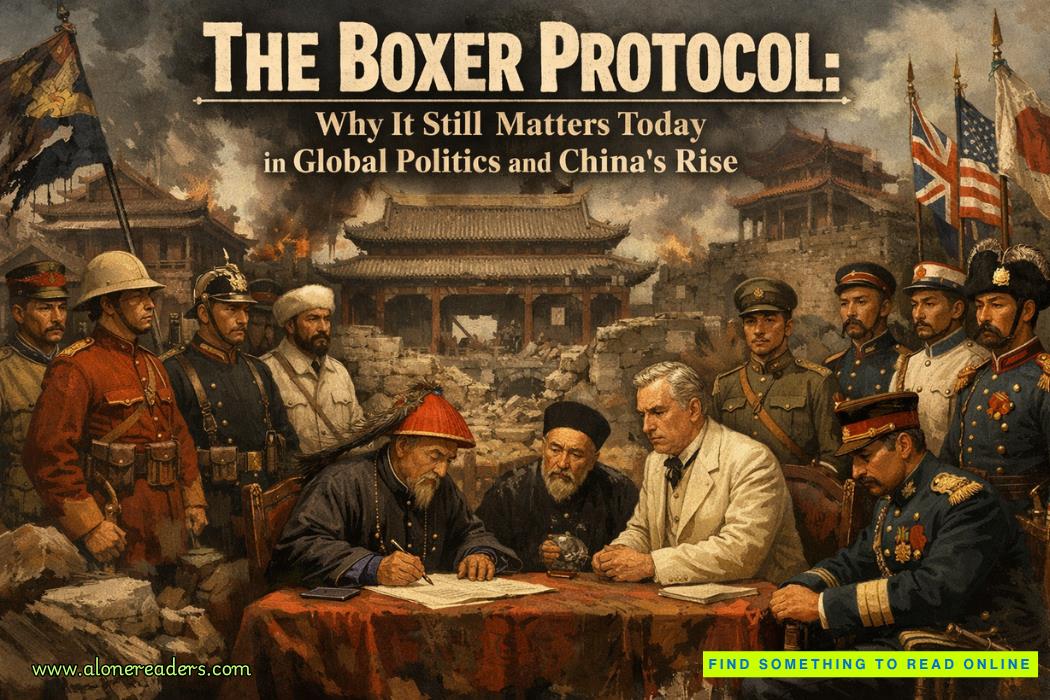
The signing of the Boxer Protocol in 1901 marked not merely the conclusion of a violent anti-foreign uprising in China, but the institutionalization of a new global order in which sovereignty, imperial power, and economic coercion were deeply intertwined. While often framed as a historical footnote following the Boxer Rebellion, the Protocol’s implications extend far beyond its immediate context, shaping the trajectory of modern China, influencing international law, and leaving a legacy that still reverberates in contemporary geopolitics.
At its core, the Boxer Protocol represented a formalized imposition of foreign dominance over the already weakened Qing Dynasty. Following the siege of foreign legations in Beijing, an alliance of eight major powers—including Britain, France, Germany, Russia, Japan, the United States, Italy, and Austria-Hungary—intervened militarily to suppress the uprising. The resulting treaty was not negotiated on equal footing; it was dictated. China was forced to accept terms that were designed not only to punish but to permanently constrain its sovereignty.
One of the most striking features of the Protocol was the massive indemnity imposed on China: 450 million taels of silver, payable over 39 years with interest. In modern economic terms, this was an astronomical burden, effectively placing a long-term fiscal stranglehold on the Chinese state. The indemnity payments diverted crucial resources away from domestic development, reinforcing economic dependency on foreign powers. This mechanism of financial control mirrors contemporary debates over debt diplomacy, where weaker nations find themselves bound by financial obligations that limit policy autonomy.
Equally significant was the permanent stationing of foreign troops in Beijing and along key strategic corridors, particularly between the capital and the sea. This arrangement institutionalized a form of semi-colonial occupation, undermining China’s control over its own territory. The presence of foreign military forces was not merely symbolic; it was a constant reminder of China’s vulnerability and the consequences of resisting external pressure. Modern parallels can be drawn to military basing agreements and security dependencies that continue to shape international relations today.
The Protocol also mandated severe internal measures, including the execution or punishment of officials deemed responsible for supporting the Boxers, and the prohibition of anti-foreign organizations. These provisions effectively extended foreign influence into China’s domestic governance. The blurring of external pressure and internal policy reform is a recurring theme in international politics, raising enduring questions about the limits of sovereignty and the legitimacy of external intervention.
Perhaps the most profound impact of the Boxer Protocol lies in its psychological and cultural consequences. The treaty became a symbol of national humiliation, contributing to what Chinese historiography often refers to as the “Century of Humiliation.” This period, stretching roughly from the mid-19th to the mid-20th century, is central to understanding modern Chinese nationalism. The memory of foreign domination and imposed inequality has deeply influenced China’s political culture and strategic thinking. Contemporary Chinese leadership frequently invokes this historical narrative to justify policies aimed at restoring national strength and preventing a recurrence of past subjugation.
The legacy of the Boxer Protocol can be traced directly to the collapse of the Qing Dynasty a decade later in 1911. The financial strain, political instability, and erosion of legitimacy caused by repeated concessions to foreign powers weakened the imperial system beyond recovery. Reform efforts, including attempts at constitutional monarchy, were too little, too late. The resulting revolution not only ended over two millennia of imperial rule but also set China on a turbulent path toward modernization, marked by warlordism, civil war, and eventually the establishment of the People’s Republic.
In the broader context of international law, the Boxer Protocol exemplifies a period when treaties were often instruments of coercion rather than mutual agreement. The concept of “unequal treaties” emerged from this era, highlighting the asymmetry of power that characterized interactions between Western powers and non-Western states. The legacy of these unequal treaties continues to influence contemporary debates about fairness and equity in the international system, particularly in discussions about trade agreements, investment treaties, and global governance institutions.
Another enduring consequence of the Protocol was its impact on education and intellectual exchange. Interestingly, part of the indemnity paid by China was later returned by the United States and used to fund scholarships for Chinese students to study abroad. This initiative led to the establishment of institutions such as Tsinghua University and facilitated the emergence of a new generation of Chinese intellectuals exposed to Western ideas. This paradoxical outcome—where a punitive measure indirectly contributed to modernization—illustrates the complex and often unintended consequences of historical events.
The Boxer Protocol also played a role in reshaping global power dynamics. The participation of Japan in the intervention marked its emergence as a major imperial power in East Asia. Japan’s growing influence would have profound implications in the decades that followed, including its expansion into Manchuria and its eventual conflict with China during the Second Sino-Japanese War. Thus, the Protocol can be seen as a turning point not only for China but for the entire region.
In contemporary geopolitics, the echoes of the Boxer Protocol are particularly evident in China’s foreign policy. Initiatives such as the Belt and Road Initiative can be interpreted, in part, as efforts to reshape global economic networks in ways that reduce vulnerability to external coercion. China’s emphasis on sovereignty, non-interference, and multipolarity reflects a strategic response to historical experiences of domination. Understanding the Boxer Protocol is therefore essential for interpreting China’s current behavior on the world stage.
Moreover, the Protocol’s legacy is relevant in discussions about historical memory and reconciliation. The question of how nations remember and interpret past injustices continues to shape diplomatic relations. In China, the Boxer Protocol is not merely a historical event; it is a living memory that informs national identity and policy. This raises broader questions about the role of history in international relations and the extent to which past grievances should influence present-day decision-making.
From a comparative perspective, the Boxer Protocol offers valuable insights into the dynamics of power asymmetry. Similar patterns can be observed in other historical contexts where dominant powers imposed punitive terms on weaker states, often with long-lasting consequences. The lesson is clear: when power imbalances are institutionalized through formal agreements, their effects can persist for generations.
At a deeper level, the Protocol underscores the interplay between internal weakness and external pressure. The Qing Dynasty’s inability to effectively respond to foreign challenges was not solely the result of external aggression; it was also a reflection of internal structural problems, including bureaucratic inefficiency, fiscal weakness, and resistance to reform. This duality remains relevant today, as nations navigate the challenges of globalization and internal governance.
Finally, the Boxer Protocol serves as a cautionary tale about the limits of coercive diplomacy. While the treaty succeeded in achieving the immediate objectives of the foreign powers, it also contributed to long-term instability and resentment. The humiliation and hardship imposed on China did not lead to lasting compliance or integration into a Western-dominated order; instead, it fueled a determination to resist and eventually overturn that order. In this sense, the Protocol illustrates the paradox of power: the more it is exercised without legitimacy, the more it generates opposition.
In conclusion, the Boxer Protocol is far more than a relic of early 20th-century imperialism. It is a foundational episode in the history of modern China and a key to understanding the evolution of the international system. Its legacy can be seen in contemporary debates about sovereignty, economic power, historical justice, and global governance. By examining the Protocol in depth, one gains not only a clearer understanding of the past but also valuable insights into the forces shaping the present and the future.



 The Hundred Days Offensive: How the Allies Defeated Germany in World War I
 The Second Battle of the Marne: The Turning Point of World War I in 1918
 The Spring Offensive of 1918: Germany's Final Gamble to Win World War I
 The Treaty of Brest-Litovsk: How Russia Left World War I
 The Russian Revolution and World War I: How War Brought Down the Tsar
 The Zimmermann Telegram Explained: Germany's Secret Offer to Mexico in World War I