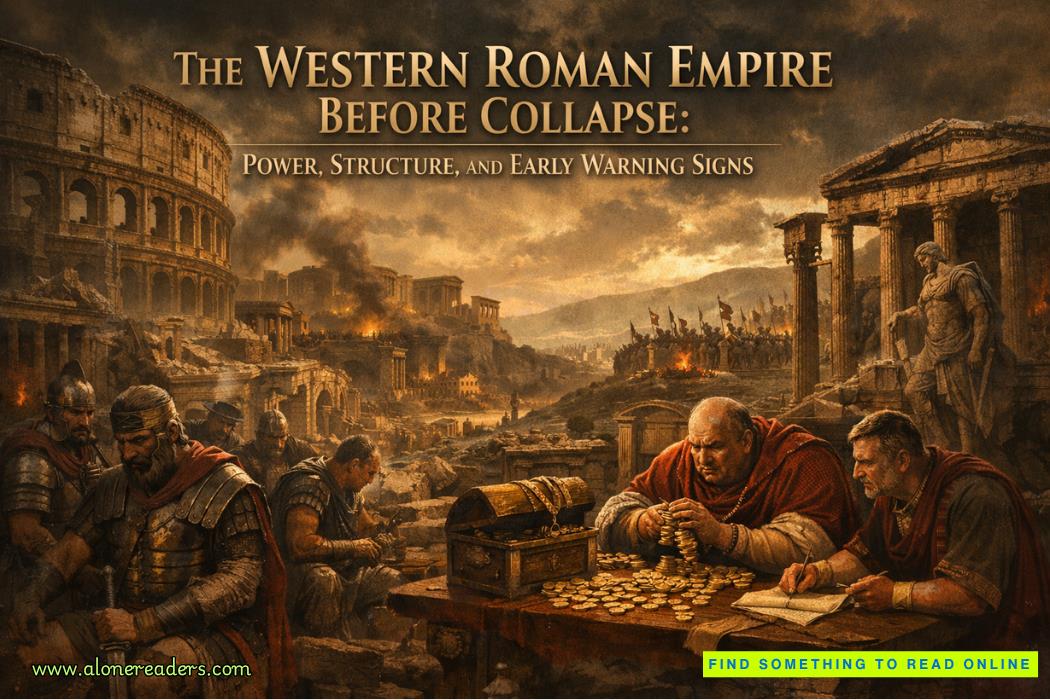
The Western Roman Empire, in the decades and centuries preceding its collapse in 476 AD, did not fall suddenly nor unexpectedly. Instead, it underwent a prolonged and deeply complex process of transformation, erosion, and internal contradiction. To understand this decline, one must examine not only its external pressures but also the intricate systems of power, governance, economy, and military organization that once sustained Roman dominance—and ultimately contributed to its fragmentation. The fall was not merely an event; it was the culmination of systemic stress accumulating over generations.
At its height, the Roman Empire represented one of the most sophisticated political entities in human history. Its administrative apparatus, particularly after the reforms of Diocletian in the late third century, was designed to manage an immense and diverse territory stretching across Europe, North Africa, and parts of Asia. Diocletian’s introduction of the Tetrarchy—a system dividing rule among four emperors—was intended to address the challenges of governing such vast lands. This system temporarily stabilized imperial control, but it also introduced a dangerous precedent: the division of authority that would later evolve into a permanent split between the Eastern and Western Empires.
The Western Roman Empire, with its capital eventually relocated from Rome to Milan and later to Ravenna, faced structural disadvantages compared to its eastern counterpart. The East retained wealthier provinces, more urbanized economies, and stronger defensive positions. In contrast, the West was increasingly rural, economically strained, and militarily exposed. This asymmetry created a growing imbalance that would prove fatal over time.
Roman political power, in theory, remained centralized in the emperor. However, by the fourth and fifth centuries, this authority had become increasingly fragile. Emperors were often elevated by military factions rather than legitimate succession, leading to frequent coups, short reigns, and chronic instability. The imperial office, once a symbol of unity and continuity, became a contested prize in a cycle of violence and opportunism. This instability undermined long-term policy planning and weakened the coherence of governance.
The bureaucratic system, once a hallmark of Roman efficiency, expanded dramatically during the late empire. While this expansion aimed to improve control and tax collection, it also resulted in excessive administrative overhead. Corruption became endemic, particularly in provincial governance, where officials exploited their positions for personal gain. Tax burdens increased significantly to support both the bureaucracy and the military, placing immense pressure on landowners and peasants alike. Economic extraction without proportional reinvestment eroded loyalty to the state.
The Roman economy itself underwent profound changes during this period. Earlier centuries had been characterized by dynamic trade networks, urban prosperity, and a stable currency. However, by the fourth century, economic vitality had declined. Inflation, driven in part by currency debasement, reduced purchasing power and disrupted markets. Trade networks contracted, and many urban centers experienced depopulation. Wealth became increasingly concentrated in the hands of a few elites, while the majority of the population faced declining living standards. The economic engine that had once powered imperial expansion was sputtering under systemic strain.
A particularly significant transformation occurred in the relationship between landowners and the state. Large estates, known as latifundia, became dominant in the Western Empire. These estates often operated semi-autonomously, with their own labor forces and internal economies. Peasants, increasingly bound to the land as coloni, lost mobility and autonomy. This system, while stabilizing agricultural production in the short term, reduced the tax base and weakened central authority. The state’s reliance on local elites inadvertently empowered forces that operated beyond its effective control.
The Roman military, long regarded as the backbone of imperial strength, also underwent critical changes. Recruitment became more difficult as the traditional pool of Roman citizens willing to serve diminished. To compensate, the empire increasingly relied on non-Roman recruits, including Germanic tribes who were settled within imperial borders as foederati. While these groups provided much-needed manpower, their loyalty was often contingent and negotiated rather than absolute. The army, once a unifying institution of Roman identity, became a patchwork of competing allegiances.
Military command structures further contributed to instability. Powerful generals, such as Stilicho and later Ricimer, wielded significant influence, often overshadowing the emperors they ostensibly served. These figures acted as kingmakers, installing and removing emperors to suit their interests. While they occasionally provided effective leadership, their dominance underscored the erosion of centralized authority. When military leaders become political arbiters, the state’s institutional integrity is fundamentally compromised.
External pressures, particularly from migrating and invading groups, are often cited as primary causes of Rome’s fall. However, these pressures were as much a symptom as a cause of internal weakness. The movement of groups such as the Visigoths, Vandals, and Huns placed enormous strain on Roman borders. Yet, it was the empire’s inability to effectively integrate or repel these groups that revealed its declining capacity. The sack of Rome in 410 by Alaric was a symbolic shock, but it was not an isolated catastrophe—it was part of a broader pattern of vulnerability.
Diplomatic strategies also shifted during this period. Rome increasingly relied on treaties and settlements rather than outright conquest. While pragmatic, this approach often involved granting land and autonomy to barbarian groups within imperial territory. Over time, these arrangements created semi-independent enclaves that operated with limited allegiance to Rome. What began as a strategy of accommodation evolved into a fragmentation of sovereignty.
Another critical dimension of decline was cultural and ideological transformation. The adoption of Christianity as the state religion under Constantine the Great and later emperors reshaped Roman identity. While Christianity provided a unifying moral framework, it also redirected resources and attention. Some historians argue that the Church’s growing influence diverted wealth from state functions and introduced new power dynamics. Others emphasize that Christianity offered social cohesion during a time of crisis. Regardless, the ideological shift marked a departure from traditional Roman values and institutions.
Urban decline in the Western Empire further illustrates the depth of systemic weakening. Cities, once centers of administration, commerce, and culture, experienced population loss and infrastructural decay. Public works such as roads, aqueducts, and baths fell into disrepair. The decline of urban life reduced economic activity and weakened administrative reach. When cities fail, the connective tissue of an empire begins to disintegrate.
The cumulative effect of these factors—political instability, economic contraction, military transformation, and social change—created a series of early warning signs that, in retrospect, clearly indicated impending collapse. However, these signs were not always recognized or addressed effectively by contemporaries. Short-term survival often took precedence over long-term reform. Emperors and officials focused on immediate threats rather than systemic restructuring. The inability to diagnose and respond to structural decline is itself a hallmark of failing states.
By the mid-fifth century, the Western Roman Empire had effectively lost control over much of its territory. Key provinces such as Gaul, Hispania, and North Africa had fallen under the control of various barbarian kingdoms. The loss of North Africa to the Vandals was particularly devastating, as it deprived the empire of a crucial source of grain and revenue. Economic and territorial losses reinforced each other in a downward spiral.
The final deposition of the last Western Roman emperor, Romulus Augustulus, by the Germanic leader Odoacer in 476 AD is often cited as the definitive end of the Western Empire. Yet, by this point, the empire had already ceased to function as a cohesive political entity. The structures of power, administration, and identity that once defined Rome had been fundamentally transformed or dismantled.
The story of the Western Roman Empire before its collapse is not merely one of decline but of adaptation, resilience, and ultimately, limitation. It reveals how even the most powerful systems can falter when internal coherence is lost and external pressures exploit existing vulnerabilities. The early warning signs were present in the shifting dynamics of power, the strain on economic systems, and the fragmentation of military and political authority. These signals, while visible in hindsight, were embedded within the very structures that once ensured Rome’s success.
Understanding this period provides not only historical insight but also a broader lesson in the lifecycle of complex systems. Empires do not fall solely because of external enemies; they fall when their internal structures can no longer sustain the weight of their own complexity.



 The Hundred Days Offensive: How the Allies Defeated Germany in World War I
 The Second Battle of the Marne: The Turning Point of World War I in 1918
 The Spring Offensive of 1918: Germany's Final Gamble to Win World War I
 The Treaty of Brest-Litovsk: How Russia Left World War I
 The Russian Revolution and World War I: How War Brought Down the Tsar
 The Zimmermann Telegram Explained: Germany's Secret Offer to Mexico in World War I










