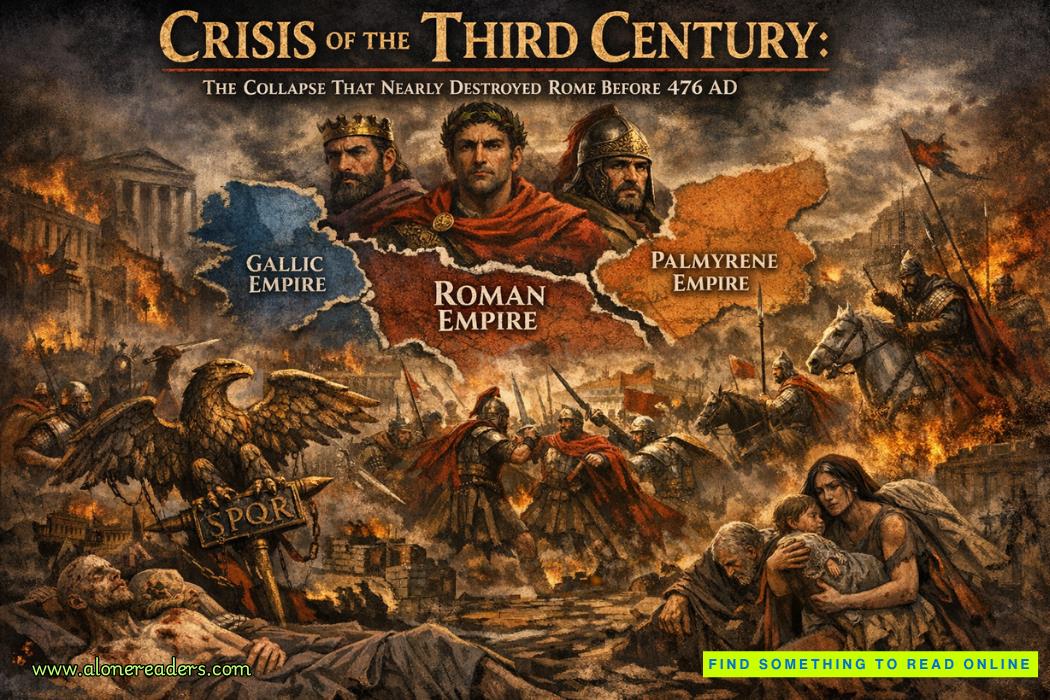
The story of Rome’s collapse is often framed around the dramatic year 476 AD, when the Western Roman Empire formally ceased to exist. Yet this final act obscures a far earlier and arguably more dangerous moment in Roman history—the Crisis of the Third Century, a period so destructive and destabilizing that it nearly erased the empire altogether. Between 235 and 284 AD, Rome endured a sustained convergence of military, political, economic, and epidemiological disasters that brought it to the brink of permanent fragmentation. This was not a slow decline but a violent, chaotic rupture in the very structure of imperial governance, one that exposed the vulnerabilities of Rome long before its eventual fall.
At the heart of this crisis was a catastrophic breakdown of political stability. The assassination of Emperor Alexander Severus in 235 AD triggered a succession crisis that fundamentally altered the nature of Roman leadership. Instead of orderly transitions or dynastic continuity, the empire entered a phase dominated by “barracks emperors”—military commanders elevated by their troops and often overthrown just as quickly. Over the next fifty years, more than twenty emperors would claim the throne, most ruling for only a short time before being assassinated, executed, or killed in battle. This rapid turnover destroyed any semblance of centralized authority and created a political environment where loyalty was transactional and fleeting.
This instability had a corrosive effect on governance. Emperors no longer ruled from a position of legitimacy derived from Rome’s institutions or traditions but from the immediate support of their armies. As a result, imperial priorities shifted dramatically toward satisfying military demands—higher pay, privileges, and rapid campaigns—often at the expense of administrative coherence and long-term planning. Civil wars became endemic, draining resources and manpower that would otherwise have been used to defend the empire’s borders. In effect, Rome began to consume itself from within, with rival claimants to power tearing apart the political fabric that had once sustained imperial unity.
Simultaneously, external pressures intensified to unprecedented levels. Along the Rhine and Danube frontiers, Germanic tribes such as the Goths, Alamanni, and Franks launched increasingly coordinated and devastating incursions. These were not isolated raids but sustained campaigns that penetrated deep into Roman territory, sacking cities and disrupting regional economies. In the East, the rise of the Sassanian Empire under rulers like Shapur I posed a formidable challenge to Roman dominance. The capture of Emperor Valerian in 260 AD—an event almost unimaginable in earlier Roman history—symbolized the extent to which Rome’s military prestige had eroded. It was a moment of profound humiliation that reverberated across the empire, signaling that Rome was no longer invincible.
The empire’s territorial integrity fractured under this pressure. By the mid-third century, Rome had effectively split into three competing political entities. In the West, the Gallic Empire emerged, encompassing Gaul, Britain, and parts of Spain under its own emperors. In the East, the Palmyrene Empire, led by Queen Zenobia, asserted control over Syria, Egypt, and large portions of the eastern provinces. Meanwhile, the central Roman government struggled to maintain authority over Italy and the Balkans. This tripartite division was not merely administrative—it represented a fundamental breakdown of imperial unity, with each region operating independently and often in competition with the others.
Economic collapse compounded these political and military crises. The constant need to fund armies and civil wars led to aggressive debasement of the Roman currency. Silver content in coins plummeted, resulting in rampant inflation and a loss of confidence in monetary transactions. Trade networks that had once connected the vast expanse of the empire began to disintegrate as insecurity made long-distance commerce increasingly risky. Urban centers, heavily dependent on stable trade and administrative functions, experienced sharp declines. The Roman economy, once a sophisticated and integrated system, regressed toward localized and subsistence-based production.
This economic disintegration had profound social consequences. Taxation became more oppressive as the state attempted to extract resources from a shrinking economic base. Peasants abandoned their lands to escape tax collectors and marauding armies, leading to declines in agricultural productivity. In cities, unemployment and food shortages became more common, exacerbating social unrest. The traditional Roman social order—anchored by a balance between elites, urban populations, and rural producers—began to unravel. The sense of a shared Roman identity weakened as regional and local concerns took precedence over imperial cohesion.
Adding to this already dire situation was the devastating impact of disease. The Plague of Cyprian, which swept through the empire during the mid-third century, caused widespread mortality and further destabilized society. Contemporary accounts describe cities emptied of inhabitants and armies weakened by illness. The loss of population not only reduced the available labor force but also undermined military recruitment and economic recovery. In a system already strained by war and political chaos, the plague acted as a multiplier of crisis, accelerating the empire’s downward spiral.
Religious and cultural transformations during this period also reflected the broader sense of instability. Traditional Roman religious practices, closely tied to the state and its institutions, began to lose their centrality as people sought alternative sources of meaning and security. New religious movements, including early Christianity, gained traction by offering frameworks that addressed the uncertainties and suffering of the time. This shift did not directly cause the crisis, but it illustrates how deeply the upheaval affected the psychological and cultural landscape of the empire.
Despite the severity of these challenges, Rome did not collapse. Instead, it underwent a process of radical transformation, driven by a series of reformist emperors who recognized that survival required fundamental change. The most significant of these was Diocletian, who came to power in 284 AD and implemented sweeping reforms aimed at stabilizing the empire. He restructured the administration, dividing authority among multiple rulers in a system known as the Tetrarchy. This innovation sought to address the problem of overextension by ensuring that different regions of the empire could be governed more effectively.
Diocletian also undertook extensive economic reforms, including attempts to stabilize currency and control prices. While some of these measures had limited success, they represented a concerted effort to restore confidence in the imperial system. Military reforms strengthened border defenses and reorganized the army to respond more flexibly to threats. Crucially, Diocletian redefined the nature of imperial authority, emphasizing a more autocratic and centralized model that distanced the emperor from traditional Roman political norms. This transformation marked the beginning of what historians often describe as the transition from the Principate to the Dominate—a shift toward a more overtly authoritarian form of rule.
The recovery initiated during this period was not a return to the Rome of earlier centuries but the emergence of a new kind of empire. The structures put in place during and after the crisis allowed Rome to endure for another two centuries in the West and even longer in the East. However, the cost of this survival was profound. The empire that emerged from the Crisis of the Third Century was more rigid, more militarized, and more dependent on centralized control. The flexibility and resilience that had characterized earlier Roman governance were replaced by systems designed to prevent collapse rather than to foster growth.
In retrospect, the Crisis of the Third Century can be understood as a decisive turning point in Roman history. It revealed deep structural weaknesses that would later play a significant role in the fall of the Western Roman Empire in 476 AD. Dependence on military strength for political legitimacy, the fragility of long-distance trade networks, the difficulty of governing a vast and diverse empire, and the mounting pressure from external enemies all became clearly visible during this period. Although the empire managed to survive, it emerged fundamentally transformed, bearing the lasting scars of this near-fatal crisis into its final centuries.
Perhaps the most striking aspect of this crisis is how close Rome came to permanent disintegration. Unlike the more gradual decline often associated with its later history, the third century presented a scenario in which the empire could have ceased to exist entirely. The simultaneous emergence of rival states, the collapse of central authority, and the convergence of multiple crises created a situation that was, in many respects, more dangerous than the events of 476 AD. That Rome endured is a testament to its capacity for adaptation, but it also underscores the fragility of even the most powerful political systems.
Understanding this period is essential for a nuanced interpretation of Rome’s fall. The events of 476 AD were not an isolated incident but the culmination of processes that had been unfolding for centuries. The Crisis of the Third Century serves as a stark reminder that the decline of complex societies is rarely linear or inevitable. Instead, it is shaped by moments of acute crisis that test the limits of resilience and force transformative change. In the case of Rome, this crisis did not end the empire, but it irrevocably altered its trajectory, setting the stage for the final chapter of Western Roman history.



 The Hundred Days Offensive: How the Allies Defeated Germany in World War I
 The Second Battle of the Marne: The Turning Point of World War I in 1918
 The Spring Offensive of 1918: Germany's Final Gamble to Win World War I
 The Treaty of Brest-Litovsk: How Russia Left World War I
 The Russian Revolution and World War I: How War Brought Down the Tsar
 The Zimmermann Telegram Explained: Germany's Secret Offer to Mexico in World War I