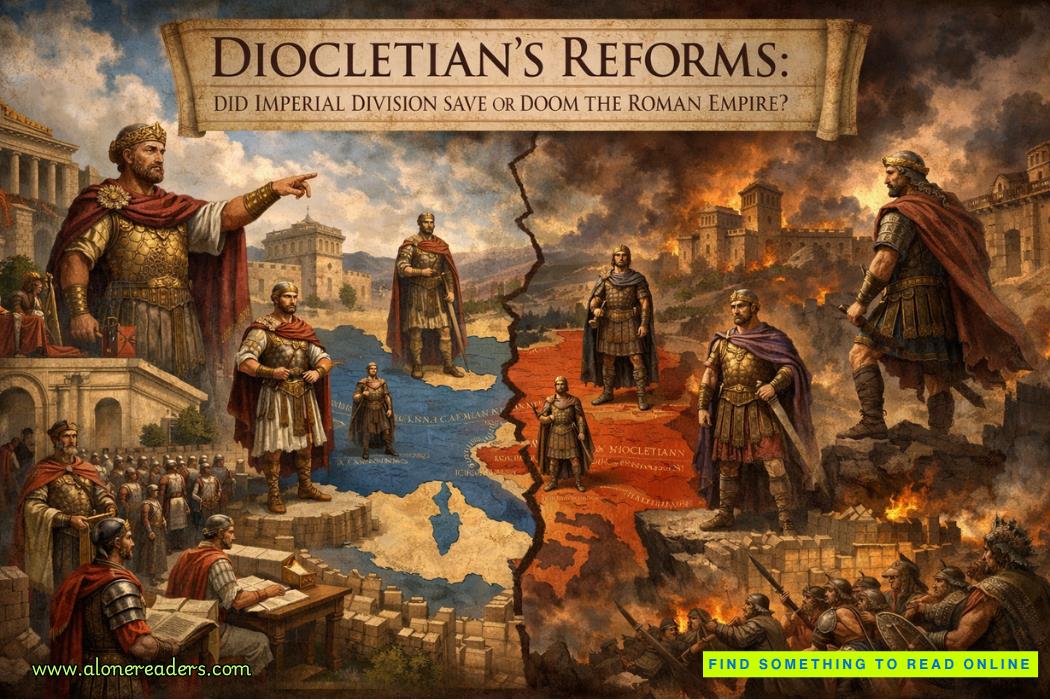
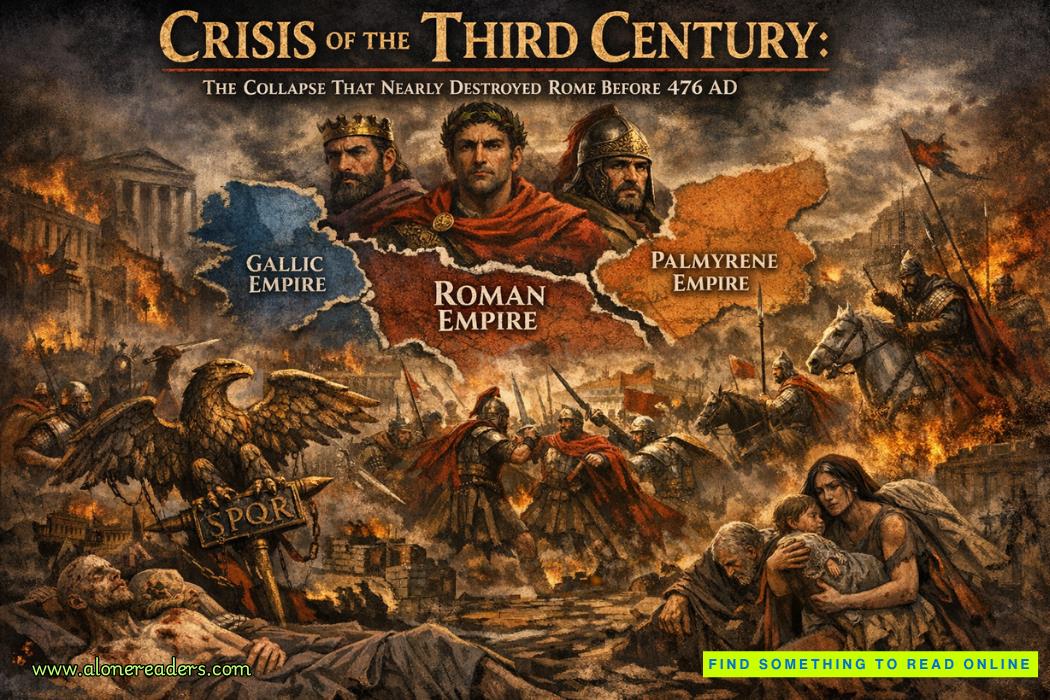
The reign of Diocletian marks one of the most transformative—and controversial—periods in the history of the Roman Empire. When he seized power in 284 AD, the empire was in a state of near-collapse, battered by decades of political instability, economic breakdown, and relentless external invasions. This era, often referred to as the Crisis of the Third Century, had seen over twenty emperors rise and fall in rapid succession, many meeting violent ends. Against this backdrop, Diocletian’s reforms were not merely administrative adjustments; they were a comprehensive attempt to re-engineer the very structure of imperial governance. The central question remains deeply debated among historians: did his decision to divide power ultimately preserve Rome, or did it plant the seeds of its eventual downfall?
Diocletian’s most radical innovation was the establishment of the Tetrarchy, a system in which imperial authority was divided among four rulers: two senior emperors, known as Augusti, and two junior emperors, known as Caesars. This was not a symbolic arrangement but a practical response to the empire’s vast geographic expanse and the increasing difficulty of managing simultaneous crises across multiple frontiers. By decentralizing authority, Diocletian aimed to ensure that military and administrative responses could be immediate and localized, rather than delayed by the limitations of communication and travel.
At first glance, the Tetrarchy appeared to be a stroke of genius. Each emperor governed a specific region, allowing for more efficient defense against threats such as Germanic tribes in the west and Persian forces in the east. The system also introduced a structured method of succession, theoretically eliminating the chaos that had plagued imperial transitions. Under Diocletian’s leadership, the empire experienced a period of relative stability. Borders were reinforced, rebellions were suppressed, and the machinery of government began to function with renewed discipline. In this sense, the division of power can be seen as a decisive intervention that halted Rome’s immediate decline.
However, beneath this apparent success lay inherent structural tensions. The Tetrarchy depended heavily on the personal loyalty and cooperation of its rulers, a fragile foundation in a political culture deeply accustomed to centralized authority and personal ambition. While Diocletian himself managed to maintain cohesion through his authority and careful selection of co-rulers, the system lacked mechanisms to sustain unity beyond his presence. When he abdicated in 305 AD—an unprecedented act for a Roman emperor—the carefully balanced structure began to unravel. Rivalries emerged, alliances shifted, and the empire once again descended into civil conflict.
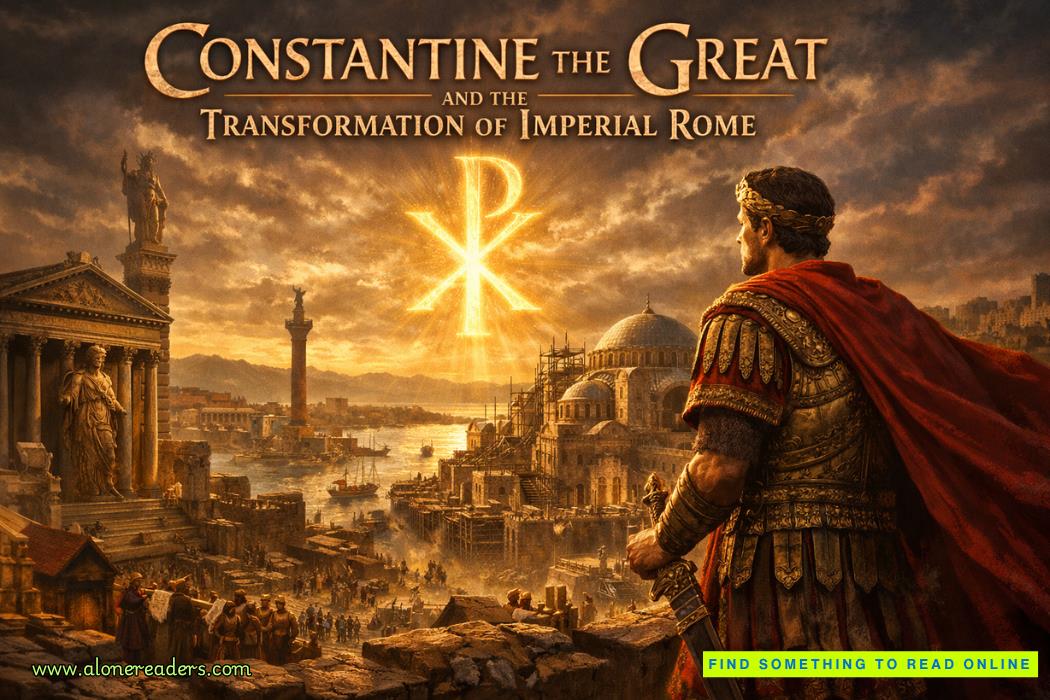
The rise of Constantine the Great illustrates both the resilience and the limitations of Diocletian’s reforms. Constantine ultimately reunified the empire under his sole rule, effectively dismantling the Tetrarchic system. Yet, in doing so, he retained many of Diocletian’s administrative and military reforms, suggesting that while the structure of divided rule failed, the principles underlying those reforms were sound. This duality highlights a crucial point: Diocletian’s vision was not entirely flawed, but its execution was dependent on conditions that could not be sustained over time.
Beyond the political sphere, Diocletian’s reforms extended into economic and social domains, further complicating their long-term impact. His attempts to stabilize the economy included the introduction of a new tax system based on land and population, as well as the infamous Edict on Maximum Prices, which sought to curb inflation by imposing price controls across the empire. While these measures demonstrated a sophisticated understanding of systemic economic issues, they often proved difficult to enforce and sometimes produced unintended consequences. The rigid tax structure, for instance, placed heavy burdens on rural populations and contributed to the gradual erosion of economic flexibility.
Socially, Diocletian’s policies reinforced a trend toward increasing rigidity within Roman society. Professions became hereditary, binding individuals to their roles in ways that limited mobility and innovation. This shift can be interpreted as a necessary step toward stability in a time of crisis, but it also contributed to the long-term stagnation of the empire. The emphasis on control and predictability, while effective in the short term, may have undermined the adaptability that had once been a hallmark of Roman success.
The division of the empire also had profound cultural and administrative implications. Over time, the eastern and western regions developed distinct identities, shaped by differences in language, economy, and external pressures. The eastern half, with its wealthier cities and more stable borders, evolved into what would later become the Byzantine Empire. The western half, by contrast, faced increasing challenges from migrating tribes and internal fragmentation. While these divergences cannot be attributed solely to Diocletian’s reforms, his decision to formalize the division of authority arguably accelerated the process. In this sense, the Tetrarchy can be seen as a catalyst for the eventual bifurcation of the Roman world.
Yet, it is important to consider the counterfactual scenario. Without Diocletian’s reforms, the Roman Empire might not have survived the third century at all. The centralized system of governance that had served Rome in earlier periods was no longer viable in the face of mounting external and internal pressures. By distributing power and responsibilities, Diocletian created a framework that allowed the empire to endure for another two centuries in the west and over a millennium in the east. From this perspective, his reforms can be viewed as a necessary adaptation to changing circumstances, even if they introduced new vulnerabilities.
The question of whether division saved or doomed the empire ultimately hinges on how one defines success and failure in historical terms. If the goal was to preserve the unity of the Roman Empire indefinitely, then Diocletian’s reforms can be seen as a failure, as they contributed to the eventual fragmentation of imperial authority. However, if the objective was to stabilize a collapsing system and extend its lifespan, then his policies were undeniably effective. The reality is that these interpretations are not mutually exclusive. Diocletian’s reforms both prolonged the life of the empire and reshaped it in ways that made its eventual division inevitable.
A deeper analysis reveals that the true significance of Diocletian’s reforms lies not in their immediate outcomes but in their long-term implications. By redefining the nature of imperial power, he transformed the Roman Empire from a relatively flexible and adaptive system into a more rigid and bureaucratic state. This transformation provided stability in the face of crisis but also limited the empire’s ability to respond to new challenges. The balance between centralization and decentralization, flexibility and control, remains a central theme in the study of political systems, and Diocletian’s experiment offers a compelling case study in the complexities of governance at scale.
In evaluating his legacy, it is essential to move beyond simplistic judgments and recognize the nuanced interplay of factors that shaped the trajectory of the Roman Empire. Diocletian was neither the savior nor the destroyer of Rome; rather, he was a pragmatic reformer operating within the constraints of his time. His decision to divide power was a calculated response to immediate threats, not a deliberate step toward fragmentation. Yet, as history often demonstrates, even the most well-intentioned reforms can produce outcomes that extend far beyond their original scope.
Ultimately, the story of Diocletian’s reforms is one of paradox. His policies brought order to chaos, yet they also introduced new forms of instability. They strengthened the empire’s defenses while simultaneously weakening its cohesion. They extended the life of Roman civilization but altered its character in fundamental ways. To ask whether division saved or doomed the empire is to confront the inherent complexity of historical causation, where actions designed to solve one set of problems often create another.
In the final analysis, Diocletian’s legacy endures as a testament to the challenges of governing a vast and diverse empire. His reforms did not provide a permanent solution, but they offered a critical reprieve at a moment when collapse seemed imminent. Whether viewed as a bold innovation or a flawed experiment, the Tetrarchy remains one of the most significant—and debated—developments in Roman history. It stands as a reminder that the line between salvation and downfall is often thin, and that the very measures that preserve a system in the short term may shape the conditions of its eventual transformation.



 The Hundred Days Offensive: How the Allies Defeated Germany in World War I
 The Second Battle of the Marne: The Turning Point of World War I in 1918
 The Spring Offensive of 1918: Germany's Final Gamble to Win World War I
 The Treaty of Brest-Litovsk: How Russia Left World War I
 The Russian Revolution and World War I: How War Brought Down the Tsar
 The Zimmermann Telegram Explained: Germany's Secret Offer to Mexico in World War I