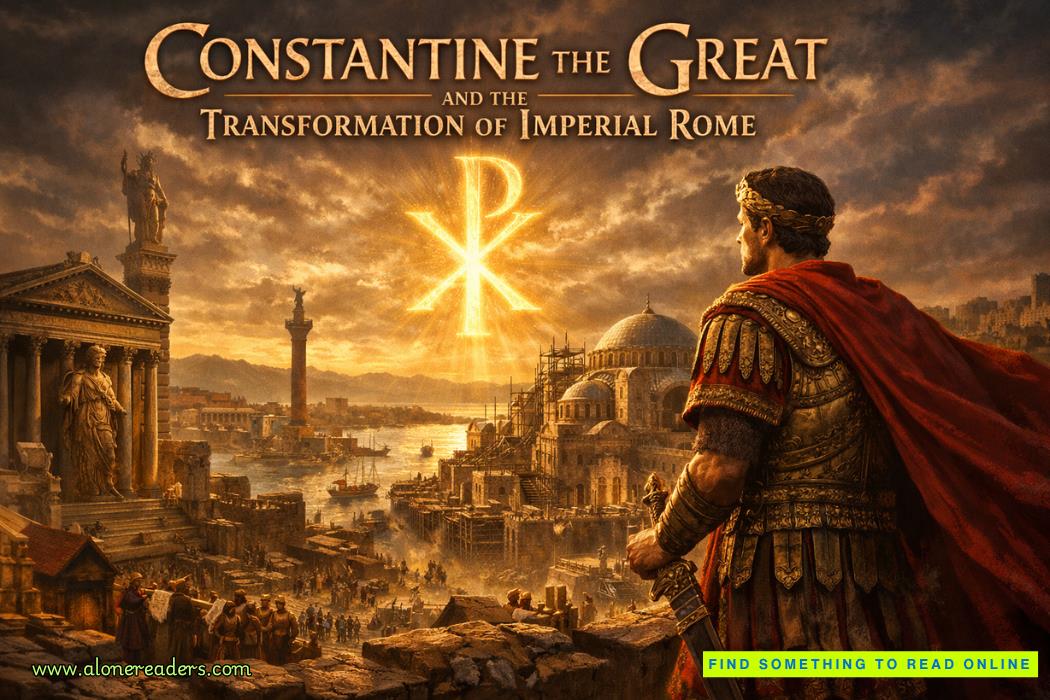
The transformation of the Roman Empire in the early fourth century stands as one of the most profound turning points in world history, and at the center of this transformation was Constantine the Great. His reign did not merely continue the traditions of Roman imperial rule; it fundamentally redefined them. Through a combination of military authority, administrative reform, and a decisive shift in religious policy, Constantine reshaped the ideological and structural foundations of the empire. His legacy is best understood not as a single act of change, but as a complex and layered process of transformation that bridged the ancient pagan world and the emerging Christian civilization of Late Antiquity.
Before Constantine’s rise, the Roman Empire had been undergoing significant strain. The third century crisis had nearly dismantled imperial unity, with economic collapse, military instability, and political fragmentation threatening the survival of Rome itself. The introduction of the Tetrarchy under Diocletian had stabilized the empire temporarily by dividing power among multiple rulers. However, this system also created competing centers of authority, making civil conflict almost inevitable. Constantine emerged from this volatile environment as both a product of its instability and the architect of its resolution.
His ascent to power was marked by decisive military action, most notably the Battle of the Milvian Bridge in 312 AD. According to later accounts, Constantine experienced a vision that would alter the course of Roman history: a divine sign associated with the Christian God, instructing him to conquer under this symbol. Whether interpreted as genuine religious experience or calculated political symbolism, this moment marked the beginning of a new imperial ideology. The adoption of the Chi-Rho symbol on military standards represented more than personal belief; it signaled the integration of Christianity into the machinery of imperial power.
The subsequent issuance of the Edict of Milan in 313 AD further solidified this transformation. This decree, co-authored with Licinius, granted religious tolerance across the empire, effectively ending the persecution of Christians that had characterized earlier reigns. However, the significance of this act goes beyond simple tolerance. Constantine’s policies gradually shifted from neutrality to active patronage of Christianity. He funded the construction of churches, granted privileges to clergy, and involved himself in theological disputes. In doing so, he positioned the emperor not merely as a political leader, but as a guardian of religious unity.
One of the most critical aspects of Constantine’s transformation of Rome was his redefinition of imperial authority. Traditional Roman emperors had been closely associated with pagan religious institutions, often holding titles such as Pontifex Maximus. Constantine did not immediately abolish these traditions, but he began to reframe imperial legitimacy through a Christian lens. The emperor became a chosen instrument of divine will, ruling under the authority of a singular, universal God rather than the fragmented pantheon of Roman deities. This ideological shift provided a new foundation for political unity, particularly in a diverse empire where traditional religious practices varied widely.
Constantine’s involvement in the Council of Nicaea in 325 AD further illustrates his role in shaping the religious direction of the empire. This council was convened to address the Arian controversy, a theological dispute that threatened to divide the Christian community. By presiding over the council and endorsing the Nicene Creed, Constantine established a precedent for imperial intervention in doctrinal matters. This was a crucial development, as it linked religious orthodoxy with political stability. Unity of belief became synonymous with unity of the state, reinforcing the emperor’s role as both ruler and arbiter of faith.
Another defining element of Constantine’s transformation was the founding of Constantinople. Established on the site of Byzantium and inaugurated in 330 AD, this new capital represented a strategic and symbolic shift in the center of imperial power. Unlike Rome, which was deeply rooted in pagan traditions and senatorial influence, Constantinople was designed as a Christian imperial city. Its location at the crossroads of Europe and Asia allowed for greater control over trade routes and military movements, while its urban design reflected the emerging Christian identity of the empire.
The establishment of Constantinople also signaled a broader transition from the classical Roman world to what historians often describe as the Byzantine era. The city became a hub of administrative efficiency, economic vitality, and religious authority. By relocating the imperial court, Constantine effectively diminished the political significance of Rome itself, accelerating the transformation of the Western Empire into a region increasingly defined by decentralization and eventual decline. In contrast, the Eastern Empire, anchored by Constantinople, would endure for centuries.
Constantine’s administrative reforms further reinforced this transformation. Building upon the foundations laid by Diocletian, he reorganized the empire’s governance structure to improve efficiency and control. Provincial administration was refined, military command was separated from civil authority, and new bureaucratic mechanisms were introduced. These changes enhanced the emperor’s ability to maintain order across vast territories, but they also contributed to the centralization of power. The emperor’s authority became more absolute, supported by a complex administrative apparatus that extended into every corner of the empire.
Economic policies under Constantine also played a crucial role in stabilizing the empire. The introduction of the solidus, a gold coin of consistent value, provided a reliable standard for trade and taxation. This monetary reform helped restore confidence in the imperial economy, facilitating both domestic and international commerce. The stability of the solidus would endure long after Constantine’s reign, becoming a cornerstone of Byzantine economic strength. Through such measures, Constantine demonstrated an understanding that economic stability was essential to political and social cohesion.
Despite his support for Christianity, Constantine did not completely abandon traditional Roman religious practices. Pagan temples continued to operate, and traditional rituals were not immediately suppressed. This approach reflects a pragmatic strategy of gradual transformation rather than abrupt revolution. By allowing continuity alongside change, Constantine minimized resistance and ensured a smoother transition toward a Christianized empire. However, the long-term trajectory was clear: Christianity would increasingly dominate the religious landscape, eventually becoming the official state religion under later emperors.
The social implications of Constantine’s policies were equally significant. The elevation of Christianity altered the moral and cultural framework of Roman society. Concepts such as charity, humility, and compassion gained prominence, influencing legal and social norms. The church emerged as a powerful institution, providing social services, education, and a sense of community. This transformation contributed to the development of a new cultural identity that blended Roman administrative traditions with Christian ethical principles.
At the same time, Constantine’s reign introduced tensions that would shape the future of the empire. The close relationship between church and state created opportunities for cooperation, but also for conflict. Disputes over doctrine, authority, and jurisdiction would become recurring themes in the centuries that followed. The emperor’s role in religious affairs set a precedent that later rulers would both embrace and struggle to manage. In this sense, Constantine’s legacy is not one of simple resolution, but of enduring complexity.
The transformation initiated by Constantine also had profound implications for the Western Roman Empire. While the East benefited from the stability and resources of Constantinople, the West faced increasing challenges. Economic disparities, military pressures from barbarian groups, and administrative inefficiencies contributed to its gradual decline. Although Constantine’s reforms were not directly responsible for the fall of the Western Empire in 476 AD, they reshaped the balance of power in ways that influenced its trajectory. The shift of resources and attention դեպի the East left the Western provinces more vulnerable, setting the stage for their eventual collapse.
Constantine’s personal legacy is often viewed through the lens of his religious conversion. However, it is important to recognize that his impact extends far beyond this single aspect. He was a strategist, reformer, and visionary leader who understood the need for adaptation in a changing world. His ability to integrate new ideas with existing structures allowed him to create a more resilient and unified empire. At the same time, his policies introduced new dynamics that would continue to evolve long after his death.
In evaluating Constantine’s transformation of Imperial Rome, it becomes clear that his reign marked the beginning of a new historical era. The transition from a pagan empire to a Christian state was not merely a change in religious affiliation; it represented a fundamental redefinition of identity, authority, and purpose. The Roman Empire, once centered on the traditions of classical antiquity, became the foundation for a medieval Christian civilization that would shape the course of European history.
Ultimately, Constantine the Great stands as a figure of immense historical significance because he operated at the intersection of continuity and change. He preserved the structural integrity of the Roman state while simultaneously redefining its ideological core. His actions demonstrate how leadership can influence not only the immediate conditions of an empire, but also its long-term evolution. The transformation he initiated was not confined to his lifetime; it extended across centuries, influencing the development of political institutions, religious practices, and cultural identities.
The story of Constantine is therefore not simply about an emperor who embraced Christianity. It is about the reconstruction of an entire imperial system in response to the challenges and opportunities of a new age. Through his reforms, policies, and vision, Constantine reshaped the Roman Empire into a form that could endure beyond the collapse of its western half. His legacy lives on in the enduring influence of Constantinople, the spread of Christianity, and the transformation of Rome from a classical empire into a cornerstone of medieval civilization.



 The Hundred Days Offensive: How the Allies Defeated Germany in World War I
 The Second Battle of the Marne: The Turning Point of World War I in 1918
 The Spring Offensive of 1918: Germany's Final Gamble to Win World War I
 The Treaty of Brest-Litovsk: How Russia Left World War I
 The Russian Revolution and World War I: How War Brought Down the Tsar
 The Zimmermann Telegram Explained: Germany's Secret Offer to Mexico in World War I