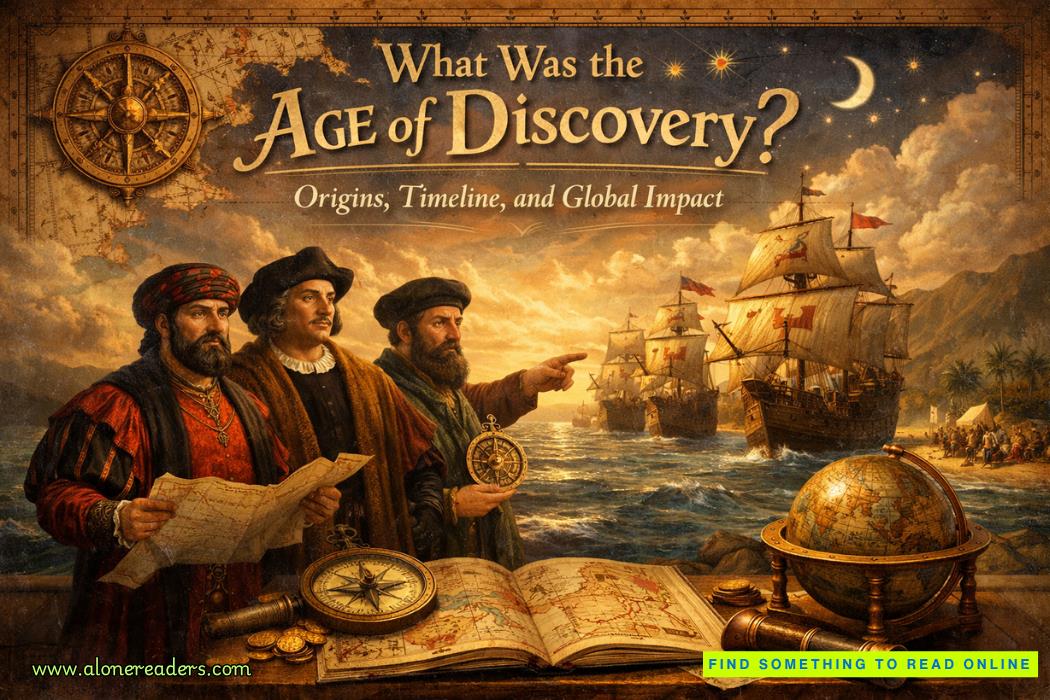
The Age of Discovery, often called the Age of Exploration, represents one of the most transformative chapters in world history, stretching roughly from the early 15th century to the late 17th century. It was a time when European nations—principally Portugal and Spain, later joined by England, France, and the Netherlands—ventured beyond familiar shores in search of new trade routes, lands, and knowledge. What began as a quest to bypass Middle Eastern and North African intermediaries in the spice trade soon evolved into a profound reshaping of global geography, economics, science, and culture.
Although many civilizations had engaged in long-distance exploration before this era, what defines the Age of Discovery is the systematic, sustained, and interconnected expansion that linked continents through maritime power and technological innovation. The age’s defining feature was not merely discovery itself, but the birth of a truly global world—a world connected by sea routes, commerce, ideology, and empire.
At the heart of this movement stood Portugal, a small Iberian kingdom with ambitious maritime aspirations. Under the patronage of Prince Henry the Navigator in the early 15th century, Portuguese explorers began mapping the West African coast. Their initial motives were economic—access to gold, ivory, and slaves—but their navigations gradually extended the known world’s boundaries. The invention and refinement of navigational tools such as the astrolabe and the caravel gave these explorers new confidence to sail into previously uncharted waters.
By the mid-15th century, Portuguese mariners like Bartolomeu Dias had rounded the Cape of Good Hope, proving that the Indian Ocean could be reached from the Atlantic. This achievement culminated in 1498, when Vasco da Gama finally reached Calicut (modern-day Kozhikode, India), establishing the first direct sea link between Europe and Asia. This route broke the overland monopoly held by Islamic and Venetian merchants and redefined economic power in Europe. Lisbon, once a peripheral trading city, became the epicenter of a global network of goods—from spices and silks to gold and souls.
Meanwhile, Spain, equally driven by ambition and competition, sought new opportunities westward. In 1492, Christopher Columbus, sailing under the Spanish crown, reached what he believed were the islands near Asia—but instead found the Americas. Though unaware of his real location, Columbus’s voyage irrevocably altered human history. The Atlantic, once a barrier, became a highway of exchange and conquest. Within a few decades, Spanish expeditions led by Hernán Cortés and Francisco Pizarro overturned powerful indigenous empires—the Aztec and Inca—giving Spain vast new territories and unmatched wealth in gold and silver.
This new wealth shifted the European balance of power and funded further explorations. The Treaty of Tordesillas in 1494, negotiated under papal authority, divided the non-European world between Spain and Portugal: a demarcation line running west of the Cape Verde islands. Although meant to prevent conflict, the treaty instead accelerated competition among other European states eager for a share of the newly revealed world.
As the 16th century unfolded, exploratory zeal spread northward. England and France, lacking papal sanction and Iberian access, began to chart their own routes. English explorers like John Cabot and later Sir Francis Drake undertook voyages across the Atlantic and around the world, while the French—led by Jacques Cartier—ventured into the St. Lawrence River, laying claims that would shape North America’s future.
At the same time, the Dutch Republic emerged as a maritime powerhouse. Through their Dutch East India Company (VOC) and West India Company (WIC), they established trading posts and colonies in Africa, the Americas, and Asia. Amsterdam rose to prominence as the commercial capital of the northern world, its wealth anchored in maritime trade and the efficient management of empire through corporate enterprise.
The timeline of the Age of Discovery cannot be confined to one century or one empire, for its impacts were cumulative and global. The period roughly spans from 1415, when Portugal conquered Ceuta in North Africa, to 1648, when European trade incorporated nearly all known regions of the world. During these years, human perception of geography transformed dramatically—from medieval maps depicting mythic creatures and fragmented continents to increasingly accurate nautical charts and global atlases.
The Renaissance spirit played a subtle but essential role. Exploration was not only about economics but also about knowledge and curiosity. The expansion of human horizons coincided with advancements in cartography, astronomy, and mathematics. Sailors navigated by the stars, and scholars back in Europe began to reshape theories of the Earth and the cosmos. This era indirectly paved the way for the Scientific Revolution by challenging old worldviews and encouraging direct observation of reality.
Yet the Age of Discovery also carried darker dimensions. The encounter between continents led to the Columbian Exchange—a massive transfer of crops, animals, diseases, and human populations between the Old and New Worlds. From Europe came horses, cattle, and wheat; from the Americas came maize, potatoes, tobacco, and tomatoes. While these exchanges enriched cuisines and agriculture worldwide, they also spread devastating epidemics such as smallpox and measles, which decimated indigenous American populations who had no immunity to Old World diseases.
The transatlantic slave trade arose as a grim byproduct of the same global integration. As European colonies in the Americas demanded labor for sugar, tobacco, and later cotton plantations, millions of Africans were forcibly transported across the Atlantic. This system of slavery reshaped demographics, economies, and societies across three continents, leaving deep scars that persist into the modern era.
Economically, the Age of Discovery signaled the beginning of a global capitalist system. European empires monopolized valuable resources, established new trading monopolies, and developed maritime warfare to protect their interests. Colonies became extensions of national wealth, their prosperity measured in ounces of silver and barrels of sugar rather than local stability or justice.
Politically, the age redefined European power hierarchies. The wealth flowing into Spain and Portugal initially gave them dominance, but mismanagement and overextension shifted influence toward England and the Netherlands by the 17th century. The English focus on colonization rather than conquest led to enduring settlements in North America, while the Dutch trading system prioritized efficiency, capital, and maritime supremacy.
For Asia and Africa, the Age of Discovery introduced a complex mix of opportunity and exploitation. In Asia, established civilizations such as China, Japan, and India responded in varied ways—sometimes embracing trade, sometimes resisting foreign encroachment. Portuguese and later Dutch traders established footholds in Goa, Malacca, and the Spice Islands; the Japanese shogunate eventually restricted contact after observing European ambitions. Africa, meanwhile, became both a transit point for commerce and a major target of slave raiding and colonization, its societies disrupted by external demand and internal conflicts fueled by foreign profit.
The Pacific Ocean, too, entered the narrative through the daring exploit of Ferdinand Magellan, whose expedition (1519–1522) achieved the first recorded circumnavigation of the globe. Though Magellan himself died during the voyage, his fleet’s completion of the journey demonstrated, conclusively, the Earth’s roundness and the vastness of its oceans. It marked the symbolic culmination of centuries of human curiosity about the limits of the world.
As exploration progressed, cartography became a revolutionary science. Early world maps such as those of Gerardus Mercator and Abraham Ortelius redefined how people visualized the planet. The term “America” appeared on maps for the first time, and geographic knowledge became a strategic asset as much as a scholarly one. This era's mapping practices would later underpin the imperial age, as accurate maps determined colonial boundaries and trade routes.
The cultural consequences of the Age of Discovery were just as far-reaching. European languages, religions, and political systems spread across continents, creating vast cultural hybridizations but also erasing countless indigenous traditions. The Christian missionary movement, intertwined with colonial expansion, sought to convert native populations, often by coercion or persuasion. In return, Europe absorbed exotic goods, art, and scientific ideas that broadened its cultural horizons. The perception of the “Other”—of foreign peoples and lands—shifted from myth to reality, albeit filtered through imperial ideology.
In intellectual terms, the age altered human self-understanding. No longer could Europe perceive itself as the universe’s center. Contact with diverse civilizations forced Europeans to rethink assumptions about race, morality, and civilization. The Enlightenment, which followed in the 18th century, drew partly on the broader worldview established during the Age of Discovery—an age that first made it possible to imagine humanity as a collective species inhabiting one shared planet.
However, historians increasingly emphasize that the Age of Discovery was not purely a European achievement. Chinese mariner Zheng He had led astonishing voyages across the Indian Ocean decades before Columbus sailed. Muslim and African navigators had mapped coasts and traded over centuries. The difference lay in Europe’s later use of these discoveries to construct empires reinforced by military power and commercial control. Thus, while “discovery” is a term embedded in Eurocentric history, the era’s true legacy is global interconnection, not one-sided exploration.
By the late 17th century, the great age of initial discovery had given way to the Age of Empire. The world’s shores were no longer mysterious; instead, they became theaters of competition and colonization. The process that began with a handful of explorers venturing into the unknown culminated in a world divided by colonial rule—a new order governed not by curiosity but by control.
The long-term global impact of this era is vast. Economically, it laid the foundations of global trade networks that still shape commerce today. Scientifically, it fostered a spirit of inquiry and precision measurement that advanced navigation, astronomy, and geography. Culturally, it redefined identity and power across continents. But morally and politically, it opened deep wounds: conquest, epidemic devastation, and slavery became the shadowed companions of progress.
In the end, the Age of Discovery represents humanity’s paradox—its yearning to know, to expand, to connect, shadowed by its capacity to dominate and destroy. The oceans, once barriers separating worlds, became bridges that wove our histories together. Out of this tangled legacy arose the modern era—a time of global interdependence, born from centuries of sails on the wind and compasses pointed toward the unknown.



 The Hundred Days Offensive: How the Allies Defeated Germany in World War I
 The Second Battle of the Marne: The Turning Point of World War I in 1918
 The Spring Offensive of 1918: Germany's Final Gamble to Win World War I
 The Treaty of Brest-Litovsk: How Russia Left World War I
 The Russian Revolution and World War I: How War Brought Down the Tsar
 The Zimmermann Telegram Explained: Germany's Secret Offer to Mexico in World War I