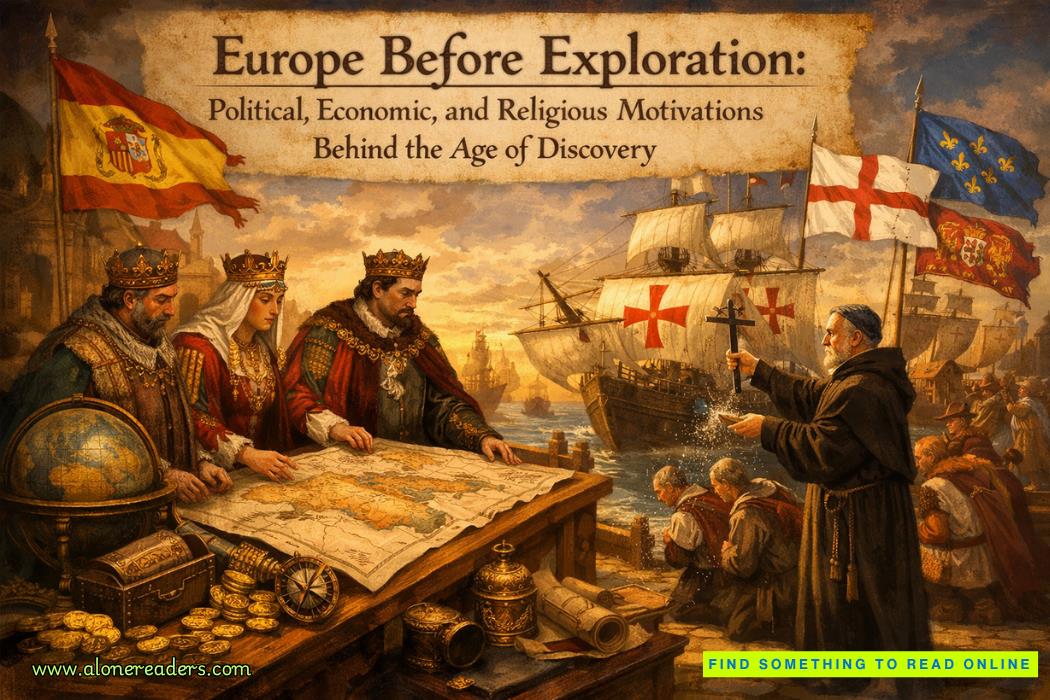
Europe before the great voyages of exploration stood at a crossroads of transformation, driven by conflict, ambition, and a renewed curiosity about the wider world. This period, stretching roughly from the late fourteenth to the early fifteenth century, witnessed the birth of conditions that would make the Age of Discovery not a mere accident of invention, but the inevitable outcome of Europe’s evolving political, economic, and religious pressures. To understand why European fleets began charting unknown seas, one must first understand what Europe was before it set sail — a fractured continent seeking wealth, power, and divine purpose amid both decay and revival.
By the late Middle Ages, Europe was still emerging from the shadow of feudalism. The feudal order, with its vast patchwork of lordships and vassal ties, had begun to crumble under the weight of new political realities. Monarchies were consolidating power in England, France, Spain, and Portugal, creating centralized nation-states that could command resources and sustain vast projects — something fragmented medieval kingdoms could not. This shift from local authority to royal absolutism was not only political but deeply strategic. Kings and queens understood that power in the fifteenth century depended on more than controlling land; it depended on controlling trade routes, resources, and the means of expansion.
The Hundred Years’ War between England and France, though long and devastating, ignited the evolution of stronger centralized governments and professional armies. When the war finally ended, both realms turned their ambitions outward rather than inward. Similarly, on the Iberian Peninsula, after the completion of the Reconquista in 1492, Spain’s newly unified crowns of Castile and Aragon, under Ferdinand and Isabella, sought new horizons to keep their warrior class active and their religious identity triumphant. Across Europe, political leaders saw in the oceans both a solution to internal restlessness and a path toward global prestige.
Economically, Europe in the early fifteenth century was hungry — not for conquest alone, but for connection. The closing of the land-based Silk Road in the wake of the fall of Constantinople in 1453 had severed Western access to Eastern luxuries such as spices, silk, and precious metals. Italian merchant republics like Venice and Genoa had long dominated the trade in these goods through their Mediterranean networks, enriching themselves through intermediaries. But as the Ottoman Empire expanded control over these routes, prices soared and access narrowed. Western European kingdoms, excluded from this lucrative commerce, began seeking direct routes to Asia to bypass both Ottoman tolls and Italian monopolies.
The quest for spices — particularly pepper, clove, cinnamon, and nutmeg — might seem trivial to modern readers, yet in the fifteenth century spices were symbols of power and sophistication, vital for preserving and flavoring food, and commanding prices higher than gold. Economic incentive, therefore, played the most immediate role in prompting exploration. The Portuguese, under Prince Henry “the Navigator,” spearheaded systematic voyages down the African coast, not merely to evangelize but to probe for gold, ivory, and access to Eastern trade. Each new discovery brought profit and prestige, reinforcing the monarch’s faith in exploration as a tool of national stability.
At the same time, technological and intellectual shifts equipped Europeans with new confidence. The invention of the printing press spread navigational knowledge faster than ever before. Portolan charts, the magnetic compass, and innovations like the caravel — a nimble ship capable of tacking against the wind — made long voyages feasible. Yet these advances alone do not explain the zeal of exploration. The deeper motivation lay within a Renaissance mindset, a rebirth of curiosity, inquiry, and human achievement that infused every act with a sense of destiny. To explore was not only to seek wealth but to fulfill a divine and intellectual purpose — to know more, to conquer distance, and to map creation itself.
Religion, however, was not a mere background truth but a driving, fiery force. Europe remained profoundly Christian and deeply divided between its Catholic and Orthodox worlds. The Muslim control of Jerusalem and the dominance of Islam in North Africa and the Near East were perceived not only as barriers to trade but as spiritual affronts. Thus, exploration carried a crusading impulse — to outflank Islam, spread Christianity, and convert “heathen” populations said to inhabit distant lands. The Papacy of the late fifteenth century actively blessed conquest; the Treaty of Tordesillas (1494), dividing the non-European world between Spain and Portugal, was sanctified by papal decree. To rulers like Portugal’s King João II or Spain’s Queen Isabella, maritime expansion was a continuation of religious warfare by other means. Their ships bore not just flags and cannons but crosses.
This religious drive also intertwined with Europe’s need for unity after centuries of internal division. The Catholic Church, though powerful, faced criticism, corruption, and, soon enough, Protestant challenge. Missionary expansion abroad offered moral justification at home — the sense that Christendom still had a grand purpose amid internal decay. Every new voyage thus became a pilgrimage, every map a prayer, every colony a potential bastion of faith. In royal courts, divine sanction became political legitimacy; expansion was framed as both salvation and survival.
The intertwining of politics, economy, and religion was nowhere clearer than in Iberia, especially in Portugal. Prince Henry’s school at Sagres combined maritime science with missionary zeal and mercantile ambition. Portuguese explorers like Bartolomeu Dias and Vasco da Gama did not only push the geographic limits of Europe — they extended its spiritual frontier. They saw reaching India not as commercial conquest alone, but as God’s providence in proving Europe’s chosen destiny. By contrast, northern states such as England and the Netherlands, when they later joined the game, emphasized trade sovereignty and maritime rivalry against Catholic empires, showing how each region’s blend of motives evolved with its history.
Another often-overlooked factor behind the Age of Discovery was Europe’s demographic pressure. The population had begun recovering after the catastrophic Black Death of the fourteenth century, producing youthful, land-hungry generations with few prospects at home. Exploration offered release — for ambition, for commerce, and for restive aristocracy. The young nobles and adventurers who had once fought in crusades or feudal wars could now pursue fortune at sea. Monarchs cleverly redirected potential rebellion into conquest abroad. It was, in effect, a political pressure valve disguised as opportunity.
Economic patterns also shifted toward capital accumulation and early proto-capitalism. The merchant classes of Flanders, Genoa, Seville, and Lisbon began financing expeditions as commercial investments, forming the early mechanisms of joint enterprise that would later become chartered companies. This was a profound shift from the land-based wealth of medieval aristocracy to the sea-based wealth of global trade. Exploration became an expression of a changing worldview: wealth was no longer static but dynamic, created through circulation and risk — the very essence of capitalism’s birth.
Religion, while spiritual in expression, dovetailed neatly with this material logic. Missionary justification gave moral cover to commercial expansion, allowing monarchs and merchants to accumulate wealth without appearing sacrilegious. The conversion of souls and accumulation of gold were thus presented as twin victories. In art, literature, and courtly rhetoric, explorers were romanticized as saints of commerce, their conquests divine acts. This synthesis of faith and fortune gave exploration a moral urgency unknown to earlier centuries.
Politically, Europe’s transformation from feudal principalities to centralized monarchies required legitimacy narratives — stories that proved divine favor and national greatness. Discovery served this purpose perfectly. A successful voyage not only enriched the crown but also sanctified its rule. The Iberian monarchs could present themselves as global patrons of both civilization and Christendom. For nations like Portugal, tiny in landmass but mighty in naval enterprise, exploration compensated for military limitation through maritime dominance, creating a new model of empire based not on conquest of territory but control of trade routes.
By the close of the fifteenth century, all three forces — political consolidation, economic hunger, and religious zeal — had converged into an unstoppable engine. Europe stood at the threshold of global expansion not because of accidental invention, but because centuries of crisis and adaptation had prepared it. The Age of Discovery, then, was not an aberration; it was Europe’s natural next act after surviving plague, schism, and feudal decay. Its ships carried not just sailors, but the ambitions of a civilization reborn, determined to redeem both its faith and fortunes on the open sea.
The irony of this transformation, however, was profound. Europe’s search for freedom — freedom of trade, of worship, of knowledge — would soon produce systems of colonial exploitation and domination repeating the hierarchies it had just outgrown. Yet, in that moment before Columbus sailed west or Vasco da Gama rounded the Cape, Europe believed it was embarking on a sacred mission. It saw itself not as conqueror but as enlightened messenger, bringing God and progress to what it perceived as the dark edges of the world.
Thus, the true story of Europe before exploration is not one of singular ambition but of converging necessities. Political competition made exploration a matter of survival; economic deprivation made it a matter of profit; and religious conviction made it a matter of destiny. Together, they forged not only the Age of Discovery but the modern world it birthed — a world defined by global trade, cultural exchange, and the enduring tension between power and morality. The ocean became Europe’s new battlefield, marketplace, and mission field all at once, and from its shores sailed both the greatest hopes and the deepest contradictions of Western history.



 The Hundred Days Offensive: How the Allies Defeated Germany in World War I
 The Second Battle of the Marne: The Turning Point of World War I in 1918
 The Spring Offensive of 1918: Germany's Final Gamble to Win World War I
 The Treaty of Brest-Litovsk: How Russia Left World War I
 The Russian Revolution and World War I: How War Brought Down the Tsar
 The Zimmermann Telegram Explained: Germany's Secret Offer to Mexico in World War I