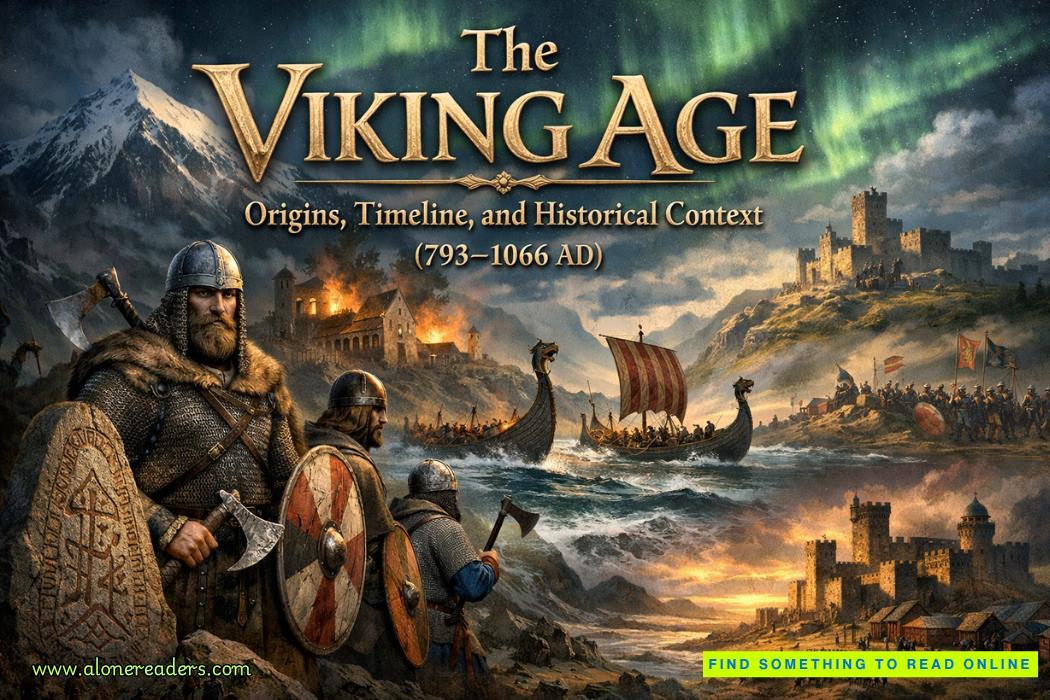
The period known as the Viking Age spanned from 793 AD to 1066 AD, marking nearly three centuries of profound transformation in Northern Europe. It was an era defined by expansion, exploration, warfare, and cultural fusion, orchestrated by the seafaring peoples of Scandinavia — primarily from modern-day Norway, Sweden, and Denmark. The Viking Age was not merely a time of raids and plunder; it was an age of discovery, navigation, and societal evolution. This epoch reshaped the political map of early medieval Europe and left a lasting imprint on art, language, religion, and trade networks.
The origins of the Viking Age can be traced back to both internal dynamics within Scandinavia and external opportunities beyond its shores. The harsh northern environment demanded resilience and innovation. Limited arable land drove many Scandinavians toward the sea, seeking resources, new lands, and wealth. The development of the longship, a revolutionary design that combined speed, strength, and shallow draft, gave the Vikings an unprecedented advantage in naval mobility. These agile vessels allowed them to strike swiftly along coastlines, navigate rivers deep inland, and retreat before local forces could organize a defense.
The catalyst that symbolically launched the Viking Age was the raid on Lindisfarne in 793 AD. The attack on the Northumbrian monastery shocked Christian Europe. The image of heathen warriors desecrating sacred ground spread terror and fascination, cementing the Vikings’ reputation as ruthless pagans. Yet, behind the violence lay pragmatic motives — wealth extraction, political assertion, and the establishment of dominance over valuable coastal trade routes. The Lindisfarne raid marked the moment when Europe first reckoned with the Scandinavian maritime power that would define centuries of interaction.
Following 793 AD, Viking activity expanded rapidly across northern waters. Norwegian Vikings, known for their Atlantic ventures, began exploring the outer isles — the Shetlands, Orkneys, and Hebrides — before colonizing Iceland and venturing to Greenland by the late 10th century. From there, explorers like Leif Erikson pushed further to the coast of North America, identifying a region they called Vinland. Meanwhile, Danish Vikings turned their energy toward the British Isles and the European mainland, targeting wealthy monasteries, ports, and kingdoms. Their influence eventually extended to the creation of the Danelaw, a vast region of England under Norse control. Swedish Vikings, often referred to as the Varangians, moved eastward, navigating the rivers of modern-day Russia and Ukraine, establishing trade routes that reached all the way to the Byzantine Empire and the Caliphate of Baghdad.
The Viking Age timeline is therefore not a uniform wave of conquest but a tapestry woven from different regional ambitions. Each Scandinavian group pursued distinct spheres of influence shaped by geography and economic opportunity. Between the late 8th and the mid-9th century, the pattern of seasonal raiding evolved into something far more complex — permanent settlement and kingdom building. The initial goal of seizing riches transformed into creating lasting power bases overseas. Towns such as York (Jorvik), Dublin, and Hedeby became vibrant centers of trade and cultural exchange, where Norse craftsmen and traders mingled with locals, fostering hybrid communities that blurred the boundaries between raider and merchant.
Economically, the Vikings integrated northern Europe into a dynamic early medieval trade network. They exported furs, iron, amber, and slaves, while importing silver, silk, and luxury goods from the East. The wide circulation of Arabic dirhams in Scandinavian archaeological sites reveals the scope of their commerce. The Viking economy was thus far from purely predatory — it was entrepreneurial and adaptive. The Norse merchants’ open-sea routes and inland pathways connected previously isolated regions in ways that allowed social, cultural, and technological innovations to flow in both directions.
At home, the political landscape of Scandinavia itself was evolving. The traditional chieftain-based power structure gave way to the rise of centralized monarchies. Kingdoms began to coalesce under ambitious rulers who leveraged military prowess, trade, and alliances to consolidate control. Figures such as Harald Fairhair in Norway and Gorm the Old in Denmark represent the emergence of hereditary kingship, signaling the movement away from loose tribal federation toward organized statehood. These early monarchies played crucial roles in unifying their territories and transitioning Norse society toward a more complex political order.
Religion too evolved during the Viking Age. The Old Norse pantheon — populated by gods such as Odin, Thor, and Freyja — reflected a worldview of heroism, fatalism, and battle glory. Yet as Norsemen settled in Christian lands, cultural and religious exchange became inevitable. Conversion to Christianity was gradual but transformative. By the late 10th and early 11th centuries, Christianization spread across Scandinavia through royal decree and missionary effort. Kings like Olaf Tryggvason and Olaf Haraldsson championed the new faith, often blending Christian and pagan practices in pragmatic syncretism. Churches replaced temples, runes gave way to Latin script, and burial traditions shifted toward Christian norms. The end result was not the erasure of Norse identity but its integration into the broader medieval European framework.
Culturally, the Viking world was rich and multifaceted. The Norse sagas, though written down later in Iceland during the 13th century, preserve echoes of this earlier age — tales of heroism, exile, vengeance, and destiny. These narratives reveal a society keenly aware of honor and lineage, governed by laws encoded in oral tradition and assembly gatherings known as “things.” Norse art displayed intricate interlaced designs, often depicting mythological beasts or warriors locked in eternal struggle. Weaponry — swords, axes, and shields — were both functional tools of war and symbols of status and craftsmanship. Every object, from ship carvings to jewelry, carried meaning tied to identity, belief, and memory.
The Viking Age also redefined the military landscape of Europe. The Viking longship remained the central instrument of power — both transport and weapon. Its speed and mobility enabled surprise attacks that undermined the slower, less organized defenses of early medieval kingdoms. But beyond their military success lay tactical intelligence: Vikings used diplomacy, alliances, and even mercenary service to expand influence. Scandinavian warriors served as elite guards in foreign courts, most famously the Varangian Guard in Constantinople. Their swords and loyalty were valued by emperors and princes alike.
By the mid-10th century, as Scandinavian societies became wealthier and more centralized, overseas expeditions shifted from desperate necessity to organized enterprise. Large-scale attacks, such as the invasions of England by King Sweyn Forkbeard and King Cnut the Great, reveal the maturity of Viking political ambitions. Cnut’s empire — encompassing England, Denmark, and parts of Norway — represented the zenith of Norse dominance. Under his rule in the early 11th century, Viking culture intertwined with Anglo-Saxon governance and Christianity, marking a period of political sophistication and relative stability.
However, the Viking Age began to wane by the mid-11th century. Multiple factors converged: the strengthening of European kingdoms, the spread of Christianity, changing trade patterns, and the internal consolidation of Scandinavian monarchies. As Scandinavian rulers adopted European-style governance and religion, the distinct warrior culture that had fueled Viking expansion transformed into something more institutional. The Battle of Stamford Bridge in 1066, where King Harald Hardrada of Norway fell against the English army of Harold Godwinson, is traditionally marked as the symbolic end of the Viking Age. Just weeks later, William of Normandy’s conquest of England confirmed that a new era had begun — one of feudal states, fortified monarchies, and fully Christianized Europe.
Despite its decline, the legacy of the Viking Age endured. Norse settlements laid foundations for towns and trade across the British Isles, Ireland, and Eastern Europe. Scandinavian governance models influenced Anglo-Norman law and maritime custom. Linguistically, Norse words seeped into English vocabulary — terms like “sky,” “knife,” and “window” attest to centuries of cultural blending. The genetic and cultural imprint of the Vikings remains visible in the population and folklore of many northern and western European regions.
Modern archaeology continues to reshape our perception of the Vikings, revealing a complex society far more nuanced than the “barbarian raider” stereotype of earlier histories. Evidence from burial mounds, hoarded treasures, shipyards, and settlements uncovers a people skilled in navigation, metalwork, governance, and art. Excavations at Hedeby, Birka, and L’Anse aux Meadows illustrate the full geographical sweep of Norse activity — from the heart of Scandinavia to the edges of North America. The Vikings were not only destroyers but also connectors, linking separate worlds through trade, diplomacy, and storytelling.
In the end, the Viking Age stands as a bridge between the ancient and medieval worlds, between paganism and Christianity, between isolation and integration. It was a time when sea-borne adventurers from the cold north transformed geography, economy, and identity across continents. Their impact developed far beyond their own lifetimes, shaping the evolution of kingdoms that would one day form the modern nations of Scandinavia, Britain, and beyond. The echoes of their sails, songs, and sagas still resonate through history, reminding us that behind every raid and conquest lay a quest for survival, power, and memory — the essence of the Viking spirit itself.



 The Hundred Days Offensive: How the Allies Defeated Germany in World War I
 The Second Battle of the Marne: The Turning Point of World War I in 1918
 The Spring Offensive of 1918: Germany's Final Gamble to Win World War I
 The Treaty of Brest-Litovsk: How Russia Left World War I
 The Russian Revolution and World War I: How War Brought Down the Tsar
 The Zimmermann Telegram Explained: Germany's Secret Offer to Mexico in World War I