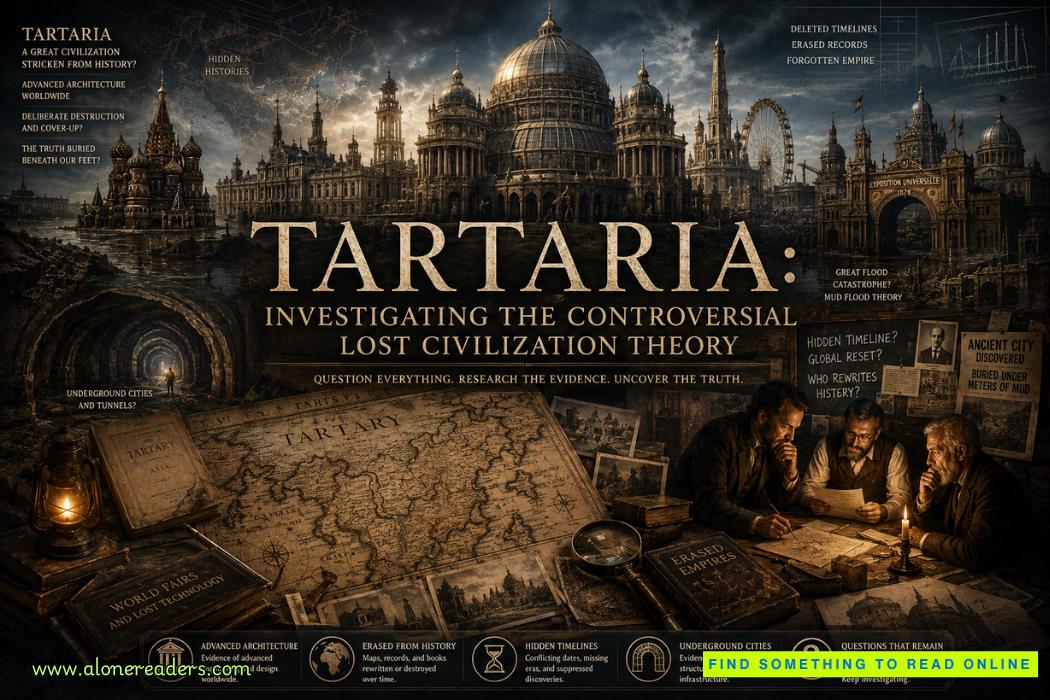
Tartaria has become one of the most controversial and widely debated alternative-history theories on the internet. To supporters, it represents evidence of a forgotten advanced civilization whose existence was deliberately erased from human history. To historians, archaeologists, and historical geographers, however, Tartaria is not evidence of a hidden empire but rather the result of misunderstood historical terminology, distorted maps, architectural misconceptions, and modern conspiracy culture amplified through social media algorithms. The theory sits at the intersection of historical curiosity, distrust of institutions, internet folklore, and fascination with ancient lost civilizations.
The word “Tartary” or “Tartaria” did indeed exist historically. It appeared on many European maps between the sixteenth and nineteenth centuries. However, understanding what the term actually meant is crucial. In early modern Europe, Tartary was not the name of a unified global superpower. Instead, it was a broad and imprecise geographical label Europeans used to describe enormous and poorly understood regions of northern and central Asia. These lands included parts of Siberia, Mongolia, Central Asia, and territories inhabited by Turkic, Mongolic, and Tatar peoples. European cartographers often lacked detailed knowledge about these remote regions, so large areas were grouped together under generalized names.
The origins of the term are closely connected to the Tatars, a collection of Turkic and Mongol-related peoples who became widely known after the Mongol expansions of the thirteenth century. European chroniclers, fearing the destructive invasions associated with the Mongol Empire, sometimes altered the word “Tatar” into “Tartar,” linking it symbolically to Tartarus, the underworld of Greek mythology. Over time, the label Tartary evolved into a cartographic convenience rather than a political description of a single empire.
Despite this relatively straightforward historical explanation, modern Tartaria theorists argue that historians intentionally conceal the “true” meaning of Tartaria. According to these claims, Tartaria was supposedly an advanced worldwide civilization possessing extraordinary architecture, sophisticated energy systems, advanced technology, and perhaps even knowledge surpassing modern science. Proponents frequently suggest that this civilization was destroyed in a catastrophic event and later erased from historical memory by powerful elites, governments, or secret societies.
One of the central pillars of the Tartaria theory revolves around architecture. Supporters often point to elaborate nineteenth-century buildings, particularly those constructed for world fairs and exhibitions, claiming that such structures could not possibly have been built using the technologies officially available at the time. Massive domes, ornate facades, giant columns, intricate carvings, and enormous public buildings are interpreted as remnants of Tartarian civilization rather than products of industrial-era engineering and craftsmanship.
World’s fairs receive particular attention within Tartarian narratives. Events such as the 1893 World’s Columbian Exposition in Chicago or the 1904 St. Louis World’s Fair featured spectacular temporary architectural complexes designed to demonstrate industrial achievement and artistic ambition. Many Tartaria theorists insist these buildings were actually ancient structures inherited from a lost civilization rather than newly constructed exhibition halls. The eventual demolition of many fair structures is interpreted as evidence of a deliberate cover-up.
However, mainstream historians explain these buildings through extensive surviving documentation. Architectural blueprints, construction contracts, labor records, photographs, newspaper reports, engineering journals, and financial accounts demonstrate how these structures were built. Many world fair buildings were intentionally temporary, constructed with materials such as plaster, wood, and staff—a mixture designed to imitate stone. Although visually grand, these structures were often not engineered for long-term durability.
Another major component of the theory is the so-called “mud flood” hypothesis. According to this idea, a massive global catastrophe buried Tartarian cities beneath layers of mud sometime in the eighteenth or nineteenth century. Supporters often present photographs of buildings with partially submerged lower floors or basement windows as evidence. They argue that entire urban centers were buried rapidly, erasing the civilization from public awareness.
Yet urban historians and archaeologists offer far more conventional explanations. Over centuries, cities naturally accumulate layers of construction, demolition debris, road elevation changes, sewage infrastructure, flood control systems, and redevelopment. Many older cities contain buried lower levels because streets were gradually raised over time. This phenomenon is well documented in cities such as Chicago, Seattle, Rome, London, and Istanbul. What conspiracy theorists interpret as evidence of a sudden worldwide catastrophe is typically explained through ordinary urban development processes spanning decades or centuries.
The internet played a decisive role in transforming Tartaria from an obscure fringe theory into a global online phenomenon. Platforms such as YouTube, TikTok, Reddit, and image-sharing forums allowed creators to circulate dramatic visual comparisons, old maps, historical photographs, and speculative narratives to millions of viewers. Algorithms rewarding emotionally provocative content helped accelerate the spread of the theory. Images of ornate abandoned buildings paired with ominous music and claims of “hidden history” became particularly influential.
The appeal of Tartaria is partly psychological. Modern societies are increasingly characterized by institutional distrust. Many people question governments, media organizations, academic institutions, and scientific authorities. Within this environment, theories suggesting hidden truths or suppressed histories become emotionally compelling. Tartaria offers believers the excitement of uncovering a secret world supposedly concealed by powerful forces.
There is also a deeper cultural dimension to the theory. Industrial modernity often creates feelings of alienation and loss. Enormous nineteenth-century buildings, handcrafted ornamentation, and monumental public architecture appear almost impossible when compared to many utilitarian modern structures. Some people interpret this contrast as evidence that humanity has declined technologically or spiritually rather than progressed. Tartaria becomes a symbolic narrative about lost greatness and forgotten human potential.
Another factor contributing to the theory’s popularity is widespread misunderstanding about historical construction capabilities. Modern observers frequently underestimate the engineering sophistication of earlier societies. Ancient civilizations built pyramids, cathedrals, aqueducts, fortresses, and cities using immense labor forces, advanced mathematics, and highly skilled craftsmanship. The industrial nineteenth century, powered by railroads, mechanized manufacturing, steel production, and vast immigrant labor pools, was fully capable of constructing monumental buildings at remarkable speed.
Tartarian architecture has become a phrase commonly used online, although professional architectural historians do not recognize it as a legitimate style category. Buildings labeled “Tartarian” by theorists are usually examples of Beaux-Arts, Neoclassical, Second Empire, Gothic Revival, or Art Nouveau architecture. Their grandeur reflects historical artistic trends rather than evidence of a hidden civilization.
Some Tartaria-related claims become increasingly fantastical. Certain proponents argue that Tartarians possessed free-energy technology harnessing atmospheric electricity through domes, spires, and antenna-like structures. Others claim the civilization used giant humans, advanced sound technology, anti-gravity engineering, or hidden global transportation networks. In extreme versions, Tartaria merges with theories about extraterrestrials, interdimensional beings, or ancient global resets.
These increasingly speculative elements have caused many historians to classify Tartaria not simply as an alternative historical interpretation but as a modern mythological system. Like earlier legends surrounding Atlantis, Lemuria, or Hyperborea, Tartaria reflects humanity’s enduring fascination with lost golden ages. Throughout history, societies have repeatedly imagined vanished civilizations possessing superior wisdom or technology. Such myths often emerge during periods of uncertainty or cultural transition.
The comparison to Atlantis is particularly revealing. The philosopher Plato originally described Atlantis as a moral and philosophical allegory, yet over centuries the story evolved into pseudo-historical speculation about real lost continents and advanced prehistoric societies. Tartaria follows a similar trajectory: fragments of genuine historical terminology become transformed into elaborate narratives disconnected from their original context.
Professional historians reject Tartaria primarily because there is no credible evidence supporting the existence of such a civilization. No archaeological layer, written archive, linguistic continuity, governmental system, currency network, industrial infrastructure, or coherent material culture supports claims of a suppressed worldwide empire. Historical records from Europe, China, the Islamic world, Russia, and Central Asia consistently describe complex but well-documented regional societies rather than a hidden super-civilization.
Cartographic evidence, often cited by Tartaria proponents, also fails under scrutiny. Early modern maps regularly contained vague geographic labels because many regions remained poorly explored from the European perspective. Terms like “Ethiopia,” “India,” or “Scythia” historically referred to enormous and loosely defined territories. Tartary functioned similarly. It described broad geographic regions rather than a unified nation-state.
Russian imperial expansion into Siberia further clarifies the historical reality. Between the sixteenth and nineteenth centuries, the Russian Empire gradually incorporated vast territories previously inhabited by diverse indigenous and nomadic peoples. European maps evolved accordingly as geographical knowledge improved. The disappearance of “Tartary” from maps reflects increasing cartographic precision rather than historical erasure.
Interestingly, some researchers studying conspiracy theories note that Tartaria exemplifies how digital culture reshapes historical imagination. Online communities collaboratively build alternative narratives through image analysis, selective interpretation, emotional storytelling, and crowdsourced speculation. The process resembles participatory myth-making more than formal historical research. Visual aesthetics often matter more than documentary evidence.
This phenomenon has broader implications for how modern societies engage with history. Digital media encourages fragmented learning, where isolated images or quotes circulate without context. An old map labeled “Great Tartary” can appear persuasive when detached from the conventions of early modern cartography. Similarly, photographs of partially buried buildings become mysterious when viewers lack knowledge of urban archaeology or architectural history.
At the same time, dismissing Tartaria entirely without understanding its appeal risks overlooking deeper cultural anxieties. The popularity of the theory reflects widespread dissatisfaction with simplistic historical narratives. Many people feel conventional education presents history as sterile memorization rather than an evolving and mysterious human story. Tartaria fills that emotional void with wonder, hidden knowledge, and grand speculation.
There is also an aesthetic dimension impossible to ignore. The internet communities surrounding Tartaria often celebrate monumental architecture, craftsmanship, and urban beauty. Ornate train stations, cathedrals, civic buildings, and exhibition halls inspire genuine admiration. In many ways, the emotional power of Tartaria comes less from evidence and more from visual longing for a world perceived as more ambitious, artistic, and spiritually meaningful.
Yet the danger of such theories lies in their tendency to replace historical complexity with conspiratorial certainty. Real history is already astonishingly rich, filled with empires, migrations, technological revolutions, forgotten kingdoms, and extraordinary human achievements. The actual histories of the Mongol Empire, Central Asian trade networks, Siberian exploration, and nineteenth-century industrial expansion are deeply fascinating without requiring hidden civilizations or global cover-ups.
The story of the historical Tartars themselves is remarkable. Turkic and Mongol peoples shaped Eurasian history through trade, warfare, diplomacy, and cultural exchange across immense distances. The Mongol Empire connected East and West in unprecedented ways during the thirteenth and fourteenth centuries, facilitating commerce, communication, and technological transmission across Eurasia. Understanding these genuine historical dynamics offers a more grounded appreciation of the regions once labeled as Tartary.
Ultimately, Tartaria reveals more about the modern world than the ancient past. It demonstrates how digital culture can transform obscure historical terminology into elaborate global mythology. It exposes deep public fascination with hidden histories, distrust of institutions, and nostalgia for perceived lost greatness. It also highlights the power of visual media in shaping historical imagination, especially when emotionally evocative imagery is detached from scholarly context.
The enduring popularity of Tartaria underscores a timeless human impulse: the desire to believe that somewhere beneath the surface of accepted history lies a forgotten truth waiting to be rediscovered. Whether expressed through myths of Atlantis, medieval legends of hidden kingdoms, or modern internet theories about Tartarian empires, people remain irresistibly drawn to the idea that civilization’s past may contain secrets beyond conventional understanding.
Yet historical investigation requires more than mystery and speculation. It demands evidence, context, critical analysis, and methodological rigor. When examined carefully, Tartaria appears not as a suppressed super-civilization but as a fascinating case study in how myths evolve in the digital age. The theory persists because it combines fragments of real history with powerful emotional narratives about loss, secrecy, beauty, and forgotten human achievement.
In that sense, Tartaria itself has become a modern legend—not an ancient empire buried beneath the earth, but a twenty-first-century myth born from old maps, internet culture, architectural nostalgia, and humanity’s enduring attraction to the unknown.



 The Hundred Days Offensive: How the Allies Defeated Germany in World War I
 The Second Battle of the Marne: The Turning Point of World War I in 1918
 The Spring Offensive of 1918: Germany's Final Gamble to Win World War I
 The Treaty of Brest-Litovsk: How Russia Left World War I
 The Russian Revolution and World War I: How War Brought Down the Tsar
 The Zimmermann Telegram Explained: Germany's Secret Offer to Mexico in World War I










