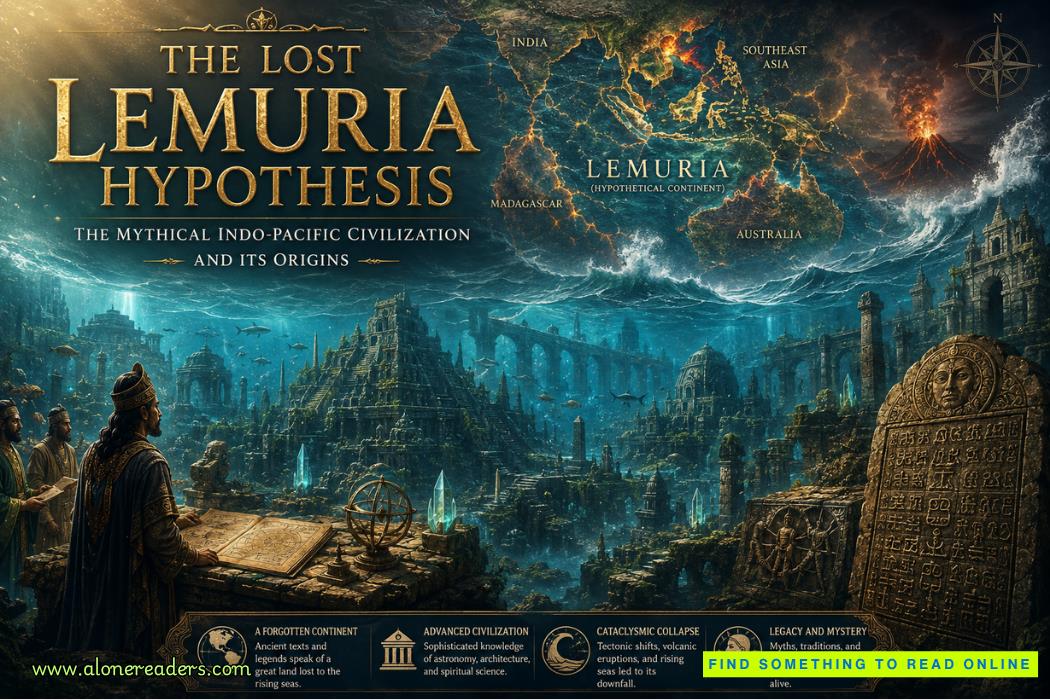
The story of Lemuria occupies a strange and fascinating place between science, mythology, colonial speculation, esoteric philosophy, and modern pseudo-history. Unlike Atlantis, which is primarily associated with the Atlantic Ocean and the writings of the Greek philosopher Plato, Lemuria emerged from a very different intellectual tradition. It was born not from ancient mythology but from nineteenth-century scientific attempts to explain puzzling biological and geological patterns across the Indian Ocean region. Over time, however, the idea transformed dramatically. What began as a scientific hypothesis evolved into a mystical lost-world narrative involving advanced ancient civilizations, hidden wisdom, spiritual evolution, and submerged continents beneath the Indo-Pacific.
The original Lemuria hypothesis emerged during the nineteenth century, when European scientists struggled to explain why certain species appeared across geographically separated regions. One particularly puzzling example involved lemurs, the primates found primarily in Madagascar but also related to species in India and Southeast Asia. In 1864, zoologist Philip Sclater proposed the existence of a lost landmass connecting Madagascar and India. He suggested that this vanished continent once allowed animal migration before sinking beneath the ocean. Sclater named this hypothetical continent “Lemuria” after the lemurs whose distribution inspired the theory.
At the time, the concept seemed plausible because modern plate tectonics had not yet been developed. Scientists lacked a complete understanding of continental drift, seafloor spreading, and tectonic movement. To explain similarities between species, fossils, and geological formations across distant regions, researchers often proposed ancient land bridges or submerged continents. Lemuria therefore emerged not as fantasy but as a serious scientific proposition within the limitations of nineteenth-century geology.
What makes Lemuria historically significant is the extraordinary transformation of the idea after its scientific relevance declined. Once twentieth-century geology demonstrated that continents move over geological timescales through plate tectonics, the need for a submerged Indo-Pacific continent disappeared. Madagascar and India had once indeed been connected—but as parts of the ancient supercontinent Gondwana, not through a recently sunken civilization. Scientifically, the original Lemuria hypothesis became obsolete.
Yet paradoxically, Lemuria became more culturally powerful after science abandoned it.
During the late nineteenth century, occult movements and esoteric writers adopted Lemuria and reshaped it into something entirely different. One of the most influential figures in this transformation was Helena Blavatsky, co-founder of the Theosophical Society. Blavatsky integrated Lemuria into an elaborate spiritual cosmology involving “root races,” ancient civilizations, and cycles of human evolution. According to her writings, Lemurians were not merely inhabitants of a lost continent but part of an ancient pre-human or proto-human civilization possessing extraordinary spiritual qualities.
Blavatsky’s Lemuria differed radically from the scientific hypothesis. In her interpretation, Lemuria stretched across enormous areas of the Indian and Pacific Oceans and existed millions of years ago. The inhabitants were sometimes described as giant beings with psychic abilities and advanced spiritual knowledge. The continent ultimately perished through volcanic catastrophes and geological upheaval. Although modern scholarship considers these ideas pseudoscientific and heavily entangled with problematic racial theories common in nineteenth-century occultism, their cultural impact was immense.
Theosophy played a major role in spreading the myth of Lemuria across Europe, India, and later the United States. It blended Eastern religious concepts, Western esotericism, speculative archaeology, and evolutionary theories into a compelling narrative of hidden ancient wisdom. Within this framework, Lemuria became a symbol of lost knowledge and forgotten human origins. The continent was no longer merely a geological possibility; it became a spiritual homeland.
One reason Lemuria gained such enduring popularity is its location within the Indo-Pacific region, an area already rich with legends of drowned lands and vanished civilizations. Across South Asia and Southeast Asia, numerous traditions speak of submerged kingdoms destroyed by floods or divine punishment. Tamil traditions in southern India contain stories of Kumari Kandam, a legendary lost land said by some later interpreters to have existed south of India. Although historical Tamil literature does not explicitly describe Kumari Kandam in the same extravagant ways popularized later, modern nationalist and mystical interpretations sometimes merged it with Lemuria.
This merging created a powerful hybrid mythology. In some narratives, Lemuria became identified with an ancient Tamil civilization of immense antiquity and sophistication. Advocates claimed it was the cradle of human culture, language, and knowledge before catastrophic flooding submerged it beneath the Indian Ocean. These ideas became especially popular in certain cultural and nationalist circles during the twentieth century, where Lemuria was reimagined not merely as a lost continent but as evidence of an ancient, advanced Dravidian civilization predating other world cultures.
The Indo-Pacific setting also strengthened the emotional appeal of the myth because the region genuinely contains some of the world’s most dramatic geological features. The Indian Ocean basin, Indonesian volcanic arcs, Pacific tectonic zones, and submerged continental fragments create an environment where the idea of vanished lands feels intuitively plausible. Massive earthquakes, tsunamis, and volcanic eruptions regularly reshape coastlines across the region. Ancient communities throughout history witnessed catastrophic natural disasters that could easily inspire stories of drowned worlds.
Modern geology has indeed identified submerged continental fragments in the Indian Ocean region, though none support the traditional Lemuria narrative. One notable example is Mauritia, a microcontinent beneath the Indian Ocean near Mauritius. Geological evidence suggests this fragment originated from Gondwana and became separated millions of years ago. Similarly, Zealandia in the Pacific represents a largely submerged continental mass. Discoveries like these occasionally fuel public fascination with Lemuria, even though they do not indicate the existence of a recent advanced civilization.
This distinction is critically important. A submerged geological structure is not evidence of a lost civilization. Human civilization as currently understood developed only within the last several thousand years, whereas these submerged continental fragments vanished tens or hundreds of millions of years ago. Nevertheless, popular culture often blurs these timelines, allowing scientific discoveries to reinforce mythical narratives unintentionally.
Throughout the twentieth century, Lemuria evolved further through New Age spirituality, speculative archaeology, and fringe historical theories. Writers increasingly portrayed Lemurians as spiritually enlightened beings possessing telepathic powers, crystal technologies, or harmonious societies connected deeply with nature. In many New Age traditions, Lemuria became the benevolent counterpart to Atlantis. Atlantis was often depicted as technologically advanced but morally corrupt, while Lemuria represented spiritual purity and emotional wisdom.
Some modern spiritual movements even claim that survivors of Lemuria escaped before the continent sank and preserved ancient wisdom traditions in places such as Tibet, India, Polynesia, or the Americas. Others argue that descendants of Lemurians still exist spiritually or genetically among certain populations. These narratives generally lack archaeological or scientific support, but they persist because they fulfill psychological and symbolic functions.
At its core, the Lemuria myth reflects humanity’s recurring fascination with lost golden ages. Nearly every civilization preserves stories of a distant era when humans supposedly possessed greater wisdom, harmony, or power before catastrophe caused decline. From Atlantis to Eden, from the Flood narratives of Mesopotamia to indigenous stories of submerged lands, cultures repeatedly imagine civilizations destroyed by natural disaster or moral failure. Lemuria fits perfectly within this global tradition.
The nineteenth century provided fertile ground for such myths because it was an era of rapid scientific change combined with colonial exploration. Europeans were discovering new fossils, ancient ruins, and unfamiliar cultures while simultaneously confronting theories of evolution and geological deep time. These discoveries destabilized older understandings of human history. Lemuria emerged within this atmosphere of intellectual uncertainty and imaginative speculation.
Another reason the Lemuria hypothesis endured lies in the mysterious nature of the ocean itself. The Indian and Pacific Oceans remain among the least explored regions on Earth. Vast underwater mountain chains, deep trenches, volcanic ridges, and submerged plateaus create a sense of hidden worlds beneath the sea. Even today, marine archaeology continues discovering submerged settlements and ancient coastal ruins flooded after the last Ice Age due to rising sea levels.
These genuine discoveries sometimes encourage exaggerated interpretations. During the end of the last Ice Age approximately 12,000 years ago, global sea levels rose dramatically, submerging coastal areas worldwide. Ancient human settlements that once existed near shorelines may now lie underwater. Sites near India’s Gulf of Khambhat and Japan’s Yonaguni Monument have generated intense debate regarding whether certain underwater formations are natural or human-made. While mainstream archaeology remains cautious, public imagination often links such sites to myths like Lemuria.
The Lemuria narrative also intersects with broader debates about ancient civilizations and alternative history. Some writers argue that mainstream archaeology underestimates the complexity of prehistoric societies or overlooks evidence of forgotten cultures destroyed by catastrophic events. Although mainstream scholars reject claims of a technologically advanced global civilization in remote antiquity, the popularity of such theories reveals widespread public fascination with hidden chapters of human history.
Importantly, however, there is no credible archaeological evidence supporting the existence of an advanced Indo-Pacific civilization called Lemuria. No verified ruins, inscriptions, artifacts, or settlements confirm the traditional mythological claims. The scientific consensus remains clear: Lemuria as a recent sunken continent inhabited by an advanced civilization did not exist.
Yet myths do not survive because of evidence alone. They survive because they express emotional, philosophical, and cultural desires. Lemuria symbolizes several powerful human longings simultaneously: the search for origins, the fear of catastrophic collapse, nostalgia for lost wisdom, and hope for spiritual renewal. It represents the dream that somewhere in humanity’s forgotten past existed a civilization more enlightened than our own.
In literature and popular media, Lemuria continues to inspire stories of hidden cities, underwater temples, secret civilizations, and mystical knowledge. It appears in fantasy novels, occult writings, conspiracy theories, anime, video games, and speculative documentaries. The image of a lost civilization beneath tropical seas remains deeply compelling because it combines adventure, mystery, science, and spirituality into a single narrative framework.
The myth also reveals how scientific ideas can evolve unpredictably within public imagination. Sclater’s original biological hypothesis was narrow and technical, concerned primarily with animal distribution. Yet once detached from its scientific context, the idea entered mythology and transformed into something almost entirely unrelated to its origin. This transformation demonstrates how cultural storytelling often absorbs scientific concepts and reshapes them into symbolic narratives.
Modern historians studying Lemuria therefore examine not whether the continent existed, but why people continue believing in it. The answer involves psychology, identity, colonial history, spirituality, and media culture. Lost civilization myths often emerge during periods of social change or uncertainty because they provide narratives of hidden meaning and forgotten greatness. In some contexts, Lemuria also became connected to anti-colonial or nationalist reinterpretations of history, particularly in South India, where some writers used it to emphasize the antiquity and sophistication of Tamil civilization.
The persistence of Lemuria further illustrates the blurred boundary between myth and speculative science in popular culture. Scientific terminology, geological discoveries, archaeological mysteries, and historical gaps can easily merge with imaginative storytelling. Once embedded in books, films, and spiritual movements, such narratives gain lives of their own independent of empirical evidence.
Ironically, the real geological history of the Indo-Pacific region may be even more extraordinary than the myth itself. The breakup of Gondwana, the collision of the Indian plate with Asia, the formation of the Himalayas, the volcanic complexity of Indonesia, and the immense tectonic activity beneath the Pacific constitute one of Earth’s most dramatic geological stories. Continents truly have moved, oceans truly have changed shape, and coastlines truly have disappeared beneath rising seas. Reality, in many ways, provides enough wonder without requiring a mythical super-civilization.
Still, the legend of Lemuria endures because it occupies a unique space between possibility and imagination. It is distant enough to remain mysterious yet connected enough to genuine scientific concepts that it never feels entirely impossible to popular audiences. The Indo-Pacific setting, rich with volcanic violence, submerged landscapes, and ancient maritime cultures, gives the myth an atmosphere of authenticity that continues attracting curiosity.
Ultimately, the Lost Lemuria hypothesis is less important as a historical reality than as a cultural phenomenon. It reveals how humans construct meaning from incomplete knowledge, how myths adapt to scientific change, and how the ocean itself continues functioning as a canvas for human imagination. Whether interpreted as speculative geology, spiritual allegory, nationalist mythology, or fictional adventure, Lemuria remains one of the modern world’s most enduring lost civilization legends.
And perhaps that is the true reason it survives. Lemuria represents not merely a vanished land beneath the sea, but humanity’s enduring desire to believe that somewhere beyond the horizon of recorded history lies a forgotten world waiting to be rediscovered.




 The Hundred Days Offensive: How the Allies Defeated Germany in World War I
 The Second Battle of the Marne: The Turning Point of World War I in 1918
 The Spring Offensive of 1918: Germany's Final Gamble to Win World War I
 The Treaty of Brest-Litovsk: How Russia Left World War I
 The Russian Revolution and World War I: How War Brought Down the Tsar
 The Zimmermann Telegram Explained: Germany's Secret Offer to Mexico in World War I