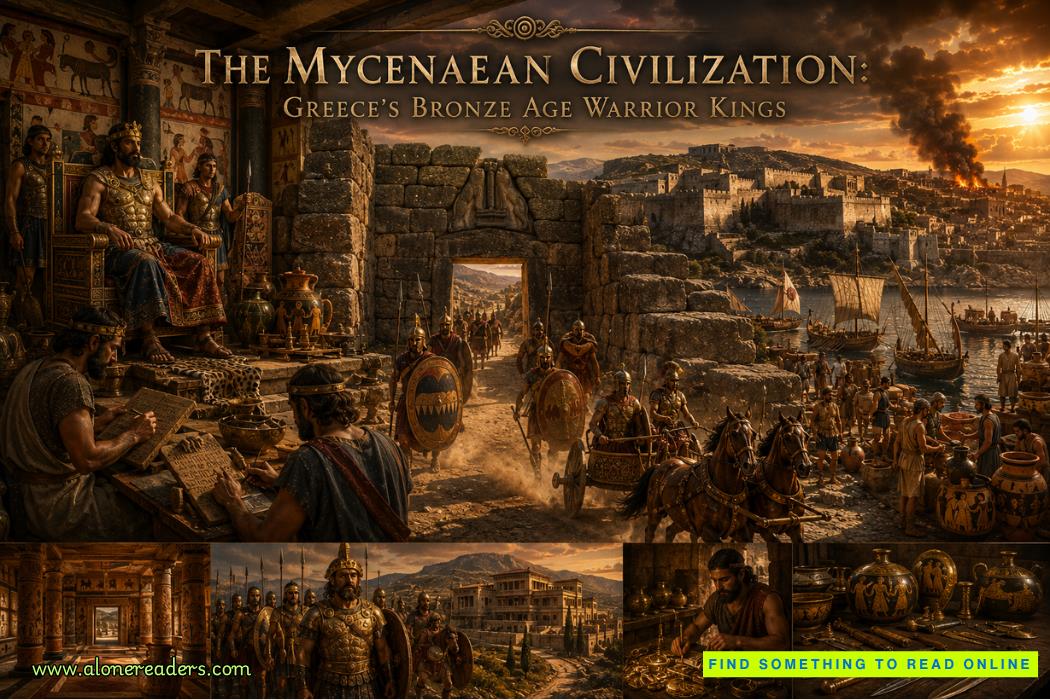
The Mycenaean civilization stands among the most influential yet often overlooked societies of the ancient Mediterranean. Flourishing during the Late Bronze Age between approximately 1600 BCE and 1100 BCE, the Mycenaeans dominated mainland Greece through a network of heavily fortified palace kingdoms ruled by powerful warrior elites. They were not merely primitive tribal rulers or isolated city chiefs. They built sophisticated administrative systems, commanded extensive trade networks, developed monumental architecture, maintained organized armies, and laid many of the cultural foundations that would later define classical Greek civilization. In many ways, the Mycenaeans represented the first great civilization of the Greek world.
The civilization derived its modern name from the city of Mycenae, one of its most important political and military centers located in the northeastern Peloponnese. Archaeological discoveries at Mycenae, Tiryns, Pylos, Thebes, and other sites revealed a highly interconnected world of palace states ruled by elite kings who accumulated immense wealth through warfare, trade, taxation, and control of agricultural production. These rulers governed societies that were simultaneously sophisticated and violent, cultured and militaristic. The image of the Mycenaean king was inseparable from the image of the warrior.
The Mycenaeans emerged during a period when the eastern Mediterranean was experiencing dramatic economic and political growth. Great powers such as Egypt, the Hittite Empire, Mitanni, and the civilizations of Crete were engaged in diplomacy, trade, and competition across the region. The Mycenaeans entered this international system not as passive observers but as ambitious participants. They absorbed influences from the advanced Minoan civilization of Crete while developing a distinctly mainland Greek identity centered on military strength and palace authority.
One of the defining features of Mycenaean society was its fortified urban centers. Unlike the relatively open and maritime-oriented Minoan settlements of Crete, Mycenaean citadels were designed for defense and domination. Massive stone walls surrounded palace complexes built on elevated terrain, creating strongholds that projected royal power across surrounding territories. The enormous limestone blocks used in construction were so impressive that later Greeks believed only mythical Cyclopes could have moved them, leading modern archaeologists to describe the architecture as “Cyclopean.”
The most famous example of this architecture is the Lion Gate at Mycenae. The monumental entrance, crowned with a relief sculpture of two lions flanking a central column, symbolized royal authority and military prestige. Passing through such gates meant entering the domain of a ruling elite that controlled resources, labor, religion, and armed force. The citadel itself functioned not merely as a royal residence but as the administrative, economic, and ceremonial heart of the kingdom.
At the center of many Mycenaean palaces stood the megaron, a large ceremonial hall featuring a central hearth surrounded by columns and a throne area for the ruler. The megaron later influenced the architectural design of Greek temples, demonstrating the long cultural legacy of Mycenaean institutions. Within these halls, kings conducted political administration, hosted feasts, received foreign envoys, distributed rewards to warriors, and reinforced social hierarchy through elaborate ceremonies.
The political system of the Mycenaean world revolved around the authority of the wanax, the supreme ruler or king. Linear B tablets discovered at palace sites reveal a bureaucratic administrative structure capable of tracking taxes, agricultural production, military equipment, livestock, labor obligations, and religious offerings. These records show that Mycenaean governance was surprisingly sophisticated for its era. Palace officials monitored economic activity with remarkable precision, demonstrating that the Mycenaean kingdoms operated as centralized administrative states rather than loose tribal alliances.
The Linear B writing system itself represents one of the most significant achievements of the civilization. Adapted from the earlier Minoan script known as Linear A, Linear B became the earliest known written form of the Greek language. The tablets primarily recorded economic and administrative information rather than literature, yet their existence fundamentally transformed historians’ understanding of Bronze Age Greece. Before their decipherment in the twentieth century, many scholars doubted whether the Mycenaeans were truly Greek-speaking peoples. The tablets confirmed that they were indeed early Greeks whose language formed an ancestral stage of later classical Greek dialects.
The economy of the Mycenaean kingdoms depended heavily on palace control and redistribution. Agricultural products, metals, textiles, and crafted goods flowed into palace storage facilities before being redistributed according to royal priorities. This system enabled kings to support craftsmen, religious institutions, military forces, and administrative officials. The palaces functioned almost like economic command centers, coordinating large-scale production and regional trade.
Trade connected the Mycenaean world to nearly every major civilization of the eastern Mediterranean. Archaeological evidence shows Mycenaean pottery and goods reaching Egypt, Anatolia, the Levant, Cyprus, and even parts of Italy. In return, the Mycenaeans imported copper, tin, ivory, glass, gold, spices, and luxury items. Maritime trade was not merely supplementary to Mycenaean power; it was essential to sustaining elite wealth and military capability.
Bronze production especially played a central role in Mycenaean society. Since bronze required both copper and tin, resources not abundantly available in mainland Greece, extensive trade networks became necessary. Control over bronze weapon production strengthened the military aristocracy and reinforced the warrior identity of Mycenaean kingship. Swords, spears, shields, helmets, and chariots became symbols of status as well as instruments of conquest.
The military orientation of Mycenaean civilization distinguished it sharply from many neighboring cultures. Frescoes, grave goods, and weapon caches reveal a society deeply invested in warfare. Elite burials frequently included armor, swords, daggers, and ceremonial weapons decorated with intricate designs. The famous Dendra Panoply, a nearly complete suit of bronze armor discovered in a tomb near Mycenae, demonstrates both technological sophistication and the importance of heavily armored warriors.
Mycenaean warfare likely combined infantry forces with chariot units used for rapid movement, elite combat, or battlefield command. Fortified citadels suggest a world of frequent regional conflict where rulers competed for territory, trade routes, and political dominance. Military success elevated kings and nobles, while failure could rapidly weaken palace authority.
This militaristic culture strongly influenced later Greek mythology and epic tradition. Many historians believe that memories of the Mycenaean age survived in oral traditions that eventually became the basis for Homer’s Iliad and Odyssey. Although the poems were composed centuries later, they preserve echoes of Bronze Age political structures, warrior values, and aristocratic culture.
The legendary Trojan War, whether entirely historical or partly mythologized, likely emerged from real conflicts involving Mycenaean expansion into the eastern Aegean and Anatolia. Hittite records mention a people known as the Ahhiyawa, whom many scholars identify with the Achaeans of Homeric tradition — possibly the Mycenaeans themselves. These records describe diplomatic tensions and military activities in western Anatolia during the Late Bronze Age, suggesting that the Mycenaeans were active participants in regional geopolitics.
The world described in Homer reflects many Mycenaean characteristics: powerful kings ruling fortified centers, elite warrior culture, gift exchange systems, chariot warfare, and honor-based aristocratic competition. While the epics cannot be treated as literal historical documents, they preserve cultural memories of a vanished Bronze Age society whose achievements continued to shape Greek identity centuries after its collapse.
Religion also played an essential role in Mycenaean society. Archaeological evidence indicates the worship of numerous deities who later appeared in classical Greek religion, including early forms of Zeus, Hera, Poseidon, Athena, and Dionysus. Religious ceremonies likely reinforced royal legitimacy, with palaces serving as both political and sacred centers.
Offerings, sacrificial rituals, and ceremonial feasting were integral components of palace life. Linear B tablets record allocations for religious activities and priestly officials, demonstrating institutionalized worship connected to state administration. Religion and kingship were deeply intertwined, strengthening elite control over society while integrating communities into shared ritual systems.
Mycenaean art reflected both local traditions and international influences. Frescoes decorated palace walls with scenes of warfare, hunting, religious rituals, animals, and maritime life. Gold masks, jewelry, decorated weapons, and carved seals reveal highly skilled craftsmanship. The so-called “Mask of Agamemnon,” discovered by Heinrich Schliemann at Mycenae, became one of the most iconic archaeological finds associated with the civilization, even though it predates the likely era of the legendary king.
The burial practices of the Mycenaean elite further emphasized social hierarchy and warrior prestige. Shaft graves and later tholos tombs — large beehive-shaped burial chambers — housed rulers and noble families alongside immense quantities of gold, weapons, drinking vessels, and ceremonial objects. These tombs projected dynastic power even in death, reinforcing the status of ruling lineages across generations.
Among the most remarkable Mycenaean structures are the monumental tholos tombs often referred to as “Treasuries.” The Treasury of Atreus near Mycenae remains one of the greatest engineering achievements of the Bronze Age. Constructed with massive stone blocks arranged in a corbelled dome, it demonstrates advanced architectural knowledge and access to enormous labor resources.
Despite its power and sophistication, the Mycenaean civilization eventually experienced catastrophic collapse around 1200 BCE. This broader regional crisis affected nearly every major Bronze Age civilization in the eastern Mediterranean. Cities burned, trade networks disintegrated, palace administrations vanished, and populations declined dramatically.
The exact causes of the collapse remain debated among historians and archaeologists. Possible explanations include invasions, internal rebellions, earthquakes, climate change, famine, economic disruption, piracy, and systemic political instability. It is increasingly likely that multiple interconnected crises combined to overwhelm the palace systems.
The centralized structure that had once strengthened Mycenaean states may also have made them vulnerable. Because the economy, military organization, administration, and trade networks were tightly interconnected, disruption in one area could rapidly destabilize the entire system. Once palace authority collapsed, the bureaucratic mechanisms sustaining Mycenaean society disappeared as well.
The destruction of the palaces marked the beginning of the so-called Greek Dark Age, a period characterized by population decline, reduced literacy, diminished trade, and the disappearance of monumental architecture. Linear B writing vanished entirely, and many settlements were abandoned. Yet the Mycenaean legacy did not disappear completely.
Cultural memories survived through oral traditions, heroic legends, religious continuity, and social practices that later resurfaced in archaic and classical Greece. The Mycenaean age became the legendary “Age of Heroes” celebrated in Greek mythology. Figures such as Agamemnon, Achilles, Menelaus, and Odysseus emerged from this remembered world of warrior kings and fortified palaces.
In many respects, classical Greek civilization grew from the ruins of the Mycenaean world. The Greek language endured. Religious traditions evolved rather than vanished. Artistic influences persisted. Political memories of kingship and aristocratic competition survived within epic poetry. Even architectural forms such as the megaron influenced later temple construction.
Modern archaeology transformed understanding of the Mycenaeans during the nineteenth and twentieth centuries. Excavations led by Heinrich Schliemann at Mycenae and later scientific investigations across Greece uncovered physical evidence confirming that a powerful Bronze Age civilization had indeed existed behind the legends of Homer. Although Schliemann’s methods were often destructive by modern standards, his discoveries fundamentally changed ancient history.
Today, the Mycenaean civilization is recognized as one of the foundational cultures of European history. It represented the first major Greek-speaking civilization, the creator of mainland Greece’s earliest bureaucratic states, and a dominant force within the Bronze Age Mediterranean system. Its rulers commanded armies, controlled trade routes, built monumental architecture, and established traditions that shaped Greek culture for centuries.
The story of the Mycenaeans is ultimately a story of ambition, warfare, wealth, and fragility. Their civilization rose through military power and international commerce, achieved extraordinary cultural and political sophistication, and then collapsed with stunning speed during one of history’s greatest systemic crises. Yet even after their palaces burned and their kingdoms vanished, their memory endured through myth, language, and cultural inheritance.
The warrior kings of Mycenaean Greece disappeared more than three thousand years ago, but the civilization they built became the hidden foundation beneath later Greek greatness. Behind the philosophers of Athens, the soldiers of Sparta, and the poets of classical Greece stood the shadow of an older Bronze Age world — a world of fortified citadels, gold-covered rulers, bronze swords, and heroic ambition that once dominated the Aegean under the banners of the Mycenaean kings.



 The Hundred Days Offensive: How the Allies Defeated Germany in World War I
 The Second Battle of the Marne: The Turning Point of World War I in 1918
 The Spring Offensive of 1918: Germany's Final Gamble to Win World War I
 The Treaty of Brest-Litovsk: How Russia Left World War I
 The Russian Revolution and World War I: How War Brought Down the Tsar
 The Zimmermann Telegram Explained: Germany's Secret Offer to Mexico in World War I










