On the morning of 14 October 1066, an English king stood on a ridge in Sussex with an exhausted army behind him and the fate of a kingdom balanced on a blade’s edge. Harold Godwinson was not merely the last crowned Anglo-Saxon king; he was the final ruler of a political order that had taken shape over centuries and was about to be transformed almost overnight by invasion, conquest, and administrative revolution. His story matters because the Battle of Hastings was not an isolated clash of arms but the climax of a succession crisis, a struggle over legitimacy, and a contest between different models of kingship and power in medieval Europe.
To understand Harold, one must begin before 1066, in a world where England was wealthy, politically sophisticated, and deeply entangled with Scandinavia and the Channel world. Anglo-Saxon England had developed a strong royal administration, a coinage system, shire government, and a political elite centered on great earls and the king’s council, the Witan. Yet succession remained imperfectly formalized. Kingship was hereditary in practice but not automatic in law; the support of the leading magnates mattered, especially when no universally accepted heir existed. Harold emerged from this system as a member of the House of Godwin, the most powerful noble family in the realm, and his rise reflected both dynastic strength and the fragility of royal succession.
The political background of Harold’s reign cannot be separated from the personality of Edward the Confessor. Edward’s long association with Normandy during his exile had deepened his ties to Norman clerics and aristocrats, and later chroniclers on both sides of the Channel treated those connections as politically consequential. By the 1050s, the balance at court had become unstable. The Godwins, especially Earl Godwin and his sons, dominated much of English politics, while Edward’s preference for Norman advisers created periodic conflict and eventually open crisis. The rivalry was not simply a personal feud; it was a contest over patronage, regional power, and the character of the English monarchy itself. England was rich enough to attract attention, while Normandy, under Duke William, had become ambitious, militarized, and keenly aware of the prestige attached to a claim upon the English throne.
Harold’s own early career showed why he became the obvious candidate when the succession broke in 1066. As Earl of Wessex, he was a proven military leader and administrator, and he had already demonstrated political discipline in managing internal English tensions. In 1065, he played a decisive role in the crisis in Northumbria, where rebellion against his brother Tostig turned into a broader judgment on governance. Tostig’s unpopularity, harsh rule, and inability to hold Northumbria made his position untenable, and Harold supported his removal when it became clear that the earldom had become a liability to the realm. This episode reveals an important aspect of Harold’s leadership: he was not a romantic rebel but a hard-headed political operator, willing to sacrifice family advantage for public stability.
Edward the Confessor died on 5 January 1066, and the English succession moved with startling speed. On 6 January, the Witan chose Harold, and he was crowned in Westminster Abbey the same day, a striking display of continuity and urgency. For Harold’s supporters, this was not a theft but a practical response to a political emergency: the realm needed a functioning king at once. For Norman writers, however, the coronation was tainted by a supposed oath Harold had sworn earlier to William, allegedly pledging support for the Norman duke’s claim. The exact circumstances of that oath remain contested. Harold had visited Normandy in 1064 or 1065 and was shipwrecked there, but the later Norman narrative transformed that visit into a moral indictment and a legal casus belli. The central historical problem, then, is not whether Harold was king—he plainly was—but whether contemporaries accepted his kingship as legitimate enough to withstand rival claims.
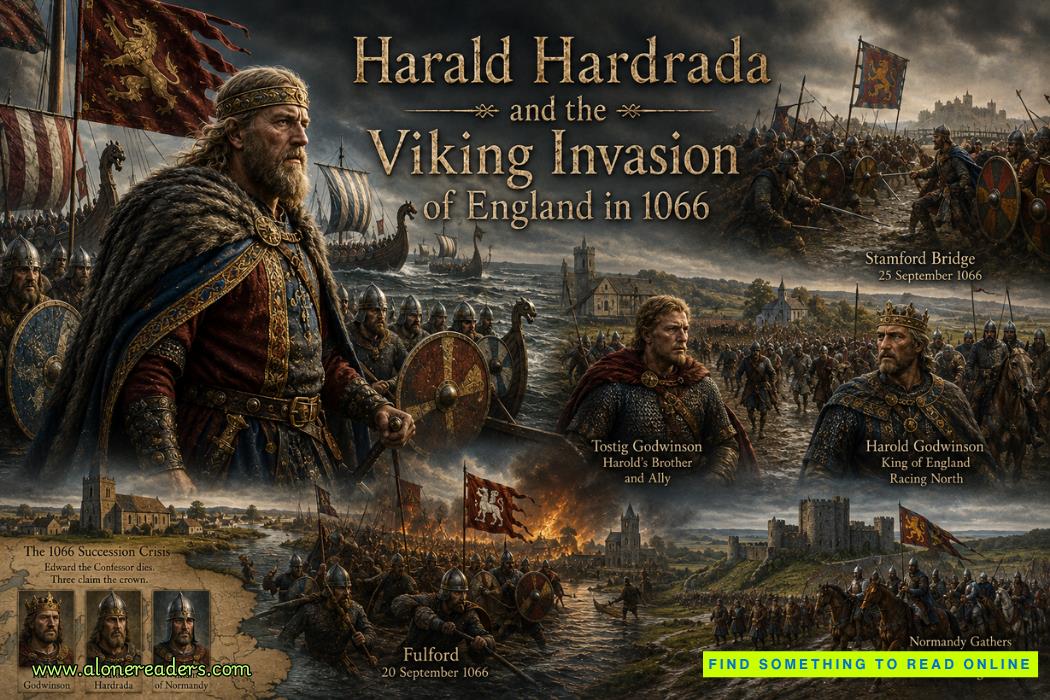
Harold’s short reign was shaped by strategic pressure from two directions. In the north, Harald Hardrada of Norway, assisted by Tostig, mounted a major invasion. On 20 September 1066, the English suffered defeat at Fulford near York, and the situation rapidly worsened. Harold’s response was extraordinary in both speed and risk. He marched north with remarkable urgency, and on 25 September he met the Norwegian invaders at Stamford Bridge. The battle ended in a decisive English victory and the deaths of Hardrada and Tostig, but victory came at a cost: Harold’s army had been strained by the long march and the battle itself, and the king had little time to consolidate before a new danger appeared. In military terms, Harold had won brilliantly; in strategic terms, he had been forced into a dangerous race against time.
That race ended when William landed at Pevensey on 28 September 1066 after building a large invasion fleet and waiting for favorable weather. The Norman army was not purely Norman. It included men from Normandy, Brittany, and other regions, and it combined mounted knights, infantry, and archers in a disciplined expeditionary force. William’s decision to land in Sussex, fortify a base, and raid the surrounding countryside was methodical. The immediate building of a castle at Pevensey was no mere afterthought; it reflected a key Norman strength, the ability to secure territory through fortified occupation rather than relying solely on a field battle. William understood logistics. He needed a defensible harbor area, a supply base, and psychological leverage. Raiding the king’s own lands was a direct challenge to Harold’s authority and an invitation to decisive battle.
Harold, meanwhile, had to make a brutal calculation. He had already defeated one invasion and could not allow William to ravage the south at leisure. He gathered forces and moved back from the north toward London, likely taking time to rest, recruit, and coordinate what remained of his army. The English host at Hastings was not a standing army in the modern sense but a mixed force of huscarls—professional household warriors—and fyrd infantry summoned from the shires. The huscarls were heavily armed, trained, and effective in close combat with swords and battle-axes; the fyrd were more uneven in quality, but the English defensive system could still be formidable when anchored in a shield wall. Harold chose ground carefully on the ridge near Senlac Hill, giving his men a strong defensive position that forced the Normans uphill. That choice reveals both confidence and necessity. He could not rely on cavalry, and he needed terrain that neutralized Norman mobility.
The Battle of Hastings on 14 October 1066 was therefore a contest between different military systems as much as between rival kings. William’s army advanced with archers, infantry, and cavalry in coordinated waves, while Harold’s men held a compact shield wall atop the slope. The English defensive line was initially effective; the hill, the dense formation, and the discipline of the huscarls blunted Norman attacks. Yet the battle’s outcome was shaped by fatigue, communication failures, and tactical adaptation. Some Norman attacks appear to have exploited the English tendency to break formation in pursuit of fleeing enemies. Whether William deliberately used feigned retreats from the outset or adapted opportunistically remains debated, but the tactic clearly helped loosen the shield wall’s integrity. Once English troops descended from the ridge, their advantage diminished, and Norman cavalry could engage them on more favorable terms.
Harold’s death became the battle’s defining image, but the exact manner of his killing remains a matter of historiographical dispute. The Bayeux Tapestry is the most famous visual source and appears to depict a warrior struck in the eye by an arrow, yet scholars have long questioned whether this reflects the original design or a later alteration, and whether the figure is meant to represent Harold alone. Some contemporary or near-contemporary accounts describe him being cut down by Norman soldiers rather than singled out by an arrow. What is not disputed is that Harold and his brothers Gyrth and Leofwine died at Hastings, and that once the king fell, the English army rapidly collapsed. Leadership in a shield-wall battle mattered enormously; remove the king, and the battle ceased to be simply a tactical contest. It became a crisis of confidence.
Harold’s personality still invites interpretation. He was capable, pragmatic, and militarily energetic, but he was also constrained by the structural problems of eleventh-century kingship. He inherited a powerful noble network, yet he lacked the long-term secure legitimacy that a universally recognized hereditary succession might have provided. His strengths lay in mobilization, responsiveness, and command presence. His weakness was that he had to fight in an environment where one kingdom could be threatened by successive invasions from north and south within weeks. William, by contrast, possessed patience, diplomatic skill, and a clearer strategic goal. He secured papal backing in the form of a papal banner, framed his expedition as a justified conquest, and turned a dynastic claim into an international campaign. Harold fought for an existing order under extreme pressure; William fought to replace it.
The consequences were immediate and profound. After Hastings, William advanced through the southeast and was crowned at Westminster on 25 December 1066. The Norman Conquest did not merely substitute one ruler for another. It initiated a transformation in landholding, fortification, church leadership, and elite culture. Norman castles spread across the kingdom as instruments of control, while aristocratic replacement reshaped the English upper class. The Domesday Book of 1086–87 later recorded a reordered land regime in extraordinary detail, showing how thoroughly Norman conquest had altered property relations and fiscal oversight. English government did not vanish, but it was repurposed to serve a new ruling class and a more centralized regime. For ordinary people, the consequences included new obligations, shifting landlords, and a more militarized landscape.
Yet Harold’s legacy was not erased. Medieval chroniclers remembered him as a defeated king, a usurper, or a tragic last defender depending on their loyalties. The Bayeux Tapestry turned his death into a visual drama that remains central to how the battle is imagined. Modern historians continue to debate the oath to William, the legitimacy of Harold’s coronation, the exact mechanics of the battle, and the degree to which the Norman victory should be understood as sudden rupture or accelerated transformation. Archaeology and battlefield studies have refined our picture of the terrain and movement, but they have not ended the discussion. Harold’s importance lies partly in this unresolved quality. He stands at the threshold between Anglo-Saxon England and Norman England, between an older political world and a newly imposed order.
Harold Godwinson was therefore more than a defeated monarch. He was the final king of an English political tradition that had proven resilient, adaptable, and administratively impressive, yet still vulnerable to dynastic ambiguity and external conquest. His reign compressed the drama of medieval kingship into nine extraordinary months: election, coronation, invasion, victory, exhaustion, and death. The history of 1066 is often told as the story of William’s triumph, but it is equally the story of Harold’s burden. In that sense, the Battle of Hastings was not only the beginning of Norman rule; it was the moment when Anglo-Saxon England, despite its strengths, was overtaken by a more ruthless political order. Harold’s final stand on the ridge near Hastings remains memorable because it was both a military defeat and the end of an age.




 The Hundred Days Offensive: How the Allies Defeated Germany in World War I
 The Second Battle of the Marne: The Turning Point of World War I in 1918
 The Spring Offensive of 1918: Germany's Final Gamble to Win World War I
 The Treaty of Brest-Litovsk: How Russia Left World War I
 The Russian Revolution and World War I: How War Brought Down the Tsar
 The Zimmermann Telegram Explained: Germany's Secret Offer to Mexico in World War I