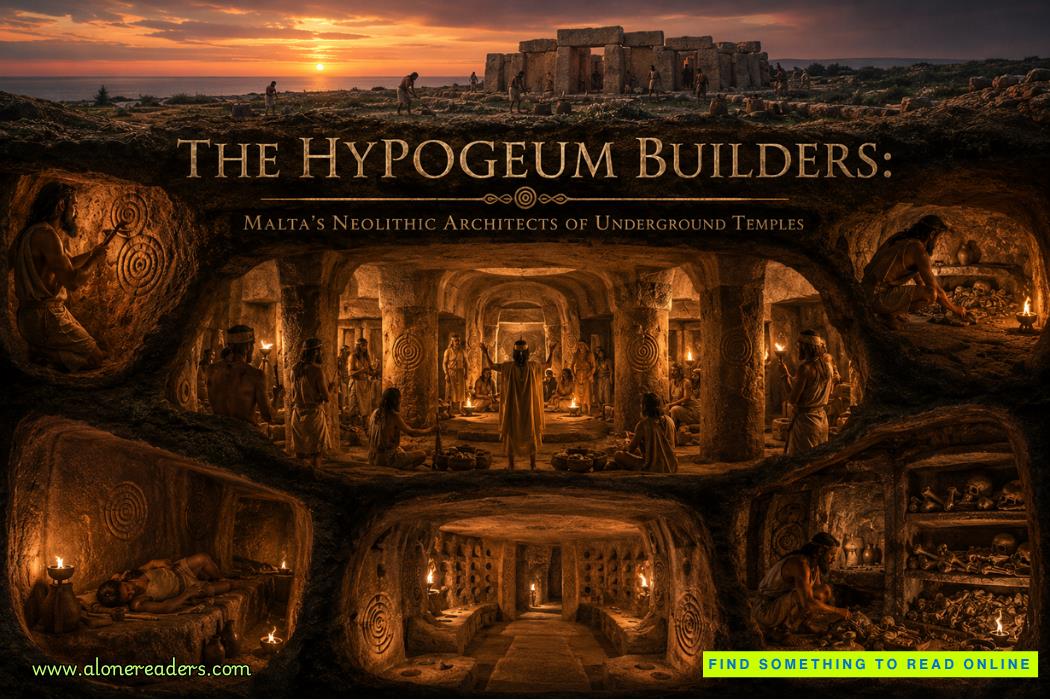
The civilization that flourished on the islands of Malta during the Neolithic period remains one of the most extraordinary yet underappreciated cultures of prehistoric Europe. Long before the rise of Classical Greece, the Roman Republic, or even the Egyptian pyramids in their mature phases, the people of Malta were carving vast underground sanctuaries into solid limestone and erecting colossal megalithic temples across a small Mediterranean archipelago. Among their greatest achievements stands the Ħal Saflieni Hypogeum, a subterranean monument unlike anything else in the ancient world. This underground complex reveals a society possessing advanced architectural understanding, sophisticated ritual systems, and a worldview deeply tied to death, rebirth, sound, and sacred space. The builders of these underground temples left behind no written records, no kings’ chronicles, and no decipherable inscriptions. Yet their stone structures continue to speak across millennia through geometry, engineering precision, symbolism, and ritual design.
The Maltese Neolithic civilization emerged around 5900 BCE when early agricultural settlers arrived from Sicily. These communities gradually transformed the islands from sparsely populated outposts into one of the Mediterranean’s most architecturally ambitious prehistoric societies. Over centuries, they developed farming systems, domesticated animals, pottery traditions, and ritual practices that culminated in the famous Temple Period between approximately 3600 BCE and 2500 BCE. During this era, Malta witnessed an unprecedented explosion of monument building. Massive stone temples such as Ġgantija, Ħaġar Qim, Mnajdra, and Tarxien appeared across the islands, constructed using limestone blocks weighing several tons.
Yet even among these monumental achievements, the underground world of the Hypogeum stands apart. Unlike the above-ground temples exposed to sunlight and public visibility, the Hypogeum descended into darkness beneath the earth itself. It represented a radically different architectural philosophy. Rather than assembling massive stones outwardly, the builders removed stone inwardly, excavating chambers, corridors, and ritual spaces from living rock. This inversion of architecture—creating sacred voids rather than sacred masses—reveals a profound symbolic understanding of the underground as a spiritual realm.
The Hal Saflieni Hypogeum, located near present day Paola in Malta, was accidentally discovered in nineteen hundred and two during construction activities. Workers cutting through limestone uncovered a hidden underground labyrinth that archaeologists would later identify as one of the most extraordinary prehistoric monuments ever discovered. Built mainly between three thousand three hundred BCE and three thousand BCE, the complex contains several underground levels connected by stairways, narrow passages, and ceremonial chambers. Covering nearly five hundred square meters, the entire structure was carved directly into solid rock using stone tools, antler picks, and other primitive instruments long before metalworking appeared on the islands.
The engineering achievement of the Hypogeum is remarkable. Its builders carved the underground complex with exceptional precision despite working in darkness with limited airflow and simple technology. Many chambers imitate the style of above ground temples, including carved doorways, curved walls, trilithon style entrances, corbelled ceilings, and decorative patterns. This strongly suggests that the underground structure was not simply a burial cave but a carefully planned sacred environment designed to reflect the ritual world of the living.
One of the most fascinating features of the Hypogeum is its acoustic design. Certain rooms, especially the famous Oracle Room, possess extraordinary resonance properties. Deep male voices can echo through the chambers in ways that create powerful physical and emotional effects. Modern studies have demonstrated that specific sound frequencies become greatly amplified within the room, producing vibrations capable of influencing human perception and emotional response. Although the builders may not have understood acoustics scientifically, they clearly recognized the spiritual and psychological power of sound inside enclosed sacred spaces.
Imagine descending into a torch lit underground sanctuary while chants echoed through stone corridors, vibrations passed through the body, shadows danced across carved walls, and ceremonial participants stood among the remains of their ancestors. Such an experience would have been deeply overwhelming for Neolithic people. The Hypogeum was not simply a place to enter; it was a carefully designed sensory environment intended to influence consciousness and strengthen spiritual authority.
Death also played an important role within the Hypogeum. Archaeologists uncovered the remains of nearly seven thousand individuals inside the complex, indicating that it served partly as a collective burial site over many centuries. However, the arrangement of bones and ritual objects suggests a much deeper relationship with death than simple burial practices. The dead appear to have remained spiritually connected to the community. Ancestor worship likely formed a central element of Maltese Neolithic religion, with the underground temple acting as both a tomb and a sacred bridge between the worlds of the living and the dead.
The architecture itself supports this interpretation. Descending deeper into the Hypogeum symbolically resembles entering the womb of the earth. Rounded chambers appear organic rather than defensive or practical. The curved walls and smooth contours create an almost living atmosphere. Many scholars believe the underground sanctuary represented ideas of rebirth, fertility, and continuous renewal. The dead were not viewed as permanently gone but as part of an ongoing spiritual cycle linked to the land and the community.
This interpretation closely matches the fertility symbolism found throughout Maltese temple culture. Many figurines discovered at temple sites depict large female forms traditionally associated with fertility goddesses or mother figures. Although interpretations differ, themes of fertility, reproduction, nourishment, and physical abundance appear central to the symbolic world of Neolithic Malta.




 The Hundred Days Offensive: How the Allies Defeated Germany in World War I
 The Second Battle of the Marne: The Turning Point of World War I in 1918
 The Spring Offensive of 1918: Germany's Final Gamble to Win World War I
 The Treaty of Brest-Litovsk: How Russia Left World War I
 The Russian Revolution and World War I: How War Brought Down the Tsar
 The Zimmermann Telegram Explained: Germany's Secret Offer to Mexico in World War I










