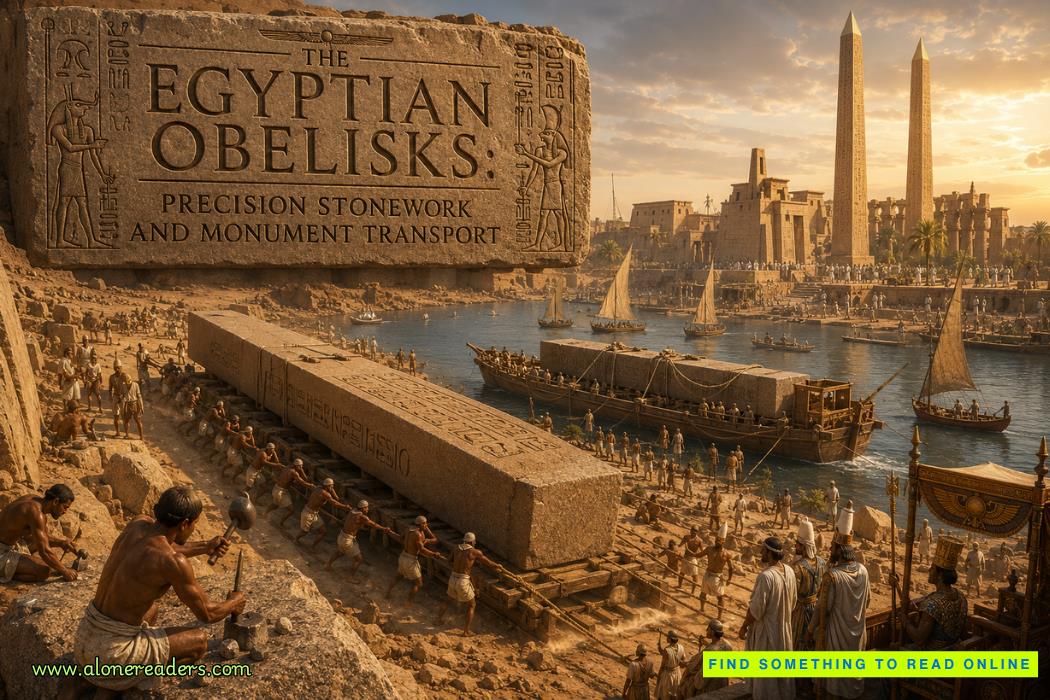
The ancient Egyptian obelisk remains one of humanity’s most astonishing achievements in monolithic stone engineering. Rising like frozen rays of sunlight above temple complexes, these towering monuments symbolized divine authority, solar worship, and royal power. Yet beyond their religious significance lies an engineering story so extraordinary that modern observers still debate how Bronze Age builders achieved such feats with limited tools, no industrial machinery, and only human labor, mathematical planning, and organizational discipline. Many surviving obelisks weigh hundreds of tons and stand over 30 meters tall, carved from single blocks of granite with an accuracy that demonstrates an advanced understanding of geometry, quarrying, transport logistics, and structural stability.
The Egyptians called obelisks tekhenu, associating them with the sun god Ra. Their pointed pyramid-shaped tops, known as pyramidions, were often covered with electrum or gold so they could reflect sunlight dramatically during sunrise and sunset. Obelisks were not merely decorative structures; they functioned as sacred solar monuments linking heaven and earth. Usually erected in pairs at temple entrances, especially in complexes dedicated to Ra or Amun-Ra, they projected political dominance while simultaneously expressing cosmic order. Pharaohs used them as instruments of propaganda, inscribing their achievements and divine legitimacy into stone intended to last for eternity.
What makes Egyptian obelisks particularly remarkable is the fact that each monument was carved from a single piece of stone. Unlike columns assembled from stacked drums or masonry towers built from smaller blocks, obelisks required the extraction, transport, and erection of one enormous granite monolith. This imposed extraordinary engineering challenges because a single fracture during quarrying or transport could ruin years of labor. The Egyptians nevertheless succeeded repeatedly across centuries, producing monuments that still stand today in Egypt, Europe, and elsewhere around the world.
Most major obelisks were quarried from the granite deposits of Aswan in southern Egypt. The granite found there possessed exceptional hardness and durability, making it ideal for monuments intended to survive indefinitely. However, granite also posed severe technical difficulties. It is significantly harder than limestone or sandstone, meaning Egyptian craftsmen had to develop specialized quarrying methods long before iron tools became widespread. Archaeological evidence shows that workers primarily used dolerite pounding stones—heavy rounded stones harder than granite itself—to pound grooves and channels into quarry surfaces.
The unfinished obelisk at Aswan provides one of the most valuable windows into this ancient process. Still attached to bedrock due to a crack discovered during carving, this colossal monument would have measured over 40 meters and weighed approximately 1,200 tons if completed. The site reveals how quarry workers isolated obelisks directly from the granite mass. Teams pounded trenches around the desired shape until the monument’s sides emerged from the surrounding stone. Workers then cut beneath the base through painstaking excavation. This operation required not only brute force but astonishing geometric precision. Even slight asymmetry could destabilize the monument during erection centuries later.
The surface quality achieved on Egyptian obelisks continues to impress modern engineers and archaeologists. Many surviving examples exhibit remarkably flat faces and sharply defined edges despite being shaped without modern steel tools or powered machinery. Craftsmen polished surfaces using abrasive sand and rubbing techniques until inscriptions could be carved with extraordinary clarity. Hieroglyphs often maintain precise alignment over massive vertical surfaces, demonstrating advanced planning and layout systems.
Transporting these monoliths represented an engineering challenge perhaps even greater than quarrying them. Once detached, obelisks had to be moved from quarry sites to the Nile River and then shipped hundreds of kilometers to temple destinations. Some monuments weighed between 300 and 500 tons, requiring coordination on a scale rarely seen in the ancient world. Egyptian engineers developed complex transport systems involving sledges, lubrication methods, earthen ramps, barges, ropes, and synchronized labor forces.
Evidence from tomb paintings and archaeological studies suggests the Egyptians moved heavy monuments using large wooden sledges dragged across prepared paths. One famous depiction from the tomb of Djehutihotep shows workers pulling a colossal seated statue while another individual pours liquid in front of the sledge runners. Modern experiments strongly suggest this water reduced friction by compacting sand particles, making transport significantly easier. Such findings reveal that Egyptian engineers possessed practical scientific knowledge of friction management long before formal physics emerged.
The movement of obelisks across land required immense manpower. Some scholars estimate that thousands of laborers may have participated in coordinated pulling operations. Rope technology therefore became critically important. Egyptians manufactured durable ropes from papyrus fibers, palm fibers, and other plant materials capable of handling tremendous loads. Supervisors likely organized labor teams with carefully timed pulling rhythms to maintain stability and prevent sudden shifts that could crack the stone.
Equally impressive was the Egyptians’ mastery of river transport. Once obelisks reached the Nile, engineers loaded them onto specially designed barges. Ancient texts and reliefs describe enormous transport vessels constructed specifically for monumental cargo. These barges likely featured reinforced wooden frameworks to distribute weight evenly and prevent structural collapse. The Nile itself served as Egypt’s engineering highway, enabling movement of massive construction materials between distant regions.
Transport timing depended heavily on seasonal flooding. During inundation periods, elevated water levels allowed barges carrying extreme loads to navigate more effectively. Egyptian planners synchronized construction schedules with environmental cycles, demonstrating a sophisticated integration of engineering and natural systems. Such logistical coordination required administrative efficiency, centralized authority, and experienced project management.
Perhaps the most astonishing phase of obelisk construction was the final erection process. Raising a multi-hundred-ton granite monolith into a perfectly vertical position without cranes remains an extraordinary achievement even by modern standards. Scholars continue debating the exact techniques employed, but evidence strongly suggests the Egyptians used massive earthen ramps combined with controlled lowering systems.
One widely accepted theory proposes that workers gradually pulled the obelisk upright using ropes while manipulating it over a pivot point into a prepared stone socket. Sand-filled pits may have allowed controlled descent by slowly removing sand beneath the monument. This would permit precise adjustment while minimizing catastrophic impact forces. The engineering challenge involved not only lifting the monument but ensuring perfect balance and alignment during the transition from horizontal to vertical orientation.
The accuracy achieved is extraordinary. Many obelisks stand with remarkably stable vertical alignment even after surviving earthquakes, floods, and thousands of years of environmental exposure. The bases had to distribute enormous compressive loads evenly across foundation surfaces. Any imbalance could eventually produce structural failure. Egyptian builders therefore demonstrated advanced understanding of weight distribution and foundation stability, even if they expressed this knowledge through practical experience rather than formal engineering equations.
The inscriptions carved into obelisks also reveal an extraordinary fusion of engineering and ideology. Pharaohs understood that these monuments communicated permanence. The harder the stone and the larger the monument, the more effectively it projected eternal authority. Obelisks frequently commemorated military victories, temple dedications, or divine favor. Their placement at temple entrances created dramatic visual axes emphasizing sacred architecture and royal legitimacy.
Among the most famous obelisk builders was Pharaoh Hatshepsut of the Eighteenth Dynasty. Her obelisks at Karnak remain masterpieces of Egyptian engineering and political symbolism. One surviving obelisk still rises nearly 30 meters high and weighs approximately 320 tons. Hatshepsut’s inscriptions boast that her monuments were completed in remarkably short timeframes, emphasizing both her devotion to Amun and her capability as ruler. The logistical accomplishment alone required enormous state resources and organizational sophistication.
Thutmose III, Ramesses II, and other powerful rulers also commissioned monumental obelisks as declarations of imperial strength. Over centuries, these structures became international symbols of Egyptian civilization itself. Later empires recognized their prestige and transported many obelisks abroad. The Romans in particular developed intense fascination with Egyptian monuments, relocating numerous obelisks to Rome using engineering systems inspired partly by Egyptian precedent.
The Roman transport of obelisks provides indirect confirmation of the immense difficulty of these operations. Roman engineers employed giant ships, cranes, and specialized labor forces to relocate Egyptian monuments across the Mediterranean. Yet even with advanced Roman engineering, such projects remained exceptionally dangerous and expensive. This reality highlights the extraordinary capabilities of the earlier Egyptians who originally quarried, transported, and erected these monuments with more limited technology.
One of the most famous relocated obelisks is often called “Cleopatra’s Needle,” though it predates Cleopatra by more than a millennium. Versions now stand in London, Paris, and New York. Their journeys in the nineteenth century demonstrated that even industrial-era engineers faced severe difficulties moving ancient monoliths. Specialized transport vessels, steam power, and modern machinery were required, yet operations still encountered accidents, storms, and engineering crises. Such modern struggles deepen appreciation for the original Egyptian achievements.
The precision of Egyptian stonework has also fueled numerous fringe theories claiming supernatural assistance or lost advanced technology. However, archaeological evidence overwhelmingly demonstrates that these accomplishments resulted from organized labor, accumulated technical knowledge, experimentation, and long-term engineering evolution. The Egyptians did not require alien intervention to create obelisks; they required disciplined workers, centralized administration, skilled artisans, and centuries of incremental innovation.
Recent experimental archaeology has provided further insight into how ancient techniques may have functioned. Researchers recreating stone transport methods have shown that lubrication significantly reduces drag forces on sledges. Studies of tool marks at Aswan reveal systematic quarrying patterns consistent with dolerite pounding techniques. Computer simulations of obelisk erection demonstrate that ramp-and-pivot systems could indeed achieve stable vertical positioning using realistic labor estimates.
Nevertheless, many details remain uncertain. Historians still debate exact labor numbers, specific ramp configurations, and the precise sequence of erection stages. Ancient Egyptians themselves left surprisingly limited technical documentation describing engineering methods in detail. Their surviving inscriptions focused primarily on religious significance and royal achievement rather than procedural explanation. As a result, modern understanding relies heavily on archaeology, experimentation, and comparative analysis.
The unfinished obelisk remains particularly important because it captures a frozen moment of ancient engineering failure. A crack discovered during quarrying forced abandonment of the project, preserving invaluable evidence of extraction techniques. This site reminds modern observers that Egyptian engineering, though extraordinary, still faced material limitations and risks. Granite could fracture unpredictably, transport accidents could occur, and immense investments of labor could be lost instantly.
Beyond technical achievement, obelisks also illustrate the broader organizational power of ancient Egypt. Monumental engineering required coordinated supply systems, food distribution, labor management, quarry administration, river logistics, skilled artisanship, and religious authority. Thousands of individuals participated in projects spanning years or decades. Such operations reveal Egypt not merely as a civilization of isolated monuments but as a highly organized state capable of mobilizing national resources on unprecedented scales.
The visual impact of obelisks further amplified their symbolic function. Their towering vertical form contrasted dramatically with the horizontal desert landscape and temple courtyards. Covered in hieroglyphs praising gods and kings, polished granite surfaces reflected sunlight in ways that reinforced associations with divine radiance. The pyramidion at the top symbolized the primeval mound and the solar connection between pharaoh and the heavens.
Modern engineering continues to admire these monuments because they embody principles still fundamental today: material selection, structural stability, transport logistics, precision measurement, load management, and risk mitigation. Egyptian builders solved problems using available technologies while maximizing human coordination and environmental knowledge. Their achievements demonstrate that advanced engineering does not depend solely on modern machinery but also on planning, mathematics, and disciplined execution.
Today, surviving obelisks remain among the most recognizable artifacts of ancient civilization. Visitors standing beside them often struggle to comprehend the immense effort required to create and move such monoliths thousands of years ago. Every polished face, aligned inscription, and balanced foundation reflects countless hours of labor and generations of accumulated expertise. These monuments are not merely relics of royal vanity; they are enduring demonstrations of human ingenuity under technological constraints.
The Egyptian obelisk ultimately represents more than a stone monument. It stands as evidence that ancient engineers possessed an extraordinary capacity for problem-solving, organization, and precision craftsmanship. Long before industrial machinery, hydraulic cranes, or computer calculations, Egyptian builders transformed raw granite into towering symbols of eternity and transported them across vast distances with astonishing effectiveness. Their work continues to inspire engineers, historians, architects, and archaeologists because it reveals what determined human societies can accomplish through knowledge, coordination, and vision.




 The Hundred Days Offensive: How the Allies Defeated Germany in World War I
 The Second Battle of the Marne: The Turning Point of World War I in 1918
 The Spring Offensive of 1918: Germany's Final Gamble to Win World War I
 The Treaty of Brest-Litovsk: How Russia Left World War I
 The Russian Revolution and World War I: How War Brought Down the Tsar
 The Zimmermann Telegram Explained: Germany's Secret Offer to Mexico in World War I










